Bands 🌎f Minerals EarthCache

Located just inside the Tulsa Zoo, this EarthCache is looking at a geological feature within the base of the Ethel Francis Crate Memorial Fountain. This creation is called a Kugel ball and is a marvel of modern engineering! The design is such that a massive polished sphere is able to rotate on a thin sheet of water with such ease, even a child could do it. Achieving this effect depends on a perfectly machined sphere and socket but surprisingly the amount of water pressure needed to allow the sphere to aquaplane (between 12-20 psi) is that of a typical garden hose! The fountain consists of a 5-ton black granite sphere sitting atop a 10-ton gneiss base.
To get credit for this EarthCache, be sure to complete the logging tasks at the bottom of this page.
Before We Begin:
As this is an EarthCache, there is no container to find. Instead, this EarthCache will focus on a unique geological feature within the rock base of this fountain.
Let's get started!
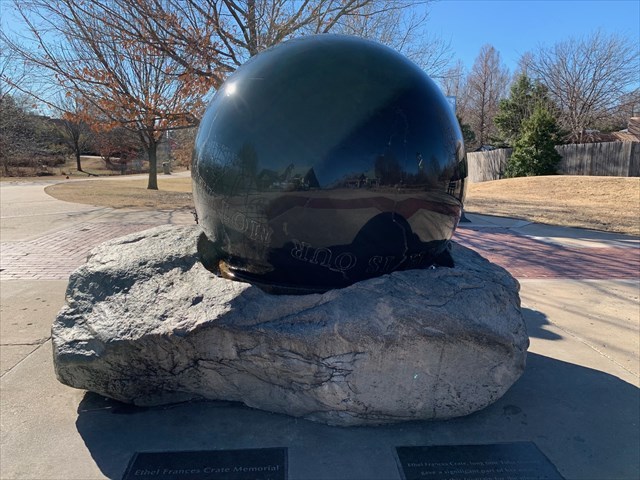
What kind of rock is this?
The base of this fountain is a rock called gneiss (pronounced "nice"). Gneiss is a metamorphic rock which means it began as a different kind of rock, either igneous or sedimentary. After having been subjected to extremely high temperature and pressure from within the Earth, it "morphed" into the rock you see today. Gneiss appears to be striped in bands like parallel lines called gneiss banding. The minerals within naturally arrange into layers during the metamorphic process that appear as bands.
A common cause of this banding is the super heated rock being subjected to extreme shearing forces. Think of it like pushing the top of a deck of cards in one direction and the bottom of the deck in the other direction. These forces stretch out the rock like plastic and the original material is spread out into sheets.
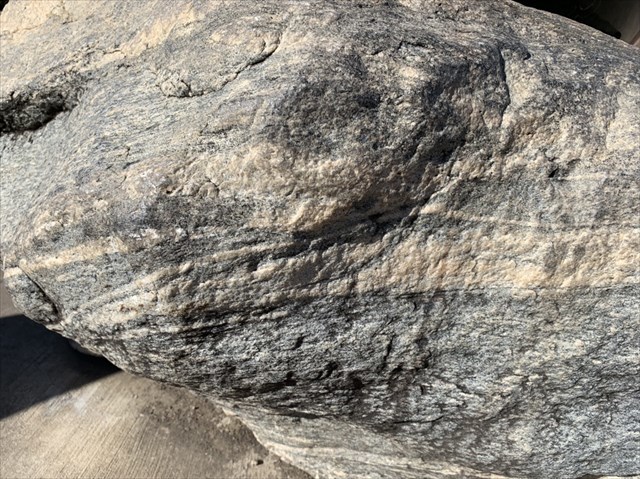
Wait, that layer looks different, what is that?
As you walk around the fountain, you can see the wavy lines of minerals that are the tell-tale sign of gneiss. However, if you look closely, you will see a completely different band of mineral running through this rock. It can only be seen on one side but you'll see that it stretches across the rock and doesn't look like any of the others bands. The presence of this mineral band in particular is the focus of this EarthCache. It is unique here because it shows you a little bit of history this rock went through in order for it to exist like this.
If you will notice, this band is made up of not only different colors than the gneiss but a different texture as well. The crystalline structure is apparent throughout this band! The presence of this mineral band here indicates it formed at a different time than the rest of the rock. This means the rock had already cooled and hardened over a long period of time and was in the presence of this mineral long enough for it to have formed its own thick crystalline layer.
Minerals have different colors they appear as and often contributes to the overall look of a rock depending on the varieties and quantities that are within. With this band showing a completely different color than the rest of the gneiss rock, you can use the chart below to see some possibilities this mineral layer may be composed of.
- Quartz - typically milky white color
- Feldspar - typically off-white color
- Potassium Feldspar - typically salmon pink color
- Biotite - typically black or dark brown color
- Muscovite - typically metallic gold or yellow color
- Amphibole - typically black or dark green color
- Cordierite - typically sapphire blue or blue violet or yellowish gray colors
- Kyanite - typically blue, white, gray, or green colors
- Staurolite - typically brown and black color, large crystals
- Andalusite - typically reddish brown, olive green, white to gray color
- Garnet - typically red, but can be orange, green, yellow, purple, black, blue or brown color
To Get Credit For This EarthCache
Copy the questions below and send your answers via geocaching messages.
- DO NOT post the answers in your log.
- Group answers are fine, just let me know who all was there.
- Note: The photo task is a requirement for each account claiming a find. See acceptable EarthCache logging tasks effective June 10th, 2019. If you don't want to post the photo with your log, you may send it to me with your answers instead.
- Please send the answers in a timely manner or it may result in the deletion of your log (no offense intended).
Logging Tasks
1| The name of this EarthCache: Bands 🌎f Minerals
2| In your log, provide a photo of yourself at the fountain.
- If you prefer, the photo can be of a personal item here instead. Just make the photo unique to you and your visit. Feel free to have fun with this!
Look at all sides of the rock base of the fountain and answer the following questions from your observation:
3| How many inches thick is the unique band of mineral that runs through this rock?
4| Is this unique band wavy like the gneiss bands?
5| What direction does this unique band run compared to the wavy bands?
6| What mineral(s) do you think this band is made from?
7| Run your hands along the unique band. Does it feel like the rest of the gneiss? Is it smooth or rough?
8| In your opinion, do you think this band formed at the same time as the rest of the rock? Why or why not?
Optional: I'd love to see other photos you took from your visit here!
*IF YOU ENJOYED THIS EARTHCACHE,
CONSIDER GIVING A FAVORITE POINT!*
Sources:
Permission for this EarthCache was granted by the Tulsa Zoo.