
This earth cache leads you to a petrified coral reef or its remains on the northwest coast of Zanzibar. On the eroded coastal section you will find a number of fossil inclusions from former inhabitants of the coastal area. Further out and especially in front of the island of Mnemba you will find interesting coral formations you can explore on a snorkeling or dive excursion.
Corals
Coral reefs are underwater structures formed by reef-building cnidarians, mainly stone corals. They are the largest structures created by living beings on earth. They are complex maritime ecosystems that have a significant physical and ecological impact on their environment. Reef-building corals can only survive at water temperatures that rarely drop below 20° C. For this reason, coral reefs are limited to a range approximately between 30 ° northern and 30 ° southern latitude.
Coral reefs are of great value to nature: they are habitats for a large number of marine organisms and are of great importance as spawning and breeding grounds for pelagic fish. They also protect beaches from erosion and storm damage and are appreciated by people for their beauty and biodiversity when diving and snorkelling.
According to their geographical distribution, coral reefs can be divided into two types: tropical reefs and deep-water reefs. Since we are in a relatively warm area, we find tropical coral reefs around Zanzibar.
There are three main types of coral reefs:
- Fringing reefs, which are directly adjacent to the coast. This type of reef is the most widespread (e.g. Red Sea or also here).
- Barrier reefs that run parallel to the coast but are separated from it by wide and sometimes deep lagoons (Australia, Central America, Bahamas, New Caledonia).
- Atolls - circular reefs around a wide lagoon that surrounds one or more islands. This species is mostly found in the Pacific and Indian Ocean.
Fossiled Corals
What is a fossil? A fossil is the prehistoric remains of a plant or animal. Fossils are typically preserved when they are buried under many layers of sand and mud. Under great pressure the sand and mud become sedimentary rock. Minerals seep into the fossil replacing the organic matter and creating a replica in stone.
Over time, these former coral reefs have dried out due to the sinking of the sea level and their inhabitants have been preserved for eternity.
Living corals have the most diverse shapes, colours and growths. Here on the beach you will only find their petrified forms, as these impressive pictures show.
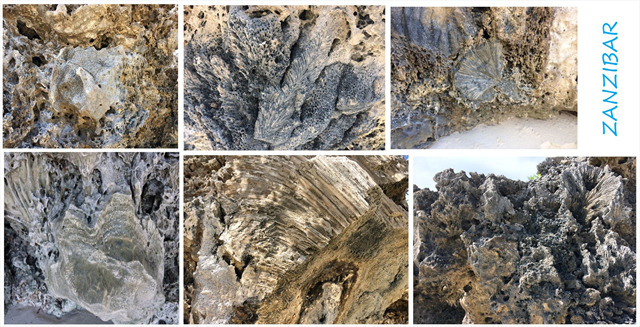
It is best to come here at low tide to discover the interesting formations next to and above you as well as the fossil inclusions at your feet. Then you can also find the small cave and take a picture as proof that you have been there.
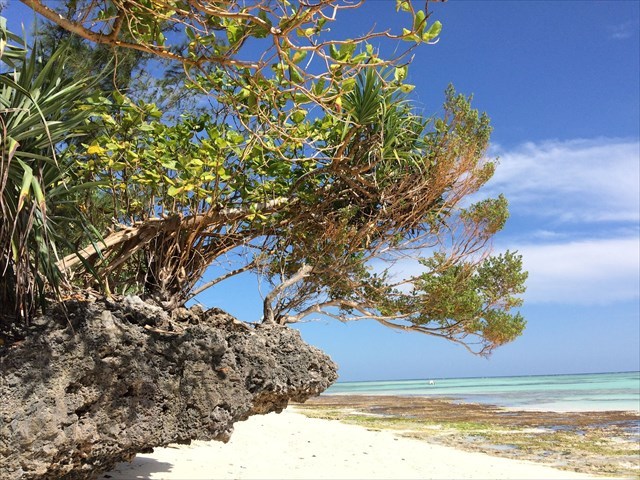
To log the Earthcache, please send me your answers to the following questions via message center or e-mail:
- Which fossilized corals can you discover here? Just describe the shapes or research their exact names
- What kind of reef are there?
- At the Earthcache location you will find a small open cave. Take a picture of yourself, your mascot, your GPS or just a thumbs-up as photo proof. Of course you can also attach more photos of the found fossils to your log.

Have fun and enjoy the location!

Dieser Earthcache führt dich zu einem versteinerten Korallenriff oder dessen Resten an der nordwestlichen Küste von Zanzibar. An dem erodierten Küstenabschnitt findest du etliche fossile Einschlüsse von ehemaligen Bewohnern der Küstenregion. Weiter draußen und speziell vor der Insel Mnemba findest du außerdem interessante Korallen-Formationen, die du bei einem Schnorchel- oder Tauchgang erkunden kannst.
Korallen
Korallenriffe sind von riffbildenden Nesseltieren, vorwiegend Steinkorallen, gebildete Riffstrukturen im Meer und die größten von Lebewesen geschaffenen Strukturen auf der Erde. Sie sind komplexe maritime Ökosysteme, die einen bedeutenden physikalischen und ökologischen Einfluss auf ihre Umgebung ausüben. Riffbildende Korallen können nur bei Wassertemperaturen überleben, die 20 °C nur sehr selten unterschreiten. Aus diesen Gründen kommen die Riffe nur in einem Bereich zwischen ungefähr 30° nördlicher und 30° südlicher Breite vor.
Korallenriffe sind von großem Wert für die Natur: Sie sind Lebensräume für eine Vielzahl maritimer Lebewesen und haben eine große Bedeutung als Laich- und Aufzuchtgebiet für pelagisch lebende Fische. Außerdem schützen sie Strände vor Erosion und Sturmschäden und werden von den Menschen ihrer Schönheit und Artenvielfalt wegen beim Tauchen und Schnorcheln geschätzt.
Nach ihrer geographischen Verbreitung können Korallenriffe in zwei Typen eingeteilt werden: Tropische Riffe und Tiefwasserriffe. Da wir uns in einem relativ warmen Gebiet befinden, finden wir um Sansibar tropische Korallenriffe.
Man unterscheidet drei Formen von Korallenriffen:
- Saumriffe, die sich unmittelbar an die Küste anschließen. Diese Riffart ist die am weitesten verbreitete (z.B. Rotes Meer oder auch hier).
- Barriereriffe, die parallel zur Küste verlaufen, von dieser aber durch breite und zumindest gelegentlich auch tiefe Lagunen getrennt sind (z.B. Australien, Mittelamerika, Bahamas, Neukaledonien).
- Atolle, kreisförmige Riffe um eine breite Lagune, die eine oder auch mehrere Inseln umgibt. Diese Art findet man meist im Pazifik und dem Indischen Ozean.
Versteinerte Korallen
Was ist ein Fossil? Ein Fossil sind die prähistorischen Überreste einer Pflanze oder eines Tieres. Fossilien bleiben normalerweise erhalten, wenn sie unter vielen Schichten Sand und Schlamm vergraben werden. Sand und Schlamm werden unter hohem Druck zu Sedimentgestein. Mineralien sickern in das Fossil ein, ersetzen die organische Substanz und bilden eine Replik in Stein.
Im Lauf der Zeit sind durch das Absinken des Meeresspiegels auch diese ehemaligen Korallenriffe ausgetrocknet und deren Bewohner wurden dabei für die Ewigkeit konserviert.
Lebende Korallen haben verschiedenste Formen, Farben und Auswüchse. Hier am Strand findest du nur noch ihre versteinerten Formen, wie diese beeindruckenden Bilder zeigen.
Am besten kommst du bei Ebbe hier her, um neben den interessanten Formationen neben und über dir, auch die fossilen Einschlüsse zu deinen Füßen zu entdecken. Dann kannst du auch die kleine Höhle finden und ein Bild als Beweis dafür machen, daß du da warst.
Um den Earthcache zu loggen, sende bitte deine Antworten auf folgende Fragen via Message-Center oder Mail an mich:
- Welche Formen von versteinerten Korallen kannst du hier entdecken? Beschreibe einfach die Formen oder recherchiere auch gerne deren genaue Namen.
- Welche Art Riff gibt es hier?
- An der Earthcache-Lokation findest du eine kleine offene Höhle. Mache von dort mit Blick auf das Meer ein Foto von dir, deinem Maskottchen, deinem GPS oder einfach einem Daumen-hoch als Foto-Beweis. Natürlich kannst du auch weitere Fotos von den gefundenen Fossilien an dein Log anhängen.
Have fun and enjoy the location!