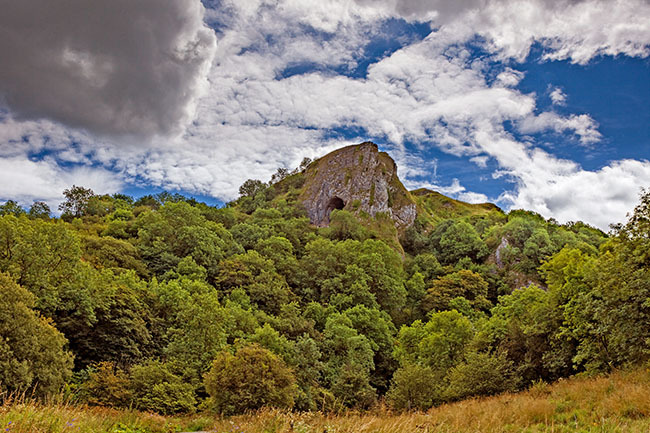
Thor's Cave is a very large and impressive natural cavern located in the Manifold Valley of the White Peak. It is classified as a Karst cave and is located in a steep limestone crag. The cave entrance is a symmetrical arch 7.5 metres wide and 10 metres high which is prominently visible from the valley bottom, around 80 metres (260 feet) below. Reached by an stepped path from the Manifold Way, the cave is a popular tourist spot, with superb views over the Manifold Valley.
By Iankelsall1 - Own work, CC BY-SA 4.0, https://commons.wikimedia.org/w/index.php?curid=64310294
Before we begin... Thor's Cave and the area surrounding it is designated an SSSI. Please do not do anything to damage the cave, no question requires you to touch anything. In fairness, the designations in this area are largely due to rare flowers and plants so please keep to the paths and don't touch the plants. Thank you.
This new EarthCache explores the fascinating Thor's Cave. It aims to give you a tour of the cave and covers a few topics so it is a longer than usual listing (sorry), but you do get a 5/5 for your efforts. There was an EarthCache set here in 2011 which was archived at the beginning of 2019. The old EarthCache did not require you to enter the cave, this one does hence the raised rating (why go and not take a tour of this fascinating geology?) Thor's Cave is probably the most impressive of the accessible caves in the Peak District so I have revisited the cave to look for which bits of the geology should be highlighted on this new EarthCache, so it is completely different to the old one.
Why a D5? All my EarthCaches can be completed by anyone with no previous geology knowledge, using the information in the listing, so it's achievable to anyone. Most EarthCaches cover one topic; different topics usually mean different EarthCaches. Here, a GPS can only guide you to the cave entrance so the one listing covers a few topics. The EarthCache explores 4 different parts of the cave. The questions are not hard, the difficulty reflects the fact that you will need to spend a bit of time finding the right parts of the cave and you will need to read a bit of information in the listing to formulate your answers. There aren't many other geocaches around here so anyone visiting Thor's Cave will probably have come especially, and you won't be disappointed if you do. The EarthCache will take you up Thor's mouth, over the tongue and into both nostrils, it is designed as a guide of the cave and the geology within.
Why a T5? This is a T5 due to a number of factors, not one bit of really tough terrain. When the cave is very dry it will not be T5 but when wet and muddy it is tricky. At all times it should be accessible to most people who are prepared. Thor's Cave is a tourist cave, so you are encouraged by the authorities to visit with paths leading to it. Qualified cavers do explore further than the tourist areas with ropes, but you do not need to go beyond the tourist areas. This is a 3.5 star location to begin with. Thor's Cave sits 260 feet above the Maniford Trail below. There is a path but it's a fair pull up and uneven in places. You can also walk in from Wetton. Then once you are at Thor's mouth you need to climb up the smooth tongue and how difficult this is will depend on when you visit. The tongue is made of downward sloping limestone polished smooth and slippy by thousands of people going in and out. If it's been raining, the limestone is wet and even more slippy. The cave is full of muddy clay and this flows out of the cave and also spreads on peoples shoes. So now you could have sloping smooth slippy wet muddy limestone. Don't panic, most people will be able to get in, but depending on your agility and the conditions on the day, it could be tricky. Once inside, much of the year there's mud everywhere. Limestone is permeable; water is often dripping from above. You could easily end up with mud all over you - the tourists in their designer white trainers and beige jeans are really quite funny when they come out with all their clothes brown. Appropriate grippy shoes and clothes are recommended, for example, if you have waterproof pants you can brush against the walls or sit down going in or out without any worry. Special equipment is required as you need a good torch - not a phone torch. The main cave is well lit but both the nostrils are pitch black. You need a good torch to light up the whole cavern to enjoy your visit and help answer the questions. You also will miss out on so much if you don't have one (most tourists miss half the cave for that reason). You also need a camera. So I feel on balance, getting to the cave, climbing up the tongue into the mouth, getting into both nostrils, and bringing suitable clothes, shoes, camera and a torch deserves a T5.
How does it work? The EarthCache is in sections. I recommend printing it. The EarthCache will guide you from the coordinates at the entrance through the cave. It will explain an aspect of the geology you see in each area, and then ask questions. It will then guide you to a different area, give different information and ask more questions, and there are four points you will visit. As previously explained, it is not intended to be complicated, but instead to give you a nice tour and the chance to earn a 5/5 rating.
Let's begin the tour.
Section 1 - Thor's Mouth
The coordinates bring you to the end of the path where the soil ends and the limestone of the Tor begins. The origins of the name Thor's Cave aren't really known. Some say it's because the cave is so big and dramatically situated looking over the lands below it's the sort of place a giant like God might have created. But the geologists believe it might be a simple corruption - the cave is in a Tor and it might have been corrupted from Tor's Cave.
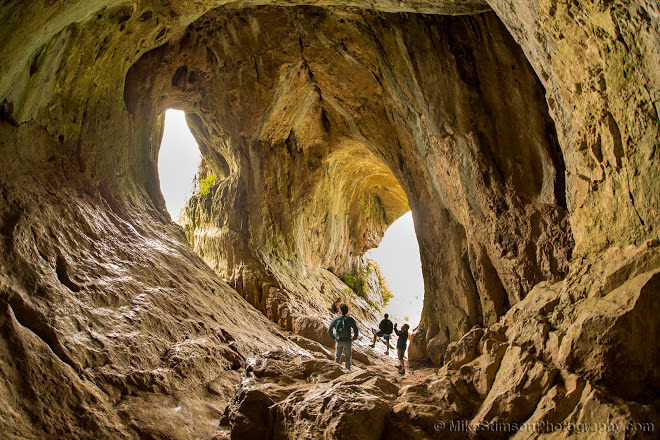
A very helpful set of five steps take you to the foot of the limestone which slopes down from the cave and as outlined above could be quite slippy. You should be able to gain assess at all times of year but in the wet it will by harder. Going up the left side and leaning against the wall is the traditional approach. Keep climbing up until you come off the sloping rock and are stood on flat firm mud in the centre of the cave. From here you can look down the mouth of the cave over the valley below. Looking west there is the second entrance; some call it the suicide exit as it all gets rather steep if you try and get out that way. The second entrance is known as the "West Window", below which is a second cave, Thor's Fissure Cavern. Please don't go too close to the end of the West Window, you do not need to go to the Fissure Cavern.
So it's time for some geology. Firstly, let's look at how this cave formed. The spectacular Manifold valley was formed by the erosive effects of running water on the Carboniferous Limestone plateau during the last 2 million years - a period of dramatic climatic variations called the Quaternary Period.
Limestone is a permeable rock meaning water can get through it. It might be hard to believe but at one time the river was up here above the cave, not 260 feet below you in the valley. And it was flowing water that created this cave. When the cave formed, the river was actually higher than the cave, with this cave forming beneath it. But why did the cave form here specifically? There are a few local factors.
- Limestone forms in layers. It is a sedimentary rock and sediment is dropped for a period of time until it is interrupted. These breaks in formation cause bedding planes in the rocks. A bedding plane at the top of a particularly hard bed in the limestone (or perhaps an impermeable bed of shale within the limestone) could be more resistant to solution and erosion, so that rain water percolating down from the surface preferentially dissolves the overlying limestone.
- Water is able to seep along the bedding plane too, so that the sites where solution is happening are joined up by tiny channels.
- Solution continues and the channels widen from a few millimetres to a few centimetres.
- One channel may start to take more water than the others and enlarges to become a small phreatic cave.
- Water flows more easily through the cave, solution is more rapid and the cave increases in size.
- The increase in water flow also increases solution (and erosion) of the more permeable limestone below, and eventually the cave grows downwards as well as upwards.
- Eventually, a cave forms. If it is entirely below the water table, phreatic solution takes place on the floor, roof and walls and the cave takes on a more circular or tube-like shape. If much of the water drains from the cave and it becomes vadose, solution takes place towards the floor of the cave and the cave becomes keyhole shaped.
For the first section we are going to look at phreatic and vadose caves and try to understand the differences.
The pheatric zone of a cave lies below the water table. Passages that are created by flowing water under pressure are called phreatic passages. They form below the water table, and when the water level drops, a passage remains. Being mostly oval shaped, they are also called phreatic tubes.
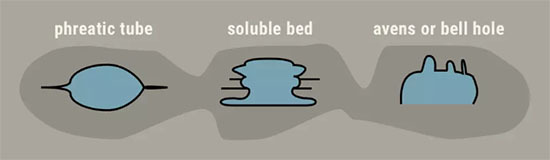
The visible enlargement up joints and small faults is a good indication that the passage is phreatic. It's likely that water has ran through this cavity under pressure once, smashing into the joints and penetrating any fissures, carving out a smooth and flowing phreatic tube.
Soluble bed are passages formed when a layer carbonarite rock (soluble) is emerged in water, and the water dissolves the rock. After the water table drops, a soluble bed remains. Soluble beds are generally very wide and low. The ceiling and floor are smooth.
Avens or bell holes are vertical tubes in the ceiling of the cave. They are formed by water swirling around under extreme pressure, trying to find its way out from the bottom. Some avens are so deep they can look like shafts. Because of the way they develop, it's safe to assume avens are generally a dead end.
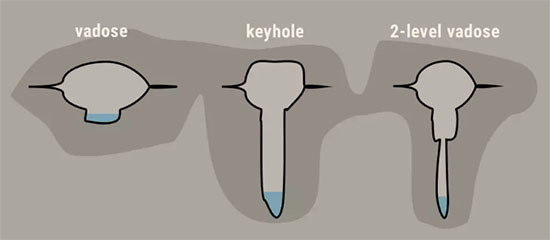
The vadose zone of a cave lies above the water table. Vadose passages are formed by free-flowing water, which create channels. They include shafts and canyons, carved out by streams very similar to those on the surface. As water levels drop in a phreatic tube, only a small stream at the bottom remains. The stream starts carving out a smaller passage in the bottom, which slowly digs deeper. These are also called stream passages. The shape of the incision tells us a lot about the way it has been formed. Narrow incisions suggest rapid incision: fast vadose passages are narrow. Wide areas on the other hand suggest stable water levels: slow vadose passages are wide. The complete vadose system of a cave is also called the drain complex.
A classic key-hole shaped passage is carved out by the stream. This is called the keyhole or vados passage. Some keyhole passages are too narrow to travel accross. That's where your caving skills come in: you can make progress by traversing the top (which is the bottom of the original phreatic tube).
As the cave increases in size, parts of the roof or walls may become unstable and collapse, so that the caves become all sorts of shapes and sizes. The caves develop best in the reef limestones rather than the surrounding thinly bedded limestones, as the reef limestones are physically stronger and do not collapse as the caves form. Thor's Cave is well preserved so the type can be identified.
Question 1:1
Firstly, look at the West Window passageway. What would you estimate the width and height of that to be? Is it bigger than the passageway you entered by? Is that notably bigger at one end than the other or not?
Question 1:2
We know from the opening paragraph of the EarthCache the entrance to the cave is 7.5 metres wide and 10 metres high. So now you are at the top of the mouth, standing in the largest point of the main cave - how big would you say it is here - bigger, smaller or the same than the entrance? Please give a size estimation of the biggest point. Why do you think it is this size here compared the the entrance passageway?
Question 1:3
Comment on the shape of the cave at the biggest point compared to the entrances. How is it different?
Question 1:4
There are two types of cave mentioned above, phreatic and vadose. By looking at the shape of the cave (either tube-shaped or keyhole-shaped) we can see whether the cave was entirely below the water level or whether much of the water was draining out. Please look very carefully at cave, focusing your attention on the main area where you are standing, and decide whether this is a phreatic or vadose cave. The illustrations in the listing will help you.
Section 2 - Thor's Tongue
You should still be stood at the top of the mouth looking North, down the tongue which is the smooth limestone you climbed up earlier. Turn 90 west degrees west and you are looking at the west window. Turn another 90 degrees and you are now facing the back of the mouth. There's a big lump of rock in front of you but to the west of it the tongue is still continuing up to the back of the throat. You need to look at the tongue directly to the west of the lump of rock. If you look closely at the clean areas you will see lots of white bits in it. These are fossils. There are others, they are in the walls at this level where you can see exposed limestone (ignore areas where the 'stuff' has flowed over the limestone). It's hard to describe exactly where to look but if you look at the floor rock you cannot miss the clearly exposed fossils.
So, back to the geology. The limestones the Manifold area were formed in warm tropical seas 325-355 million years ago. This was during the Carboniferous Period when Britain lay close to the equator, near the southern margin of the ancient continent of Laurussia. The seas teemed with life and brachiopods, corals and crinoids all flourished so any of these can often be spotted in this area. Details of what they look like are outlined below. Collections made by local teacher Samuel Carrington (1798-1870) are in national museums. His gravestone in Wetton churchyard has carvings of local fossils.
The rocks were formed by the deposition of layers of sediment, mostly shell debris and mud, that were later compacted and cemented by calcite into hard beds of limestone and thin shale. This layered sequence also contains lens-shaped masses of reef limestone that lack obvious layering. Some of these reefs formed in very shallow water while others, of a more uncertain origin, formed at depths of around 250m. A variety of organisms were responsible for their construction. The reefs form prominent features in the landscape as they are resistant to erosion. Occasionally, powerful currents swept the sea floor and, as they slowed down, sediments were deposited in graded layers, coarse at the base, fine at the top.
Crinoids
Because many crinoids resemble flowers, with their cluster of waving arms atop a long stem, they are sometimes called sea lilies. But crinoids are not plants. Like their relatives--starfishes, sea urchins, sea cucumbers, and brittle stars - crinoids are echinoderms, animals with rough, spiny surfaces and a special kind of radial symmetry based on five or multiples of five. Crinoids have lived in the world's oceans since at least the beginning of the Ordovician Period, roughly 490 million years ago. They may be even older. Crinoids came close to extinction towards the end of the Permian Period, about 250 million years ago. The end of the Permian was marked by the largest extinction event in the history of life. The fossil record shows that nearly all the crinoid species died out at this time. The one or two surviving lineages eventually gave rise to the crinoids still populating the oceans today.

Three different types of crinoid fossil you might spot
In general, crinoids have three main body parts. The first, the stem, attaches the animal to the ocean floor and consists of disk-shaped pieces stacked on top of each other. These stem pieces come in a variety of shapes - round, pentagonal, star-shaped, or elliptical - and each stem piece is perforated in its center. Rarely are crinoids preserved in their entirety: once the soft parts of the animal decayed, sea currents generally scattered the skeletal segments. By far the most common crinoid fossils are the stem pieces. Here in Derbyshire the limestone sometimes contains internal moulds of crinoid stem fragments, which have a distinctive screwlike thread pattern and have been called screwstones.
Brachiopods
Brachiopods are marine animals that secrete a shell consisting of two parts called valves. Brachiopods have an extensive fossil record, first appearing in rocks dating back to the early part of the Cambrian Period, about 525 million years ago. They were extremely abundant during the Paleozoic Era, reaching their highest diversity roughly 400 million years ago, during the Devonian Period. At the end of the Paleozoic, however, they were decimated in the mass extinction that marks the end of the Permian Period, about 250 million years ago. This event, known as the Permo-Triassic mass extinction, may have killed more than 90 percent of all living species. It was the largest of all extinction events (larger than the major extinction at the end of the Cretaceous that killed off the dinosaurs). Although some brachiopods survived the end-Permian extinction, and their descendants live in today's oceans, they never achieved their former abundance and diversity. Only about 300 to 500 species of brachiopods are exist today, a small fraction of the perhaps 15,000 species (living and extinct) that make up the phylum Brachiopoda.

A brachiopod fossil
Brachiopod shells come in a variety of shapes and sizes. Sometimes the bottom valve is convex like the top valve, but in many species the bottom valve is concave or occasionally conical. The outer surface of the valves may be marked by concentric wrinkles or radial ribs. Some brachiopods have prominent spines, but usually these are broken off and are found as separate fossils. The shells of living brachiopods typically range in size from less than 0.25 inches to just over 3 inches in length or width. Fossil brachiopods generally fall within this same range, though some adults have shells that are less than 0.04 inches in diameter, and an exceptional few have shells that are 15 inches across.
Because of their worldwide abundance, diversity, and rapid evolution in the Paleozoic, brachiopod fossils are useful indicators of the ages of different rock layers. By matching the brachiopod species contained within rocks deposited in different locations, paleontologists can determine that the rock units were deposited at the same time.
Coral
Corals are made up of small invertebrate animals, known as zooids, that look like tiny sea anemones. They feed on small food particles they find in the water around them. Together, many zooids form colonies, many colonies form reefs. Coral reefs can be massive structures, stretching hundreds of miles. The Great Barrier Reef in northern Australia can be seen from space. The oldest coral fossils are over 500 million years old. The earliest forms were different from those we see today and they died out 225 million years ago. Modern corals are still common in tropical oceans.

A coral fossil
Corals are very important fossils. Many corals have a hard exoskeleton made of calcium carbonate. It is this exoskeleton that is usually fossilised. When the coral dies, the skeleton can be broken down to form limestone, the important building stone you see here. Fossil corals also tell us about the past. Since many corals live in warm, shallow sea water, their fossils are good indicators of environmental conditions. Fossil corals found in England tell us that it must have had a much warmer, tropical environment at certain periods in its history.
Question 2:1
Look at the fossils in the tongue to the west of the lump of rock mentioned at the start of the section. Of the three fossil types above, what do you see here?
Question 2:2
What is the length of the longest fossil you see in the tongue?
Question 2:3
Have a look in the walls of the cave at this level. Can you see any more fossils? Are they the same or are they different? Feel free to keep your eyes open as you look in other areas of the cave, there are some really good ones but you'll need to have a good look to spot them. Just remember to only look at the exposed limestone, you won't see any where the original limestone has been covered by any other flowing material.
Section 3 - The Left Nostril
To get into the left nostril involves turning left at the top of the mouth and heading East. Be flexible with the anatomy, but it's the large bit of the cave heading towards the back, you can't really miss it. You'll need to climb up slightly to a raised platform and you will be entering a dark area where you will need a torch. Up above you'll see a hole in the ceiling where climbers enter with ropes, you don't need to go up there. As you shine the torch around you you can see the size of the cave, high roofs and various holes made in the limestone by the water. But what we are interested in here is the walls. Given this is a limestone cave, your first instinct might be to assume that when you look at the walls you will see limestone rock carved out by water. But look more closely. Up here they look difference, you might almost think they were growing outwards - so why might that be?
The topic we are considering in this part of the cave is speleothems. Scientifically speleothems are types of cave formations, or decorations, that formed after the cave itself had been created. Although they can vary in appearance, and how they form, the chemical composition follows only a few different formulas, which reflect the location and rocks that they form from.
The process is started with water on the surface filtering through the soil, absorbing carbon dioxide, turning the water into a weak carbonic acid. This weak acidic solution passes through the rocks and where there are rocks that contain calcium, such as limestone, the acid dissolves a small amount of this calcium. When this solution exits the rock, into the cave, the dissolved carbon dioxide is released and because of this the solution cannot hold as much dissolved calcium. As a result the calcium is then precipitated, creating the speleothems. Most commonly this calcium is deposited in the form of the mineral calcite (CaCO3).
This chemical composition makes up the majority of speleothems, but as well as the calcite the solution can dissolve other minerals from different rocks that are present. These additions to the solution affect the colour of the speleothems, and they can range from pure white all the way to black.
- Clear or pure white is the result of pure calcite that do not have any other minerals dissolved in the solution.
- Pink is formed from the rock dolomite and is actually not calcite at all, but the process happens in much the same way.
- Green is formed by impurities of glauconite, which is normally in the form of potassium iron silicate. This is typically dissolved from clays or shale.
- Reddish Brown is formed by iron oxides and as a result looks 'rusty'. This iron commonly comes from ironstone, which is easily identifiable by its rusty looking colour.
- Grey and Black is formed most commonly by manganese, but can also be a result of lead. These minerals can be found within a number of rocks.
Although the basic chemical composition of most speleothems are the same, the way they are deposited leads to vastly different appearances, and as such are categorised into different formations. We are going to consider three of the four categories in this bit of the cave and also in the next, the fourth category relates to pools in caves which Thor's Cave doesn't have so we won't look at that here.
Dripstones
These are the 'typical' speleothems and is the category that most people will associate with this process. They are formed, as the name suggests, by solution falling from the rock above and landing on the ground below.
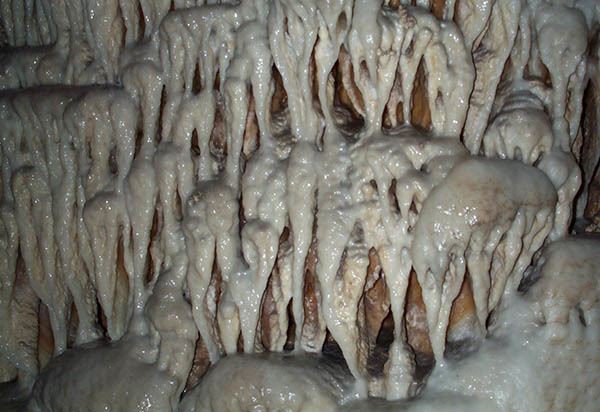
- Straws are a thin walled hollow formation that is called this because they resemble a drinking straw. The solution dripping from the ceiling deposits a microscopic ring of calcite crystal. Over time these rings continue to form and the straws continue to grow.
- Stalactites are a formation that grows, like straws, down from the cave roof. Nearly all stalactites start their 'life' as a straw, which are subsequently blocked with calcite or impurities. Over time the stalactite thicken and lengthen as a result of the solution running down their outer surface.
- Stalagmites are solid dripstones that grow upward from the cave floor, and are usually associated with a stalactite or straw on the roof above that the solution is falling from.
- Columns and Pillars are formations that result when stalactites or stalagmites extend from floor to roof.
Flowstone
These form where the solution doesn't drop down from the roof, but runs down a rock face, to the cave floor.
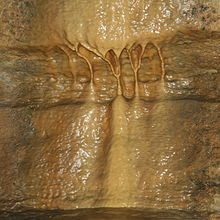
- Shawls form when solution trickles down the rock, resulting in a narrow strip of calcite that hangs away from the rock, much like the dripstones. As the solution runs along the same path the strip of calcite grows downwards and eventually creates a thin sheet.
- Flowstones are formed when solution runs over the surface of the rock, creating a wide layer of calcite. Over time the layer thickens, sometimes creating impressively thick flowstones.
Pore Deposits
These deposits form where solution enters the cave through the pores and cracks with the rocks, and because of this droplets do not form. As a result they are not subject to gravity, so they can create some amazing speleothems. Although it is not certain, it is thought that they are a combination of capillary action and hydrostatic pressure.
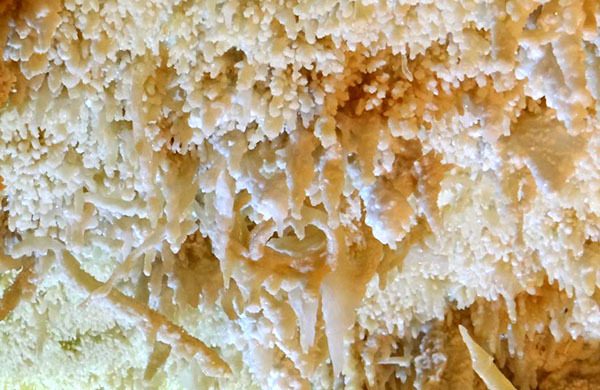
- Helictites create irregular growths that grow in any direction and are not affected by gravity. The evaporating solution creates a minute layer of crystal and slowly a capillary tube slowly develops. This draws further solution and the capillary tube grows, extending the helictite. The result of this type of formation are wonderful tube like structures that can twists any way, defying gravity.
- Cave Corrals are similar to helictites, but the capillary tubes do not form. This means that the resulting deposit grows over a large area and has a rough texture, with no discernible 'structure' to it.
Question 3:1
The limestone here originally would have been grey, a similar colour to the tongue you climbed up in the main cave below. From the listed colours, which do you see here and what is responsible for the colours?
Question 3:2
Have a look around the upper part of the cave here. Describe the texture of the walls and the colour. Compare it to the limestone you walked up as you climbed the tongue, and the limestone walls below.
Question 3:3
Of the speleothems outlined above, which do you see here? Remember, some speleothems are not as visually dramatic as others.
Section 4 - The Right Nostril
Return to the centre of the mouth at the top of the tongue where you were viewing the fossils earlier. If you walk over the fossils and climb around the rock in the middle of the cave you'll find a hidden passageway going up into the right nostril. Again, you will enter an area of darkness, go up around the corner and explore right to the back of the nostril. This is often a quieter area of the cave as many people miss it or can't come in as they don't have a torch. Again, we are interested in the speleothems but they are very different to what you saw in the left nostril.
There is calcium here of a more obvious and traditional type at first glance but if you look closely it is really quite interesting. Please refer to the information in section 3 when formulating your answers.
Question 4:1
There are two textures here very different to anything you've seen elsewhere, so these are the two areas you should focus on. One is to the side near the corner and one others are nearer the back of the cave. Describe the two unusual textures you see on the walls here.
Question 4:2
Describe the colour here. Why is it different to the left nostril? What does it tell you about the mineral content in these speleothems?
Question 4:3
From the speleothems listed in the previous section, which ones are present in this part of the cave? You should be able to identify two very different types in this area.
Section 5 - Thor's Throat
Return to the centre of the cave where you answered the first question.
Task 5
Please take a photo of yourself, GPS etc looking down the mouth from the centre of the cave. Under revised guidelines this is now a mandatory logging requirement because it provides proof that you were personally inside the cave. Additional photos can be added from the outside but there must be one proving you were inside the cave as this does have a 5/5 rating. Thank you.
And finally...
That is the end of your tour of Thor's Cave. Please only exit down the tongue the way you came in. Take care as you climb out as it's easier to slip going down. Try and keep against the wall so you can steady yourself. Remember you need to send me the answers soon after logging, either using the email feature or via the message center. If using the message center on your phone, remember it needs good signal. If you don't have enough signal the message doesn't send and disappears. I don't expect any of the questions to have long answers but please do answer them all. This is a 5/5 and most people will spend a little time completing this EarthCache. It would not be fair for anyone to log this 5/5 EarthCache without sending answers or adding a photo so please don't try. I do hope you have enjoyed exploring this spectacular cave.