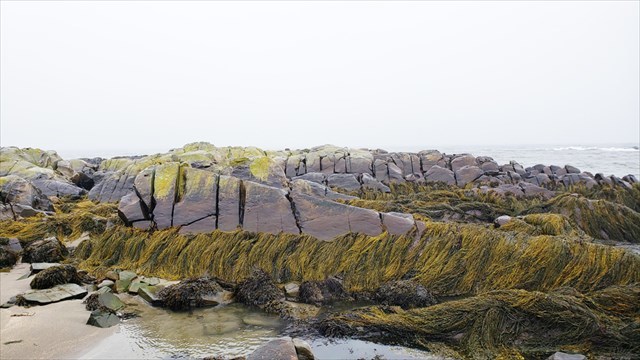
LOW TIDE ONLY!
To log this earthcache, please don’t stress about answering the questions. Simply send your best attempts in a private message to me, (the cache owner), and then go ahead and log it as found.
You don’t need to wait for my approval. All attempts will be accepted.
Go ahead and have fun learning! 
- [REQUIRED] Please post a photo in your log of yourself or a personal item at the sandbar to prove you visited the site.
- Watch the waves hit the sandbar. How do you think this current helped create the sandbar?
- How wide would you say the sandbar is at the time of your visit?
- How far is it from the beach to the rock outcrop?
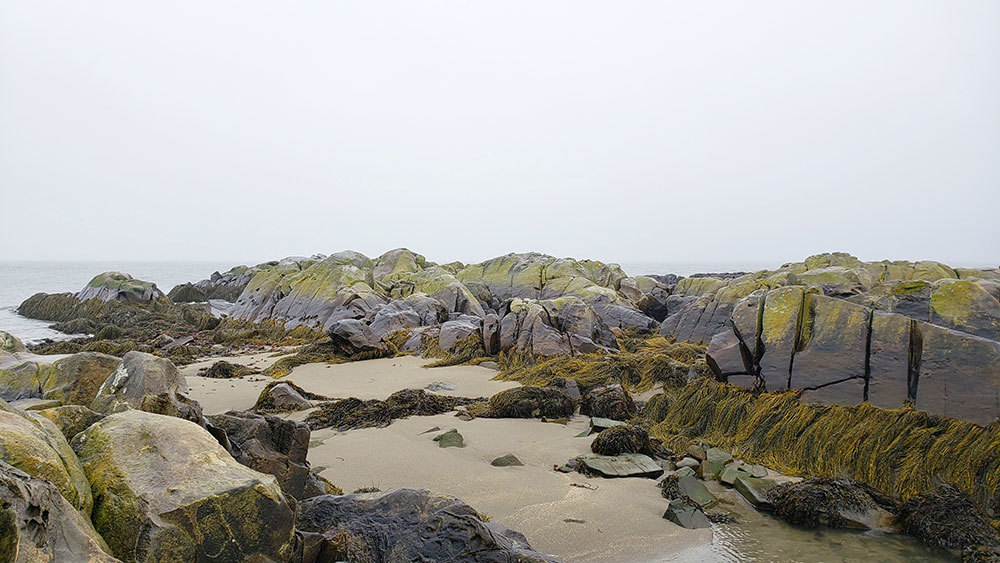
You will be able to walk directly across the sandbar to the outcrop just off shore ONLY DURING LOW TIDE. However, you don't have to walk on the sandbar to do this earthcache. You simply have to be able to see it.
Sandbars begin forming underwater. As waves break, this pulls material from the shoreline, migrating further into the ocean. During heavy storms, large waves can build sandbars far from shore, until they rise above the water’s surface.
In this case, the sandbar at Green Bay has been developed between the beach and an outcrop just off shore.
The swirling turbulence of waves breaking off a beach excavates a trough in the sandy bottom. Some of this sand is carried forward onto the beach and the rest is deposited on the offshore flank of the trough. Sand suspended in the backwash and in rip currents adds to the bar, as does some sand moving shoreward from deeper water. The bar’s top is kept below still-water (half-wave height) level by the plunge of the waves breaking over it. Bars and troughs are most pronounced in the heavy surf of the stormy season; they also migrate shoreward in gentle seas and seaward in high seas. Thus, although sandbars have greatest relief in the stormy season, they are more submerged.
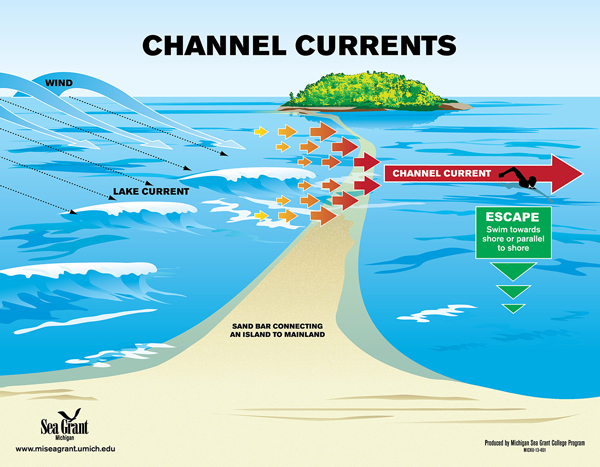
The image below is for another sandbar but does a good job of showing how water current can shape, and form a sandbar:
There are different types of sandbars. One type is called an Offshore Bar or a shoal. A shoal is a natural submerged ridge, bank, or bar that consists of, or is covered by, sand or other unconsolidated material, and rises from the bed of a body of water to near the surface. Often it refers to those submerged ridges, banks, or bars that rise near enough to the surface of a body of water. These types of sandbars are also known as sandbanks, or gravelbars. The sandbar is a submerged or partly exposed ridge of sand or coarse sediment that is built by waves offshore from a beach.
Bay-Mouth Bars may extend partially or entirely across the mouth of a bay; bay-head bars occur at the heads of bays, a short distance from shore.
Barrier Bars or beaches are exposed sandbars that may have formed during the period of high-water level of a storm or during the high-tide season. During a period of lower mean sea level they become emergent and are built up by swash and wind-carried sand; this causes them to remain exposed. Barrier bars are separated from beaches by shallow lagoons and cut the beach off from the open sea. They occur offshore from coastal plains except where the coasts are rocky; where the tidal fluctuation is great or more than 2 1/2 metres [8 feet]; or where there is little wave activity or sand. Barrier bars are common along low coasts, as off the shores of the Gulf of Mexico, where they parallel straight beaches. They often are cut by tidal inlets and are connected by underwater tidal deltas; they convert irregular shorelines to nearly straight ones.