This Multi-Cache will take you on a short journey and demonstrate how successful Durham Castle was as a defensive structure with it's great walls and gates coupled with a unique geographical positioning.
The Fortification of the Peninsula
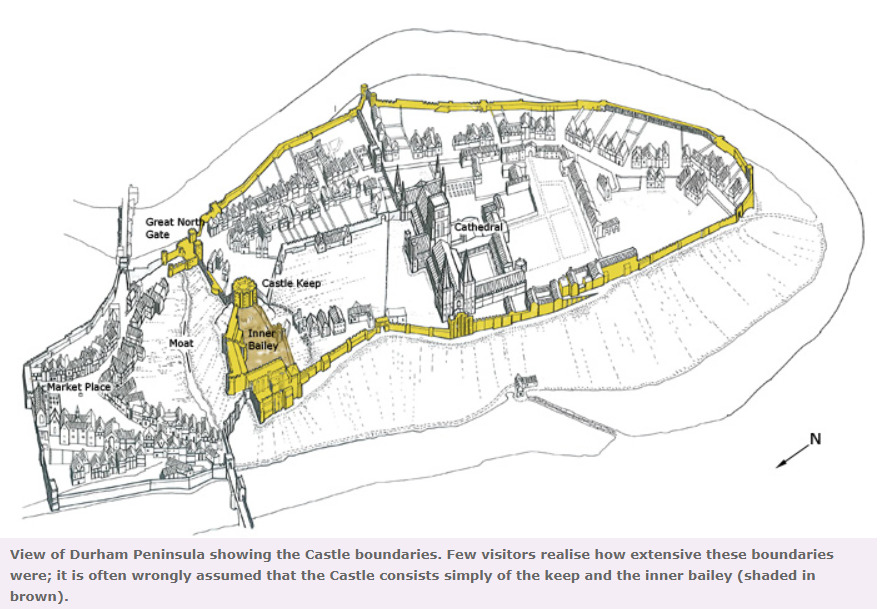
Visitors to Durham Castle today are likely to overlook the fact that the Castle comprised much of the Durham Peninsula, including the Cathedral Precinct.
Building the Outer Walls
Masonry walls were built around the peninsula between 1099 and 1128 by Bishop Flambard. These were probably a rebuilding of earlier Anglo-Saxon defences.
In addition to a wall around the southern part of the peninsula, there was a wall around Palace Green and another around the marketplace.
The walls, strengthened with flanking towers and buttress turrets, followed the contours of the hill rising up from the river banks on all sides except the north, where a wall of great strength, varying from 10m to 15m in height, was built to the north of the castle with a dry moat outside this (along modern Moatside Lane).
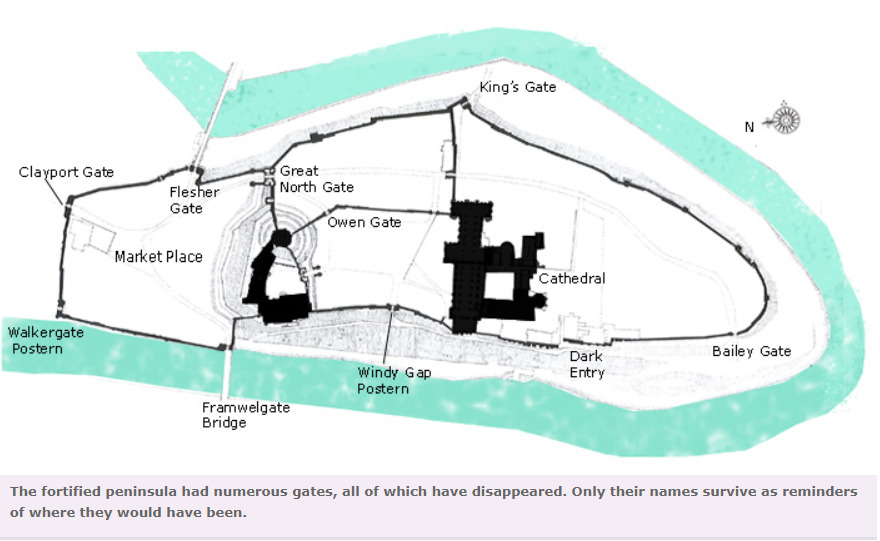
There was a massive gate in this northern wall, the North Gate, the southern end of what is now Saddler Street.
Two other gates were present in the walls, leading to fords across the river: Kings Gate (on modern Bow Lane) and Water Gate or Bailey Gate (at the southern end of South Bailey).
There was also a postern (secondary gate) Dark Entry’ in the Priory, while medieval references to a ‘Windishole Gate’ suggest another such gate at the modern Windy Gap.
The Outer Bailey Walls Today
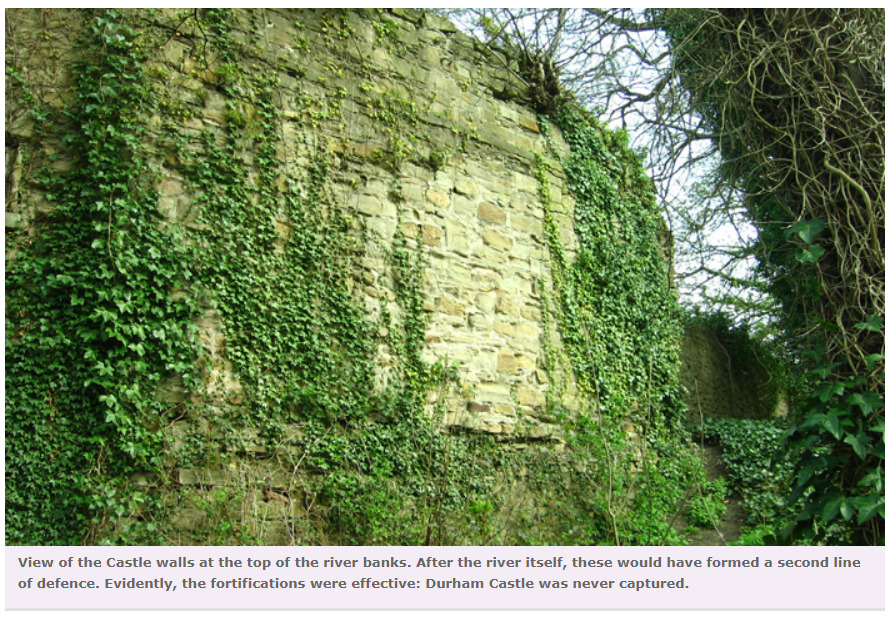
Although much overgrown, the peninsula’s outer fortifications can still be seen along the river banks. These are in fact the walls of the castle, not of the city.
Cache Information
The cache can be found at N 54 46.ABC W 001 34.DEF
At the listed coordinates you should find a map on a wooden information board.
You are looking for ABC where
A = 4th number of the old Tourist information Telephone number
B = last digit of the old Tourist information Telephone number
C = Elvet Bridge + Market Place (from the key to the map)
At the second stage you should again find a map. You are looking for DEF, where
D = 'A wooden footbridge of 1574 was replaced in 1D9D'
E = 'The Wall and Towers of Durham as they would have appeared at the end of the medieval period circa 15E0'
F = Bailygate + Kingsgate (from the key to the map)
Check summation of all 6 missing digits = 28