This EarthCache takes you to the corner of 14 Broadway, where it meets Bank Street in Bradford. You are here to look at the rock which makes up the edge of the pavement.
We are here to look at Rapakivi Granite?
Rapakivi granite is a term used for a variety of granite which is characterized by the presence of large ovoid crystals of orthoclase which are usually mantled by plagioclase.
Crystal size depends largely upon the cooling history of the granite but also on the presence of volatiles such as water, fluorine and carbon dioxide. Rapakivi granites contain two generations of crystals: first, phenocrysts, representing the early stage of magma crystallization in deep magma chambers and reservoirs and, second, much smaller, anhedral groundmass minerals that crystallized at the final intrusion level. A phenocryst is a crystal in an igneous rock, the crystal being larger than the other crystals that the rock is made of. Anhedral means crystals which do not have well defined edges.
Formation of the rapakivi plagioclase‐mantled alkali feldspar phenocrysts that are the key component of the rapakivi granites required an extreme change in the physicochemical growth conditions in the magma chamber. There are three proposed mechanisms for the formation of rapakivi texture.
(1) Mixing of two magmas of different composition. A catalyst for inducing the changes in the physiochemical conditions of the magma chamber may be the influx of ‘fresh’ mafic magma from below, upsetting the status quo of the felsic magma and triggering magma convection and possibly magma ascent. This is supported by the fact that most of the rapakivi granite complexes are associated with mafic igneous rocks. There seems to be a correlation between the frequency of rapakivi feldspars in the rock and the portion of mafic magma involved in the mixing process.
(2) Crystallisation of granite melt under conditions involving marked pressure release combined with just a small change in temperature. Some scientists propose that rapakivi textures are formed when hot and dry A‐type granite magma (∼780 °C) containing quartz and potassium‐feldspar phenocrysts is transported sub‐adiabatically (without temperature change) from intermediate depths (15‐20 km), where potassium‐feldspar and quartz are stable, to upper crustal levels. During this ascent there is no change in magma chemistry and very little change in temperature but a large decrease in pressure, so that conditions become such that potassium‐feldspar and quartz are resorbed while plagioclase feldspar becomes stable and precipitates. This would explain the ovoid shape of the alkali feldspars. Multiple plagioclase mantling including anti‐rapakivi textures which are commonly observed in Proterozoic rapakivi granites would hint to step‐wise adiabatic ascent.
(3) Synneusis—the drifting together and systematic attachment of crystals in the melt—of plagioclase crystals at the surface of potassium‐feldspar phenocryst during magma flow and/or crystal sinking. This process requires the potassium‐feldspar to move into plagioclase‐rich (mafic) melt batches in order for the plagioclase to form pure and complete mantles around the potassium‐feldspar.
Rapakivi can be produced by multiple processes and the texture and chemistry of each granite must be considered carefully and interpreted individually.
The above talks a lot about large oval crystals (ovoids) of orthoclase being mantled by plagioclase. So what does this mean? Well, in the picture below, you can see a white ovoid, which is surrounded by a greeny gray cover. The white oviod is the orthoclase. The mantle of plagioclase is the greeny gray cover . Basically one mineral is surrounded by another, think of biscuit covered in the chocolate, in laymans language, the biscuit is the orthoclase, and the plagioclase is the chocolate.
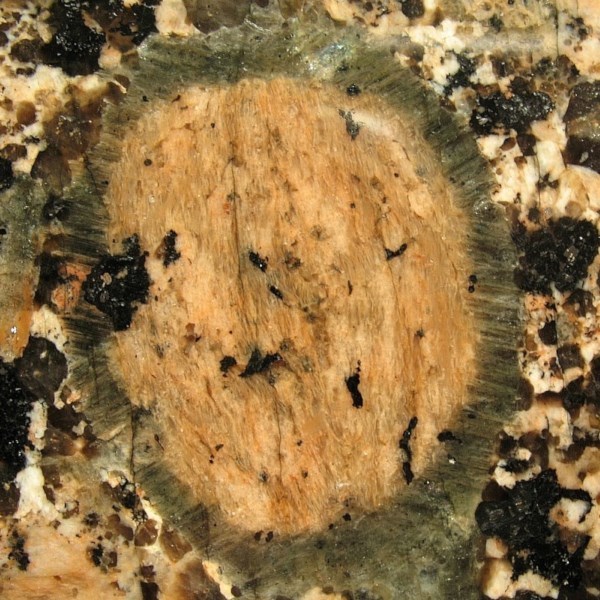
Granites where plagioclase mantles are present are described as viborgitic. Granites where plagioclase mantles are absent are described as pyterlitic.
I ask that you answer some questions. Please send them to me, and do not include them in your log. You can send them to me by using the message facility or email, both of which can be found by looking at my profile.
Please use the below picture, to aid you in completing his EarthCache, and also for you to specifically look at the correct location.
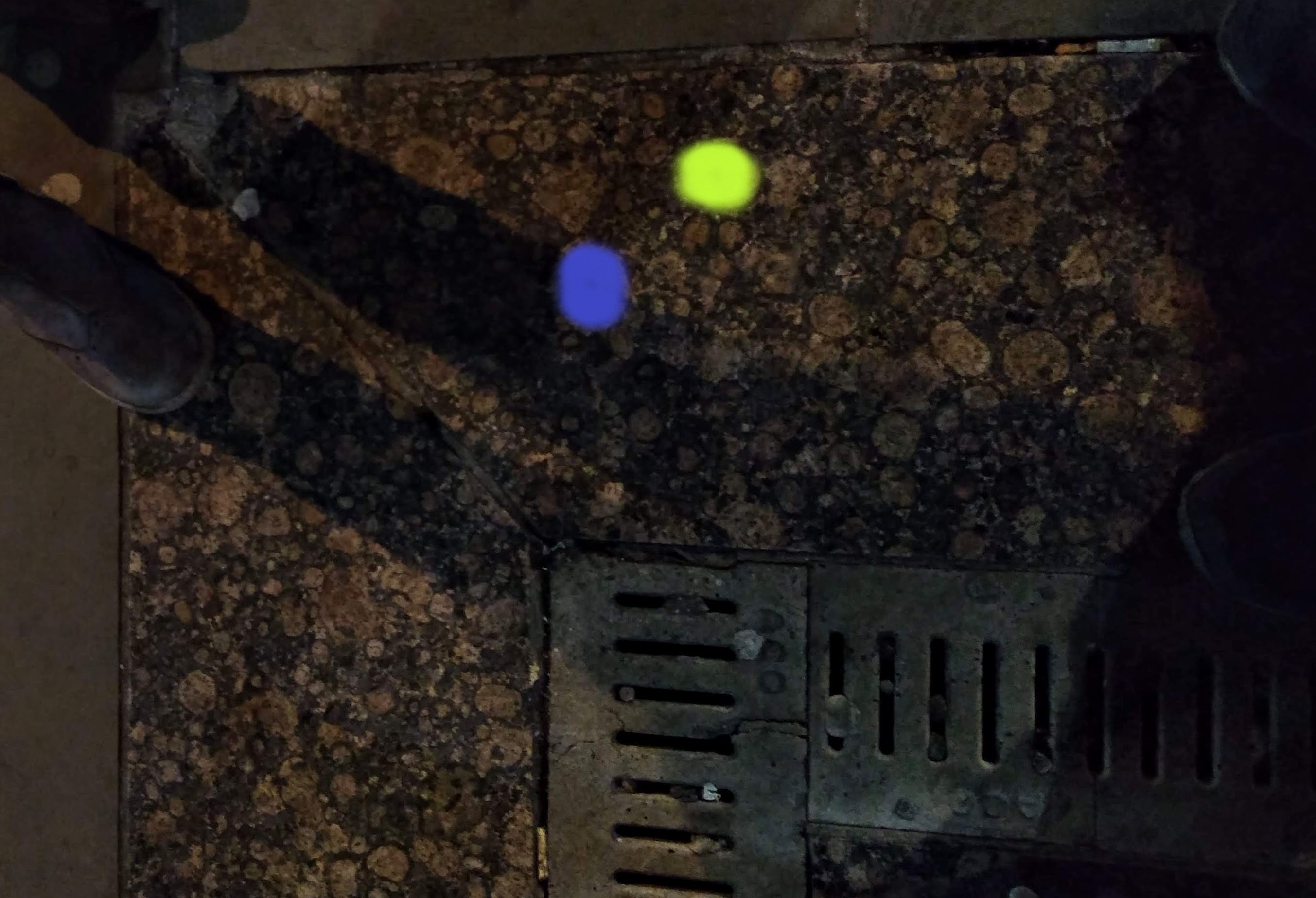
(1) Please look at the ovoid crystal indicated by the blue circle.
(a) Please tell me whether it is Viborgitic or Pyterlitic.
(b) Please describe this ovoid crystal, what colour is it, does it have a smooth border, or an irregular border, is there anything that stands out to you about his crystal? Is there any mantle, if so, what colour is it, and how wide is the line of the mantle?
(2) Please look at the ovoid crystal indicated by the yellow circle.
(a) Please tell me whether it is Viborgitic or Pyterlitic.
(b) Please describe this ovoid crystal, what colour is it, does it have a smooth border, or an irregular border, is there anything that stands out to you about his crystal? Is there any mantle, if so, what colour is it, and how wide is the line of the mantle?