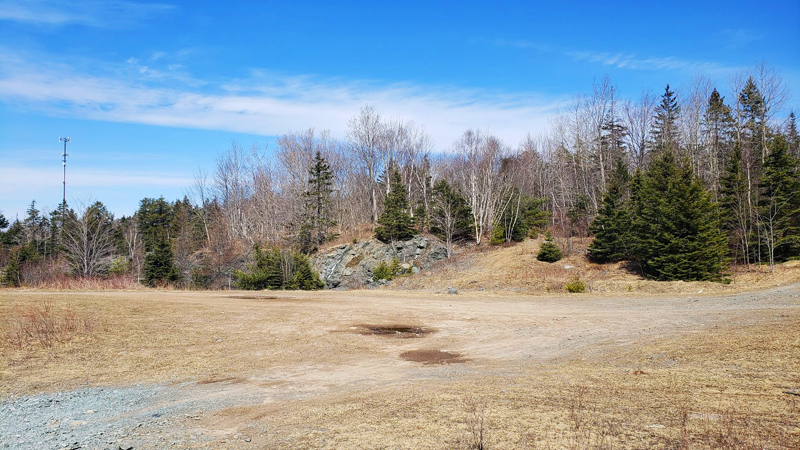
To log this earthcache, please don’t stress about answering the questions. Simply send your best attempts in a private message to me, (the cache owner), and then go ahead and log it as found.
You don’t need to wait for my approval. All attempts will be accepted.
Go ahead and have fun learning! 
- [REQUIRED] Please post a photo in your log of yourself or a personal item with the quartz vein to prove you visited the site.
- Is the quartz vein older or younger than the surrounding rock?
- Are the formations on both sides of the quartz veins consistent/mirror-images of each other? If not, what is the difference on each side?
This earthcache has been submitted for the Planetary Geology on Earth series of EarthCaches created to give geocachers the opportunity to view and learn about geological features on Earth that also exist on Mars, or other planets with documented geology.
Mineral veins such as the one found just outside of Halifax have also been found on Mars.
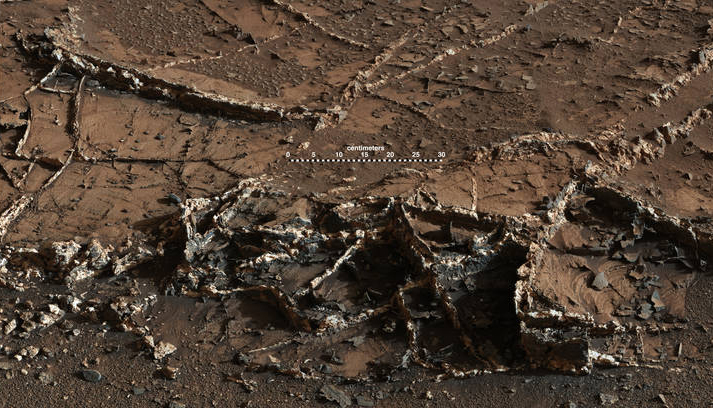
This image above was taken on March 18, 2015, and provides a view from the Mast Camera on NASA's Curiosity Mars rover showing a network of two-tone mineral veins at an area called "Garden City" on lower Mount Sharp.
Two-tone mineral veins at the Mars site offer clues about multiple episodes of fluid movement. These episodes occurred later than the wet environmental conditions that formed lake-bed deposits the rover examined at the mountain's base. The veins appear as a network of ridges left standing above the now eroded-away bedrock in which they formed. Individual ridges range up to about 2.5 inches (6 centimeters) high and half that in width, and they bear both bright and dark material.
Some of the veins looked like ice-cream sandwiches: dark on both edges and white in the middle. These materials tell us about secondary fluids that were transported through the region after the host rock formed.
In a sample taken from the Mars veins, there was a large amount of cristobalite, at about 10 percent or more of the crystalline material." Cristobalite is a mineral form of silica. The sample also contains a small amount of quartz, another form of silica. Among the possibilities are that some process removed other ingredients, leaving an enrichment of silica behind; or that dissolved silica was delivered by fluid transport; or that the cristobalite formed elsewhere and was deposited with the original sediment.
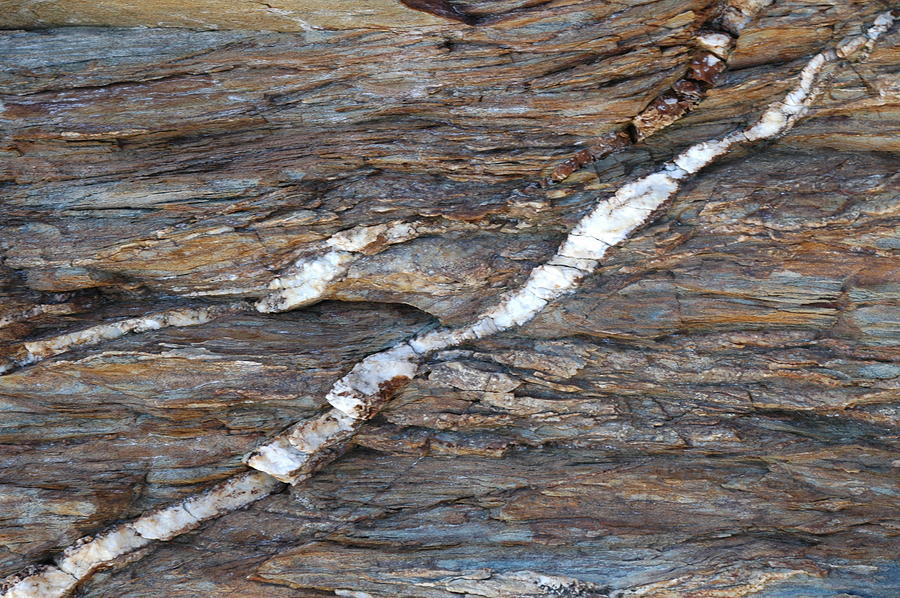
Just outside of Halifax, in the Fall River/Waverly area, is another mineral vein that we will be studying. The mineral vein found at GZ for this earthcache is a quartz vein.
Not the actual vein on site. Sample of a quartz vein:
If you look at a geology map for this area, you will see this is part of Meguma terrane's Goldenville group. Near this specific site are symbols for:
- a vein
- a shear zone
- acataclastic (shear zone) rock textures
In geology, a vein is a sheetlike body of minerals within a rock. Veins form when minerals are carried by fluids within the rock mass and deposited through precipitation. The flow is usually due to the fluid circulation.
Quartz veins are very common, they need a source of dissolvable Silicon, which is a really abundant element, especially in this area of Nova Scotia.
The formation of quartz veins needs fluids enriched in Silicon. Usually, Silicon dissolves somewhere in neighbouring formations, gets transported by fluids and precipitates where the fluid pressure is low (the fluid's Silicon-saturation capacity decreases with decreasing fluid pressure).
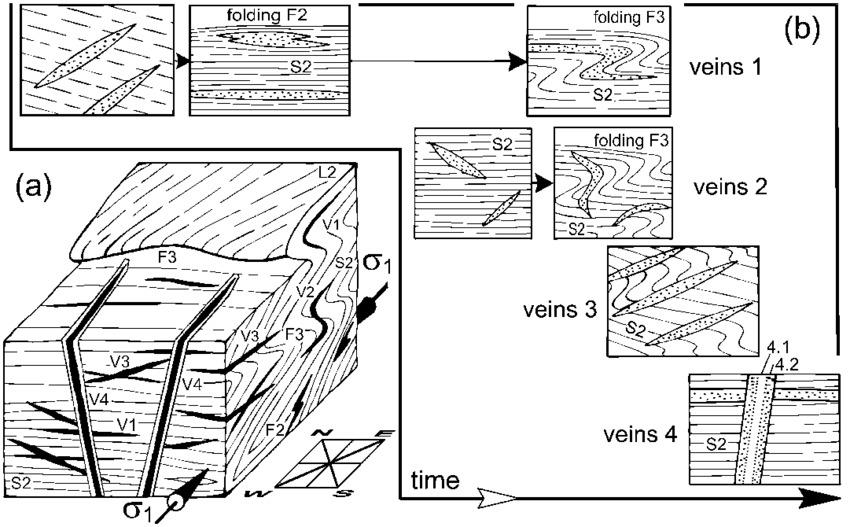
Fluid pressure is usually involved in rock fracturing. When it builds-up, it can fracture the rock. The generated fractures open up space and then the fluid pressure drops and Silicon starts to form veins. These veins reseal and restrengthen the rock, which can again lead to a renewed fluid pressure built-up. This process is known as crack-seal vein formation.
The small vein found here may have been part of a big system of fluids circulating through the rock layers in this area in the "Waverley Gold District". Nova Scotia's gold deposits are generally found within quartz veins, mainly in the noses of folds. The Waverley Gold District is directly southwest of this point, just across the highway, and the vein here may have been part of a big system of fluids circulating through the rock layers in this area.
Of note:
In Waverley, gold was first discovered in 1861. Gold in Waverley is found in quartz and required crushing equipment and chemical processes to divorce the two.
Most prospectors, when they think of hard rock gold deposits, think of quartz containing particles of gold. While gold deposits can be things besides quartz veins, gold is certainly found in the quartz of veins cutting through various types of rocks. Gold in quartz veins occurs as particles and scales scattered through the quartz, often filling cracks and openings in the vein material. The gold can be such small particles as to be invisible to the naked eye, or as larger aggregates of easy-to-see blobs, leaves, and crystals in cavities in the quartz. The gold fills cracks and spaces in the quartz as the ascending gold-bearing solutions infiltrate the existing quartz vein, filling in the last remaining openings.