This EarthCache takes you to to the outside of 27 King Street in Leeds. As an aid to help you, you need to be looking at the area indicated in blue in the photograph.
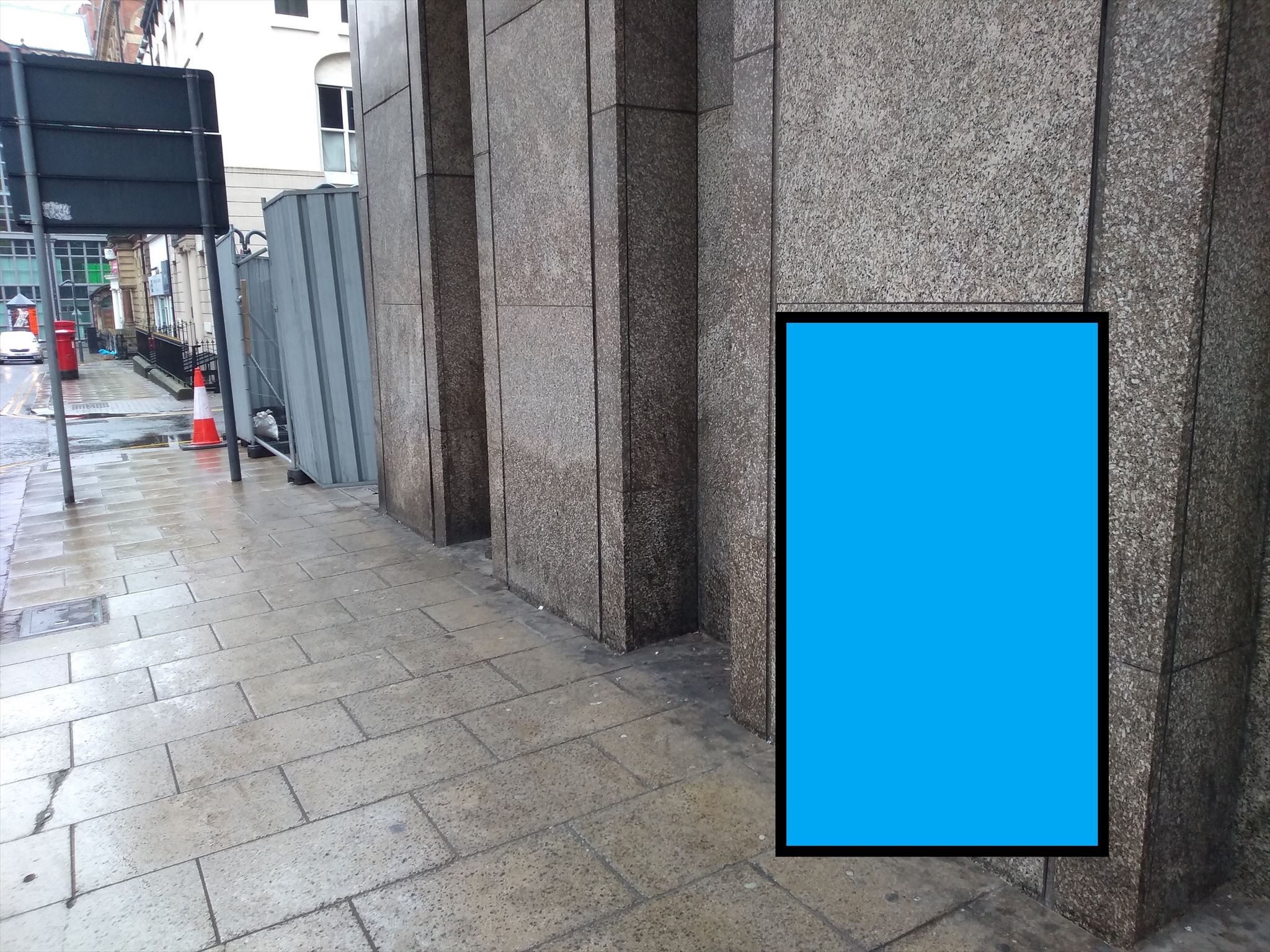
The building is built from granite, which is an igneous rock. Granite is a common type of igneous rock. Igneous rock is one of the three main rock types , the others being sedimentary and metamorphic. Igneous rock is formed through the cooling and solidification of magma or lava. Igneous rock forms by crystallisation either below the surface as intrusive (plutonic) rocks or on the surface as extrusive (volcanic) rocks. Granite can be white, pink, or gray in colour, depending on their mineralogy. Granitic rocks mainly consist of feldspar, quartz, mica and amphibole minerals, which form an interlocking matrix of crystals.
However we are here to look at the granite in more detail. We are here to look at Mafic Microgranular Enclaves, which can be abbreviated as MME.
So what are Mafic Microgranular Enclaves?
They can range from cm to metre sizes, and represent blobs of mafic magma, which have been injected into felsic host magma. Magma is the molten or semi-molten natural material from which all igneous rocks are formed. The injection of the mafic magma can happen in the magma chamber, when mixing of the two types of magma can occur. Record of this event, can be be preserved as MME, during the petrogenesis of the igneous rock. Petrogenesis means the origin and formation of rocks.
Mafic, describes an igneous rock, that is rich in magnesium, iron and calcium, and it tends to have a dark colour.
Felsic, describes an igneous rock, that is rich in feldspar and quartz, it tends to have a lighter colour.
Felsic magma tends to be more viscous than mafic magma.
As the magma flows and starts to cool, parts of it become viscous, in laymans language, thicker and sticker than other parts. When an area of non viscous magma meets an area which is more viscous, it can create friction, during this process the MME, can be subject to shear and / or compression. This can be seen in the shape of the MME in the igneous rock.
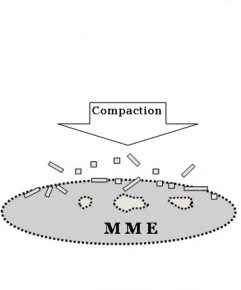
Compression, can come from any angle, but causes a round circular blob of MME to become flattened and have an elongated oval shape.
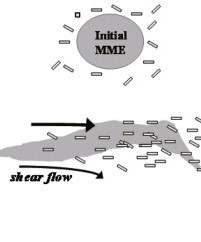
Shear, can cause the MME to become elongated and lengthened in the direction of the shear flow, as is shown in the image.
This being an EarthCache, in order to log it, I ask that you complete the below tasks. Please send the answers to me, and do not include them in your log. You can send them to me by using the message facility or email, both of which can be found by looking at my profile.
(1) Please tell me how many MME you can see in the specified location? What type of MME can you see? What is the rationale for your answer?
(2) Please describe the shape, and size of each of the MME.