Snakes and Ladders, known originally as Moksha Patam, is an ancient Indian board game regarded today as a worldwide classic. It is typically played between two or more players on a gameboard having numbered, gridded squares. A number of "ladders" and "snakes" are pictured on the board, each connecting two specific board squares. The object of the game is to navigate one's game piece, according to die rolls, from the start (bottom square) to the finish (top square), helped or hindered by ladders and snakes, respectively.
Unsurprisingly, being a game of luck, we can do some mathematical analysis on the structure of this board game. As a simple warm-up task, complete the following exercise. Please assume the following rules.
- You are the only player (how sad.)
- Your piece starts off the board. For example, if you roll a \(3\) on your first turn, your piece moves to the cell labelled \(3\).
- A move consists of rolling a standard six-sided die, moving your piece based on the number of pips on the upwards-facing side of the die, and then moving again if your piece has landed at the foot of a ladder or the head of a snake.
- To win, you must land exactly on the finishing square. If you "go past" the finish square, you stay where you are.
Here is a sample board from a game of Snakes and Ladders.
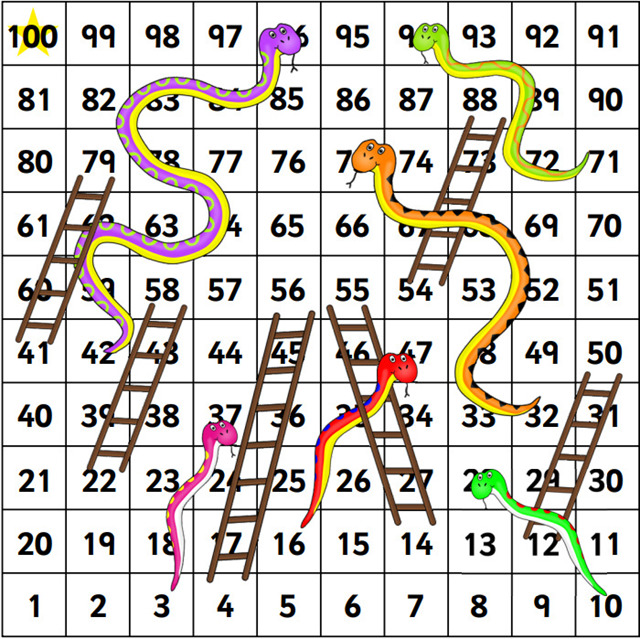
Calculate the expected number of moves it will take for your piece to reach the "victory" square.
Hopefully that was a fairly easy problem. Now, onto the real challenge! (yes, that was only a warm-up.)
I've placed \(100\) snakes and \(100\) ladders on a \(1000\)-cell game of Snakes and Ladders. They are listed below.
81→553
155→846
760→913
850→882
619→735
848→956
685→847
463→668
443→887
170→523
231→701
435→697
542→680
472→643
824→852
408→676
254→500
50→832
575→924
225→294
486→930
753→974
195→215
36→281
376→755
893→985
515→689
8→135
638→899
374→920
74→127
819→903
475→805
612→777
335→422
892→948
148→409
35→217
945→952
747→814
287→857
83→488
789→878
771→909
136→440
959→983
481→978
599→657
757→821
171→185
598→786
159→357
839→977
524→614
931→940
603→722
401→865
24→541
337→496
124→160
654→713
704→964
101→715
568→995
954→955
811→872
933→994
693→963
785→891
432→733
438→528
589→997
835→935
310→950
154→190
391→695
96→111
259→601
453→661
360→570
319→483
868→976
18→79
627→849
459→752
394→468
845→987
965→986
682→982
705→975
519→822
15→103
246→253
794→911
264→972
489→688
82→817
71→362
692→842
284→694
790→7
132→13
513→342
37→25
355→201
427→288
176→61
655→328
263→105
329→5
303→17
451→128
650→218
951→268
429→256
863→240
738→640
402→109
28→11
192→99
834→386
396→93
563→107
505→174
368→283
885→594
510→139
301→291
699→206
216→194
766→269
377→90
414→166
798→397
784→467
677→285
818→271
604→184
734→564
142→29
104→97
537→385
764→307
841→359
286→137
534→324
221→220
871→146
290→183
102→80
746→120
780→175
921→574
555→543
836→712
565→278
858→232
652→112
237→55
255→70
741→169
321→31
634→119
883→801
293→276
973→336
556→16
807→554
418→95
672→298
897→322
925→797
325→140
711→76
233→196
825→202
34→19
928→667
659→361
267→117
167→47
138→14
239→3
557→72
369→89
186→22
829→737
944→181
441→272
172→133
363→266
900→714
347→121
480→338
75→64
896→469
802→679
732→30
461→270
289→20
In addition, this game of Snakes and Ladders will be played with a five-sided die; numbered \(1\), \(2\), \(3\), \(5\), and \(8\).
Calculate the expected number of moves it will take for your piece to reach the "victory" square.
Then, write your answer as an exact fraction \(p \over q\) with \(\text{GCD}(p, q)=1\), and define \(K(b, c, m) = (pb+qc) \mbox{ mod } m\). Calculate the final coordinates as such.
N 49° 11.\(\boxed{K(46,95,372)}\)\(\boxed{K(39,29,345)}\)\(\boxed{K(59,89,757)}\)'
W 122° 11.\(\boxed{K(89,54,698)}\)\(\boxed{K(25,69,356)}\)\(\boxed{K(78,74,307)}\)'
Congratulations to huhugrub for the FTS/FTF. And congratulations also to moicy, cookie_cacher, smitranm, smitranp, Hyack, Delta Dodger, and ceesmond; the "unnecessarily large" group of guides :)