I have heard many a person saying that they live in a city, and will never see any fossils, or that they cannot physically get to fossil sites in the Dales as they are not able. Well, no need to worry, there is plenty to see in the city of Leeds itself. This EarthCache is suitable for the disabled, those with strollers and children. It is meant to be interesting and educational.
This EarthCache takes you into the Victorian Quarter of Leeds, namely into the thoroughfare that is County Arcade. Please be aware that this is a gated arcade, and the gates are locked at night, so you will have to access this location during the day. Now, County Arcade is one of the most ornate arcades in the city, and there is plenty to see, but for the subject of this EarthCache we are here to look at a certain type of limestone and a fossil within it.
It is a long arcade to look, so if you go walk halfway down the arcade to the large mosiac, then you are in the right area, you are looking for a feature low down, on a plinth and a type of fossil known as an ammonite.
The limestone you are looking for, forms the square base of a marble coloumn. Within this square base is the specific fossil. So lets first have a look at the stone that the fossil is part of.
Limestone is a sedimentary rock.
Sedimentary rocks are types of rock that are formed by the deposition and subsequent cementation of that material at the earth's surface and within bodies of water. Sedimentation is the collective name for processes that cause mineral and/or organic particles to settle in place. The particles that form a sedimentary rock by accumulating are called sediment. Before being deposited, the sediment was formed by weathering and erosion from the source area, and then transported to the place of deposition by water, or wind. Sedimentation may also occur as minerals precipitate from water solution or shells of aquatic creatures settle out of suspension.
Limestone is a sedimentary rock composed largely of the minerals calcite and aragonite, which are different crystal forms of calcium carbonate. Many,but not all limestones are composed of skeletal fragments of marine organisms such as coral, crinoids and molluscs.
This specific type of limestone is known as Rosa Verona, and indeed is called Rosa Verona marble, but it is not a marble in its true sense, as marble is a metamamorphic rock, and in most cases the process of metamorphism eradicates any trace of fossils. It is actually a highly polished limestone.
Rosa verona is a brownish red biomicritic limestone, and is commonly thought to a deeper water deposit, due to the prescence of marine organisms such as ammonites. If you compare this to the limestone that you find in the Dales, that limestone was deposited in a shallow tropical sea. It is quarried in the area of Verona in Italy.
So what does biomicritic mean?
It relates to a form of limestone, which consists of bioclasts in a micrite matrix. Bioclasts are fossil fragments, whilst micrite relates to a lime mud, which in this case has been recrystallised in limestone.
Ammonites
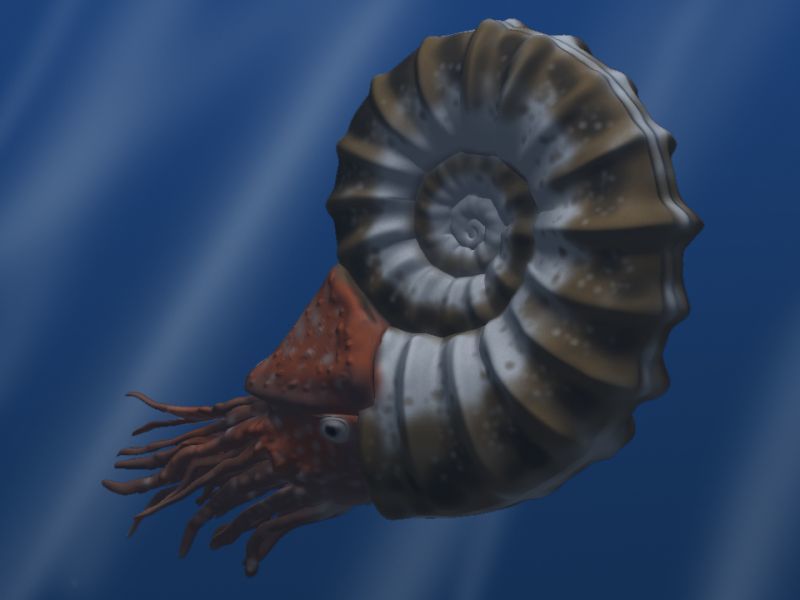
Ammonites are a group of extinct marine animals, that are related to modern day squid, cuttlefish and octupus. The living animal lived in a body chamber in a circular shell which had different chambers known as phragmocone. The circular shell consisted of a progressively larger chambers, known as camerae, with each camerae seperated from another, by thin wall called septa. Only the last and the largest of the chambers was occupied by the living animal. A thin tube passed through all the chambers, which allowed the animal to empty / fill each chamber with water, thus creating buoyancy, and allowing the ammonite to rise up and down in the water. The coiled appearance of an ammonite shell is known as planispiral.
This being an EarthCache, in order to log it, I ask that you answer the above questions. Please send them to me, and do not include them in your log. You can send them to me by using the message facility or email, both of which can be found by looking at my profile.
1. Please locate the ammonite fossil on the rosa verona plinth.
(a) Please describe its width.
(b) Please describe the fossil ammonite, in terms of how many whirls, and is there anything specific that stands out about it?
(c) Please compare it to another ammonite fossils on the nearby coloumns, is it more intact than them, or less intact.
2. Please look at the rosa verona marble that the ammonite fossil on the plinth forms part of.
(a) Please describe the colour of the limestone, and are there any feature that stand out?
search