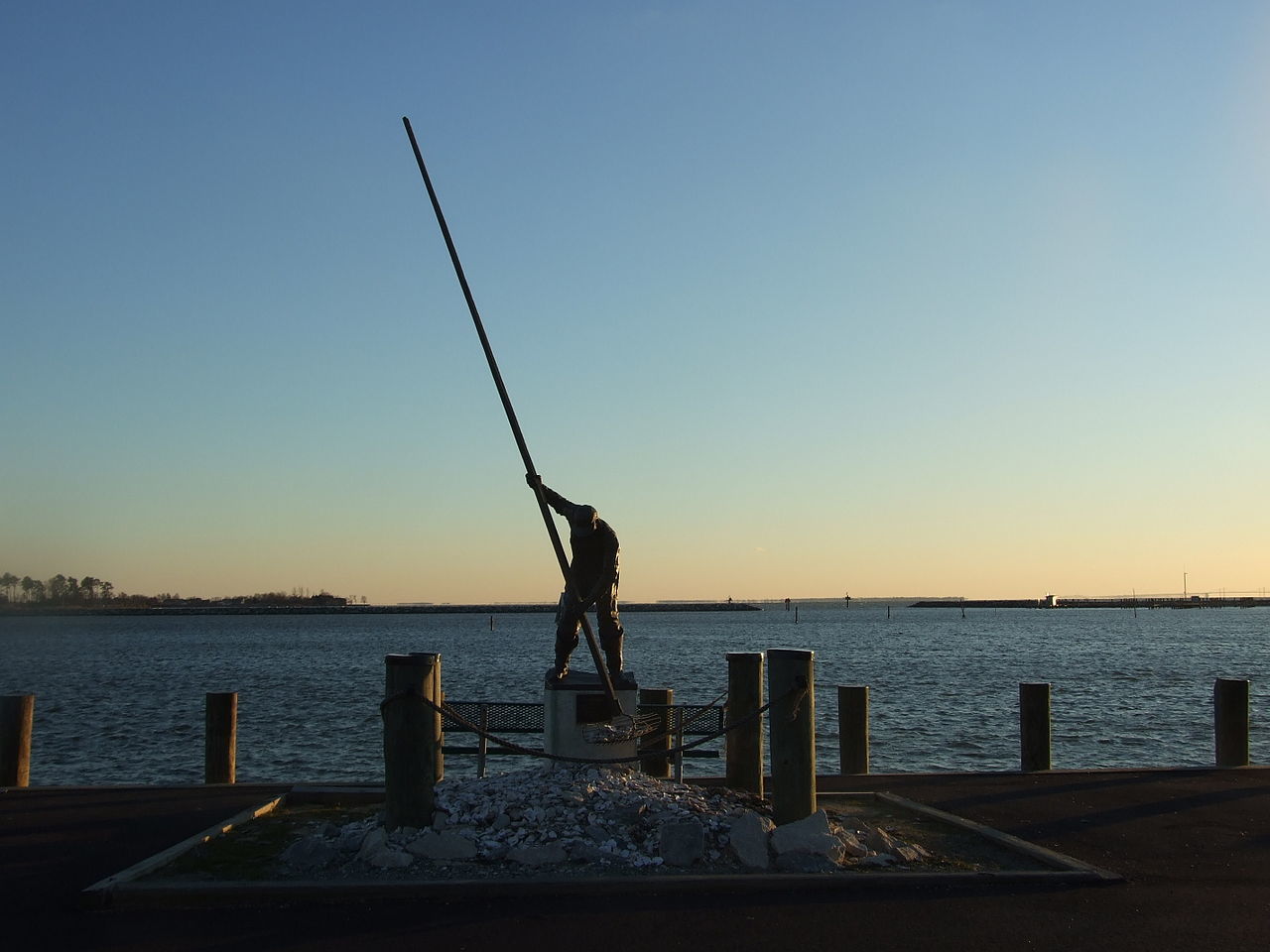
Statue of an Eastern Shore Waterman Hand Tonging for Oyster
Oysters first colonized the Chesapeake Bay around 5,000 years ago, after the rapid rise of sea level caused by melting glaciers had slowed and conditions stabilized. Very soon thereafter, people began eating oysters. The earliest evidence of oyster use found thus far in the region dates to around 4,500 years ago.
There are many types of harvest techniques on public oyster bars. In Maryland, five gear types are employed: patent tonging, power dredging, diving, hand tonging and sail dredging from skipjacks. The latter two modes are inefficient and were the only choice for more than a century.
In 1865, the Maryland legislature passed a sail-only law for dredging oysters, one of the earliest conservation statutes in the country. This law prompted the development of the bugeye and the skipjack to dredge oysters in shallow waters under sail power. It remained unchanged on the books until 1967, when it was modified to allow power dredging from a skipjack for two days a week. Then, in 1999, the law was completely overturned to allow power dredging from regular workboats (without sails), which is one of the efficient methods currently on the block.
* BYOP