
In the middle of the Gouland Downs is a limestone outcrop - the Enchanted Forest. It is worth stopping a couple of hours here to explore the wonderful limestone caves and ravines.
This earthcache will show you a cave with some interesting cave formations (speleothems). The attached DoC sketch map, DoC information and waypoints will help you find the caves.
(1) Hut cave
(2) Under-the-track caves (this earthcache)
(3) Waterfall cave & GC50175
WARNING: There are many sinkholes in the limestone, some hidden by bush. Take care at all times and if you leave the established routes, stay on high ground.
DoC recommend that you leave your backpack either at Gouland Downs Hut or where you leave the track, to avoid accidentally damaging the cave formations.
* BRING A TORCH – you will need it to look at features inside the caves.
* You will need a camera for the final logging task.
* Read through the cache description and logging tasks before you start the Heaphy, so you know how to get to GZ and what information you're looking for.
* PRINT OUT THE CACHE DESRIPTION AND PICTURES AND TAKE IT WITH YOU - it is too long to read on a GPS.
* You will need to schedule enough time to explore the area properly.
.
 |
|
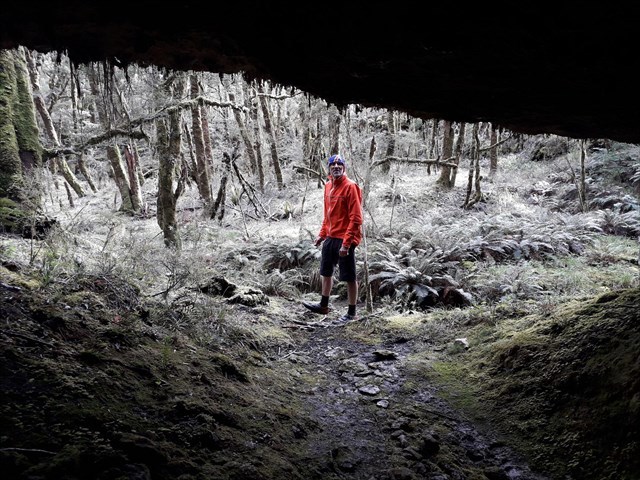
View of Enchanted Forest from GZ, inside the Second Under-the-Track Cave
Photograph this same view, with your GPS or personal item, and post the photo with your log.
|
HOW TO FIND THE "UNDER-THE-TRACK" CAVES AND GET TO GZ:
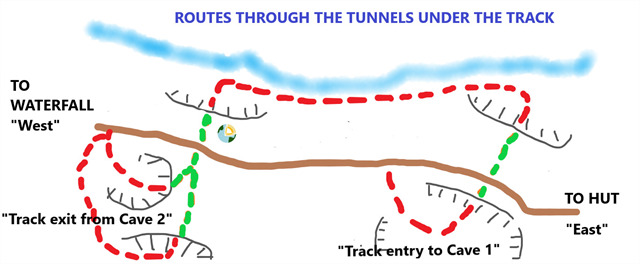
The GZ for this earthcache is inside the second "Under-the-track" Cave. To get there, follow this route recommended by the DoC ranger. It takes you through both the two small caves that cross under the Heaphy Track:
- From Gouland Downs Hut, follow the main Heaphy Track into the Enchanted Forest.
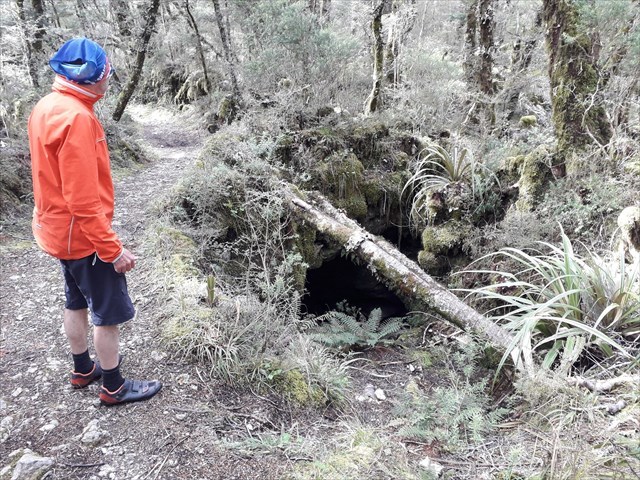
- In the forest, around the first bend of the track, on your left (SW side) you will see a muddy streambed at the bottom of a steep gully.
- At the "Track entry to Cave 1" waypoint, find the well-used route down on the left (SW) of the Heaphy Track. Clamber down the steep bank to the stream bed.
- Go through the First Under-the-track cave (under the Heaphy Track). It will be more-or-less muddy, depending how much rain there's been.
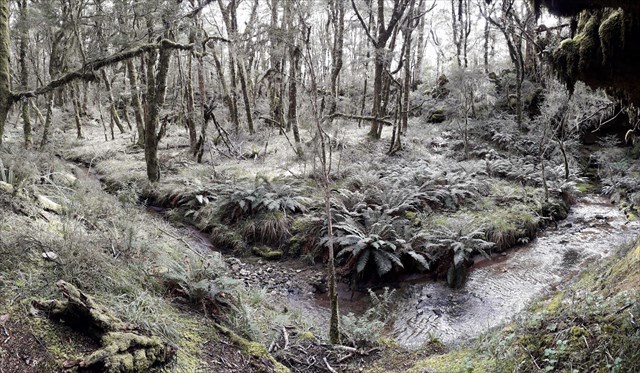
- On the other side of the first cave, (NE side of Heaphy Track) there is a small stream.
- Turn left and follow the stream 30 m to the second cave. This second cave is the earthcache GZ.
- Look around inside the cave; do the logging tasks; take a photo of the Enchanted Forest from inside the cave entrance.
- Continue through the Second Under-the-track cave, which crosses back under the Heaphy Track.
It is a bit of a scramble up out of the back of the cave, but perfectly safe.
- You will come out at the bottom of a sinkhole, formed by collapse of the cave's ceiling.
Clamber up the bank to your right to get back onto the main Heaphy Track at the "Track exit from Cave 2" waypoint.
Exploring the two Under-the-Track Caves
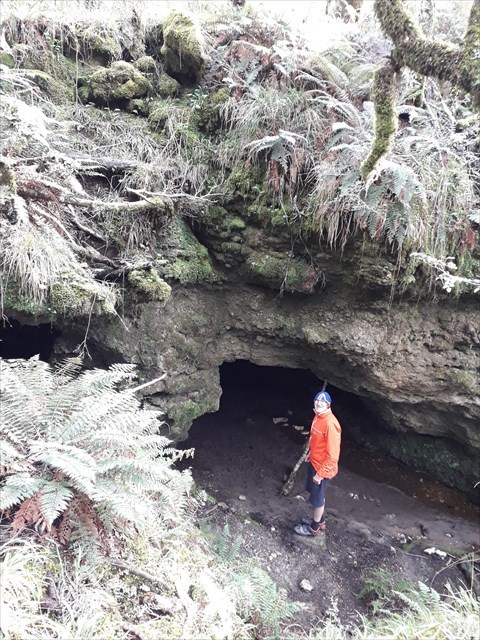
| From "Track entry to Cave 1" WP, at left of track, go down into First cave |
Go through First Under-track cave and out the other side |
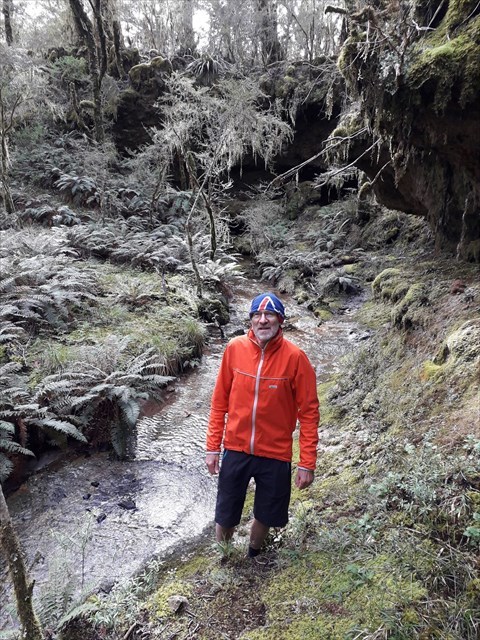
Turn left, follow the stream 30 m to GZ at Second cave |
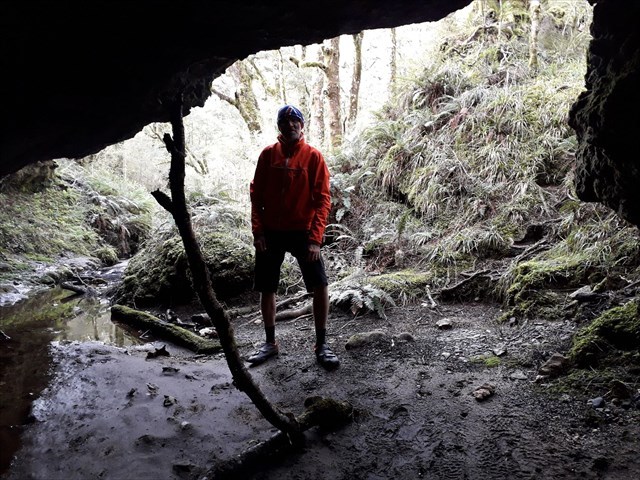
View from GZ inside Second Under-track cave |
Go through Second cave and climb out this sinkhole, back to the Heaphy Track |
 |
 |
 |
|
 |
LOGGING TASKS
Types of cave formations are described further down the page.
(1) What type/s of speleothems (cave formations) can you see inside this cave?
(2) Describe the location of spelothems (cave formations) inside this cave.
(3) Look at the speleothems ON THE CEILING OF THE CAVE, AT HEAD HEIGHT. Why do you think this type of speleothem formed here?
(4) Take a photo looking out of the cave entrance at the Enchanted Forest, including you, your GPS, a trackable or other personal item, and post this photo with your log.
Please email or message us your answers to the earthcache questions and log your find at the same time. Only post the photo with your log. If you cannot send the answers immediately then it would be better to log a note about your visit, and then change your note to a find log when you do send the answer email. Your log date will be the day you visited the caves. If your answers are incorrect or incomplete you will be asked to provide more details.
WHAT IS A SPELEOTHEM?

Speleothems (also called cave formations or cave decorations) are cave features formed by the deposition of minerals. The word speleothem comes from the Greek words spelaion meaning "cave" and thema meaning "deposit". They are common in limestone solution caves, such as the caves in the Enchanted Forest.
Under the right conditions, water that drips from the cave roof and walls deposits calcite to create the cave decorations that adorn so many limestone caves. Like the creation of limestone caves, the formation of speleothems inside the caves depends on the levels of carbon dioxide in the rainwater, in the soil and in the cave air.
HOW SPELEOTHEMS FORM
Groundwater seeping into caves carries dissolved limestone
Rainwater absorbs carbon dioxide from the air and from the soil, forming a weak solution of carbonic acid. This acidic water reacts with calcium carbonate, the main component of limestone, to form soluble calcium bicarbonate [Ca(HCO3)2]. Now the acidic groundwater carries the minerals from the dissolved rock.
As this groundwater seeps through the rock, it holds the dissolved calcium bicarbonate [Ca(HCO3)2 ] and carbon dioxide [CO2] in equilibrium with the concentration of calcium carbonate [CaCO3] and carbon dioxide [CO2] in the surrounding rock. It will stay that way until the equilibrium is upset.
Mineralised groundwater reaches a cave and loses carbon dioxide gas into the cave air
Eventually the mineralised groundwater reaches the roof or wall of a cave where it meets the air inside the cave. This mineralised water contains a much higher concentration of dissolved carbon dioxide [CO2] than the air in the cave.

A substance will always diffuse from a region of higher concentration to a region of lower concentration. One example we are all familiar with is a bottle of fizzy drink, which has a lot of carbon dioxide dissolved in the water. The air has much less carbon dioxide gas in it. Once you open the bottle and expose the fizzy drink to the air, the excess carbon dioxide gas bubbles out of the fizzy drink into the air.
Loss of carbon dioxide (CO2) from the mineralised water drives precipitation of calcite (CaCO3)
As soon as the mineralised groundwater comes in contact with the cave air, some of the carbon dioxide [CO2] in the surface layer of the water is released and lost into the air of the cave.
This upsets the chemical equilibrium of the mineralised groundwater. The water becomes supersaturated, which means it cannot hold on to all the dissolved calcium bicarbonate [Ca(HCO3)2]. This causes some of the dissolved calcium bicarbonate to change to insoluble calcium carbonate [CaCO3] which is deposited on the cave’s surface, as shown by the chemical reaction below:
Ca(HCO3)2 → CO2 + H2O + CaCO3
calcium bicarbonate → carbon dioxide + water + calcium carbonate (calcite)
in groundwater lost to the air flows away deposited on cave roof/wall
 Evaporation of mineralised groundwater will also leave calcite deposits
If there is air flowing through a cave, then evaporation may also help to form speleothems. We have all done the experiment leaving a bowl of saltwater for several days, and know that the water will all evaporate, leaving salt crystals behind.
In the same way, as a film of mineralised groundwater seeps through the ceiling of a cave, a breeze flowing though the cave will evaporate the water, leaving the minerals behind.
The calcite crystals deposited on the cave surface by evaporation form characteristic types of cave decoration. Cavers who are exploring new caves look for these special cave decorations, because they show there is air movement through the cave causing evaporation. If there is airflow, it means that there will be a passageway out of the cave at the other end.
DIFFERENT TYPES OF SPELEOTHEMS
Speleothems form at varying rates as calcite (calcium carbonate) crystals build up. Several factors can determine the rate of growth. Two important factors are the temperature outside (which affects the rate of decay of plants and animals, hence the amount of carbon dioxide in the soil), and the amount of rainfall. The shapes of speleothems are determined by how the mineralised water enters the cave (by dripping, seeping, or splashing), whether there is air movement inside the cave that may cause evaporation, and how the water flows or ponds after entering the cave.
Types of speleothems include:
 STALACTITES: Pointed pendants of calcite hanging down from the cave ceiling.
Remember that a stalaC-tite holds “tite” to the Ceiling.
A stalactite forms when mineralised water reaches the cave ceiling at the end of a joint. Calcite is deposited in a wide area around the end of the joint. The percolating water flows down the sides of the developing stalactite, precipitating calcite all the time. The stalactite forms a conical structure, widest where it is attached to the ceiling where most calcite is precipitated, and tapering downwards. It can take a very long time for a stalactite to form – they usually grow only about 10 cm every 1000 years.
 STALAGMITES: Upward-growing, massive calcite mounds deposited from drip water, often immediately below a stalactite. Remember that a stalaG-mite “mite” be on the Ground.
As a film of saturated dripwater (about 0.1 mm thick), moves down from the stalagmite tip to its sides, calcite is deposited over the whole surface of the stalagmite. The shape of stalagmites is mainly determined by the drip rate, the distance the drop falls from the stalactite above, and the amount of calcite in the dripwater.
If the water drips rapidly, more calcite will be deposited on the cave floor than the ceiling, so that the stalagmite will be longer than the stalactite. If the water drips slowly, more calcite is precipitated on the ceiling than the floor and the stalactite will be longer than the stalagmite.

COLUMNS: Pillars of calcite that extend from the cave floor to the ceiling, formed when a stalactite and stalagmite join. The water that drips from the end of a stalactite splashes onto the top of the stalagmite growing below. Calcite is deposited both at the end of the stalactite and on the top of the stalagmite. If the water drips rapidly, more calcite will be deposited on the cave floor than the ceiling, so that the stalagmite will be longer than the stalactite. If the water drips slowly, more calcite is precipitated on the ceiling than the floor and the stalactite will be longer than the stalagmite. In time, if calcite-rich water continues to drip, the stalactite and stalagmite will eventually meet to form a column, as shown in the diagram below:

 CAVE POPCORN: Also known as "coralloids" or "cave coral". Small, knobby clusters of calcite, sometimes covering large sections of roof or walls. These are often formed by seepage from the underlying rock, where calcite-laden moisture wicks through to the outer surface of a popcorn knob and evaporates to leave another layer of calcite. Cavers often use the presence of cave popcorn as an indication that there is air movement through the cave, causing evaporation.
 FLOWSTONES: These attractive formations occur when flowing water leaves a sheet of calcite covering the original cave wall or floor, often to a considerable thickness. Flowstones tend to be formed when there is a relatively high seepage or dripping of water carrying a low load of dissolved calcite. The calcite precipitation is controlled by degassing over a large surface area, possibly helped by a more turbulent flow that allows carbon dioxide to be lost faster from the water.
 HELICTITES: Small irregular growths which proceed in any direction contrary to gravity. Helictites are named from the Greek word helix, meaning 'a twist'. They are formed by water slowly entering the caves through pores and cracks in the limestone. The most accepted theory for their growth and development is a combination of capillary action and hydrostatic pressure. The saturated solution emerges from a pore so slowly that it doesn't form a drop. Evaporation occurs and a minute layer of crystal is deposited. A capillary tube slowly develops, through which the solution is drawn, extending the helictite. Because no drop forms, gravity has no effect and the helictite can develop in any direction, defying gravity.
Plus, you might find fossil scallop shells in the limestone:

The rock here is Nile Group limestone, between 33.7 and 23.8 million years old. It contains marine fossils.
Shine your torch around the cave walls and see whether you can spot a fossil scallop shell.
Information:
