Håfa Adai! and welcome to Ypao Beach and Governor Joseph Flores Beach Park. If the main parking lot is full, an additional parking lot is also available on the West side of the park. Both parking lots are free of charge. Waypoints for both are shown below.
⚠️ ARCHAEOLOGICAL ADVISORY ⚠️
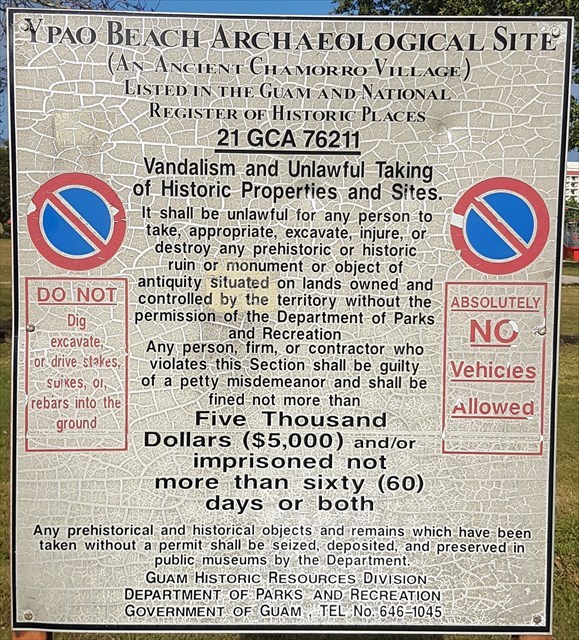
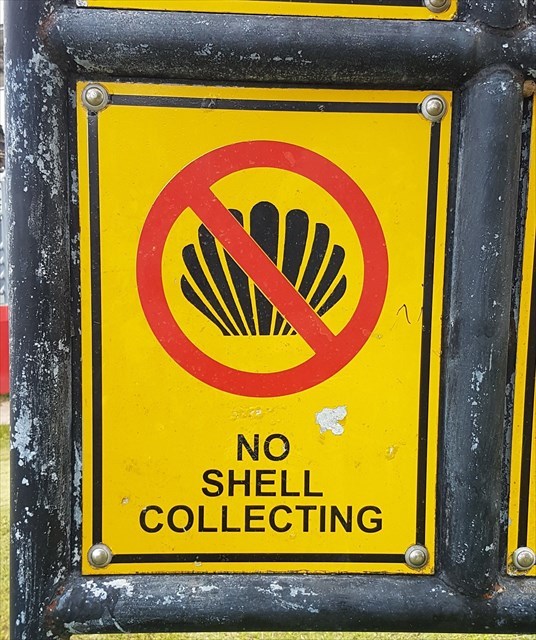
The location you are visiting was previously the site of an ancient CHamoru village and an archaeological excavation site. Please be mindful of the following information posted around the park:
What is coral?
Corals are biological animals that have tiny, tentacle-like arms used to capture their food from the water. They are generally categorized as being either SOFT or HARD. As the name implies, soft corals are soft and often resemble plants and trees under water. Hard corals however are made up of hundreds to thousands of tiny coral creatures called polyps. Each soft-bodied polyp secretes a hard outer skeleton of limestone (calcium carbonate) that attaches to either a rock or to the dead skeletons of other polyps. These groups (colonies) of polyps grow, die, and endlessly repeat the cycle over time, slowly laying the limestone foundation for geological coral reefs. This Earthcache looks at Guam's coral reefs.
Importance of coral reefs
Coral reef surrounds much of the island. Reefs form a natural barrier protection for the coastline against storm surges, coastal erosion, and high waves. They help reduce wave energy, up to 90 percent during low tides, making waves smaller and slower. During tropical storms, typhoons, and tsunamis, coral reefs can reduce the height of waves by about half. This helps protect not only the beachfront hotels and businesses that people depend on, but also the very beaches that attract visitors in the first place. Coral reefs are also important to Guam because, as the most diverse marine ecosystems on earth, they supply food and shelter to the fish that many people need, both culturally and for sustenance. Coral reefs are unique in that they cover less than 0.5 percent of the earth's surface, but are home to an estimated 25 percent of all marine species.
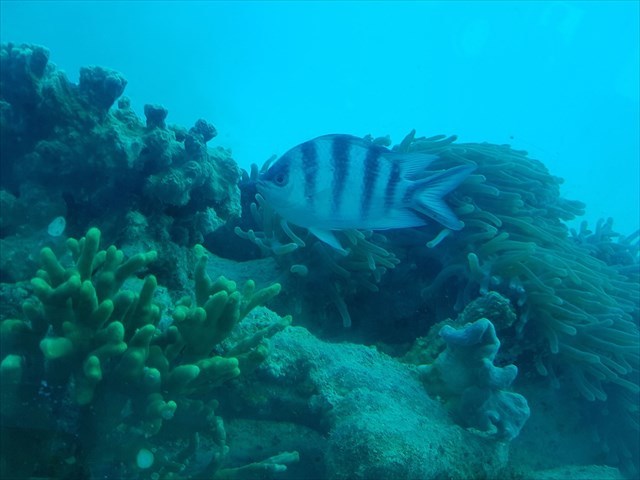
Hard and soft coral at Piti, Guam
The problem
Because of its cycle of growth, death, and regeneration among individual polyps, many coral colonies can live for a very long time. Since 2013 however, Guam’s coral reefs have been disappearing at a faster rate than they can grow. Several factors are causing this phenomenon:
1) rising ocean temperatures: University of Guam researchers report that more than 1/3 of Guam's coral reefs (34%) died between 2013 and 2017 because of warmer ocean temperatures. Coral bleaching occurs when water temperatures rise, causing stressed corals to spit out the algae living in their tissues that gives them their distinct colors. It’s also their primary food source. This results in the coral having a white, or “bleached” color. Corals can survive a bleaching event, but become severely weakened and can easily succumb to illness or death from other stressors.
2) run-off: Land-management practices and tropical storms contribute to erosion and chemical run-off. The delivery of sediment and pollutants to coral reefs blocks light, inhibits photosynthesis, and smothers coral. The 2004 Status of Coral Reefs of the World report identified sediment run-off as the major stressor to reefs surrounding Guam, the Commonwealth of the Northern Mariana Islands, and Hawai'i. Guam’s northern reefs are generally considered to be in better condition than its southern reefs, because the northern reefs don't experience as much run-off as the southern reefs do.
3) human interaction: Tourism can have a large impact on the health of coral reefs. Unaware snorkelers and scuba divers are sometimes tempted to touch coral for the experience or a memorable picture. This can easily cause damage. Accidentally striking coral with snorkel fins or dive equipment can also very easily cause damage. Walking across or standing on hard coral causes high amounts of damage. While usually unintentional, these occurrences lead to coral breakage, physical injury, and death. In addition, injured corals are more susceptible to diseases.
4) predators: A starfish having up to 23 arms called “Crown of Thorns” is a natural predator of Guam coral, and can eat up to 65ft2 (6m2) of living coral each year. Outbreaks of these coral-eating sea stars, which sometimes involve thousands of sea stars on one reef, appear to be occurring more often and may be more devastating to reefs than in the past.
Impact on Guam
University of Guam scientists reported that about 60% of the reefs along Guam's eastern coast were gone as of July 2019. The loss of Guam's coral reefs would impact its economy, food supplies, and the safety of its coastal communities. Without the coral reefs the ocean would also not be able to absorb as much carbon dioxide, leaving more CO2 in the atmosphere.
Restoration Efforts
Coral reef restoration aims to preserve vulnerable coral species and rehabilitate damaged reefs. Various reef restoration techniques are being tested and developed on Guam to help its reefs recover. Two local examples include:
- Microfragmentation: This is the act of cutting a piece of coral into several small coral fragments to trigger rapid coral growth and minimize how much coral needs to be removed from a donor parent colony. If the microfragments come from the same parent colony, they can fuse back together to form a larger juvenile colony. After it grows large enough, the coral can become sexually mature and continue to grow the reef.
- In 2013, the University of Guam Marine Laboratory, Underwater World Guam, and SECORE International established an ocean coral nursery in Guam’s Piti Bomb Holes Marine Preserve. The nursery cultures both juvenile and microfragmented corals for rehabilitation and replanting. In 2019, a second nursery was established in Cocos Lagoon: the Merizo coral nursery.
Claiming the cache
From the posted coordinates you will be able to see all of Tumon Bay, from Hospital Point (on the LEFT) to Two Lover’s Point (on the RIGHT). Look down and you will notice a line of broken and bleached coral limestone spread across the beach. Feel free to examine a few pieces to observe how individual polyps build and exist on top of each other to create these "rock" formations. Just remember not to take anything off the beach so you'll need to put them back afterwards.
For comparison, look out over the bay to find some live coral colonies. They'll look like groups of big rocks in the water. Further out, you'll notice the exposed coral reef line surrounding Tumon Bay. You can see for yourself the amount of energy in the waves crashing over existing reef, and what occurs afterwards.
To log this Earthcache please message me the following answers:
Task #1: Take a minute and look at the live coral colonies out in the bay. Describe their colors compared to what you see on the beach.
Task #2: Looking out across the coral reef line, can you observe any areas of disappearing reef where waves are passing over them more easily… or is the coral reef blocking the same amount of wave energy across the bay?
Task #3: Now that you've seen in person how waves react to the coral and reef, how different do you think the beaches and tourist area of Tumon would look if the coral reef in front of you disappeared (see "importance" paragraph above).
Task #4: (optional) Give yourself a lasting memory of your experience here by taking a picture at the Photo Attraction Waypoint and posting it in your log.
Si yu’os ma’åse’ for visiting this Earthcache. You can log your find immediately. However, please send me your answers to the tasks above within a reasonable amount of time. Otherwise, your log may respectfully be deleted for not meeting Earthcache requirements.
Logs containing the required answers will be deleted.
🥇 Congratulations to Kiwi_Eagles on the FTF !!!