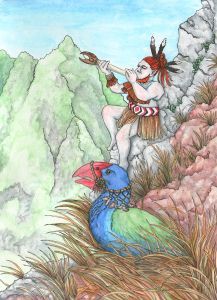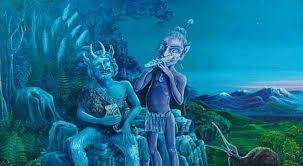
In Māori mythology, patupaiarehe are pale-skinned, fair or red-haired spirit beings that live in deep forests and mountaintops in New Zealand, and are sometimes hostile to humans. Ethereal flute music and singing sometimes reveals their presence. They are known as iwi-atua, or supernatural people. They are usually described as having the same stature as ordinary people. They can draw mist to themselves, but tend to be nocturnal or active on misty or foggy days, as direct sunlight can be fatal to them. They prefer raw food and have an aversion to steam.
Patupaiarehe, also referred to as Tūrehu, Ngāti Hotu and Urukehu (red heads), were said to live in large guarded communities. They tended to occur in certain localities, especially hilly or mountainous regions. In the North Island, these included Mt Pirongia in the Waikato, the Coromandel Range from Mt Moehau to Mt Te Aroha, the Rotorua hills, the Urewera Ranges, and the Waitakere Ranges near present-day Auckland. In the South Island, they inhabited the hills of Banks Peninsula, the Takitimu Range, and the hills between Lake Brunner and the Arahura River. Another little-known term for these fairy-like folk was pakehakeha, which has been suggested as a possible origin of the word Pākehā, used to refer to Europeans.