HORN CORAL FOSSILS
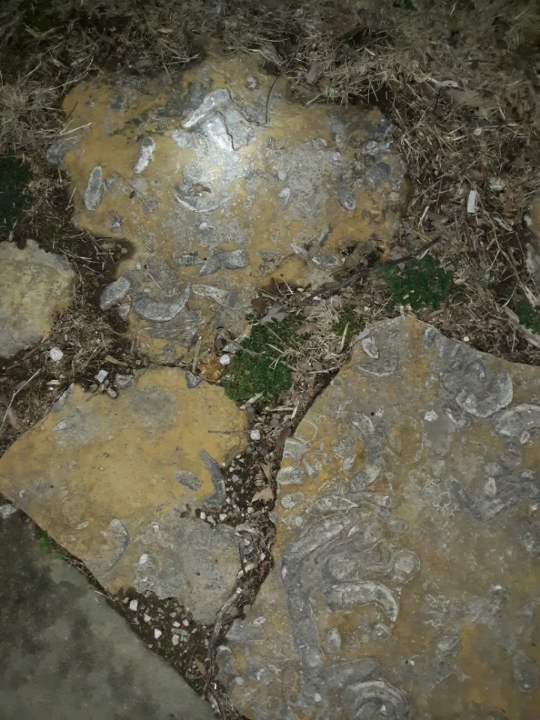
On the ground at these coordinates you will find several pieces of limestone with horn coral fossils in them. To get credit for this earthcache plese send me the answers for the following questions? Please send answers before logging as a found. Group answers are allowed, just state in the email whom all is in the group.
1. Measure the largest horn coral fossil you can find and send me the size in length and width.
2. What kind of rock are these fossils in?
3. How old are these fossils?
4. Are these fossils tabulate or rugose coral?
5. Please post a picture with your log of yourself, or your keys, gps, etc with the schoolhouse in the background. This is for confirmation that you was there.
As fossils, corals are found worldwide in sedimentary rocks. Based on these fossils, we know that the corals began their long evolutionary history in the Middle Cambrian, more than 510 million years ago. In Kansas, they are fairly common in Pennsylvanian and Permian rocks, deposited from about 323 to 252 million years ago.
Modern corals inhabit deep-water environments as well as shallow reefs. Based on evidence from the rocks, scientists have determined that the Pennsylvanian and Permian corals of Kansas lived in warm, shallow, sunlit waters where the bottom was firm enough to offer a secure point of attachment.
Two groups of corals were important inhabitants of the Pennsylvanian and Permian seas—tabulate and rugose corals. Tabulate corals were exclusively colonial and produced calcium carbonate skeletons in a variety of shapes: moundlike, sheetlike, chainlike, or branching. Tabulate corals get their name from horizontal internal partitions known as tabulae. Some tabulate corals were probably reef builders (but not in Kansas).
A common characteristic of rugose corals, from which they get their name, is the wrinkled appearance of their outer surface. (Rugose comes from the Latin word for wrinkled.) Rugose corals may be either solitary or colonial. Because solitary rugose corals are commonly shaped like a horn, these fossils are sometimes called horn corals.
Both tabulate and rugose corals died out in the major extinction that occurred at the end of the Permian Period, roughly 252 million years ago. This extinction marked the end of the Paleozoic Era. The corals that inhabited the post-Paleozoic seas differ significantly from the earlier corals. Because of this, many specialists argue that these later corals may not be closely related to the Paleozoic corals.
Tabulate and rugose corals are common in eastern Kansas. Rugose corals are especially common in the Beil Limestone Member of the Lecompton Limestone in the vicinity of Sedan, Kansas.
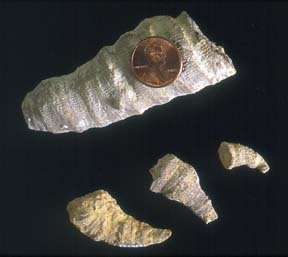
These Pennsylvanian rugose corals belong to the genus Caninia torquia, from the Beil Limestone Member, Lecompton Limestone, Douglas County.
REFERENCES: http://geokansas.ku.edu/