I have heard many a person saying that they live in a city, and will never see any fossils, or that they cannot physically get to fossil sites in the Dales as they are not able. Well, no need to worry, there is plenty to see in the city of Leeds itself. This EarthCache is suitable for the disabled, those with strollers and children. It is meant to be interesting and educational.
This EarthCache takes you to Wellington Street in Leeds. We are here to look at the cladding of the building. The cladding is formed from limestone. Limestone is a sedimentary rock.
Sedimentary rocks are types of rock that are formed by the deposition and subsequent cementation of that material at the earth's surface and within bodies of water. Sedimentation is the collective name for processes that cause mineral and/or organic particles to settle in place. The particles that form a sedimentary rock by accumulating are called sediment. Before being deposited, the sediment was formed by weathering and erosion from the source area, and then transported to the place of deposition by water, or wind. Sedimentation may also occur as minerals precipitate from water solution or shells of aquatic creatures settle out of suspension.
Limestone is a sedimentary rock composed largely of the minerals calcite and aragonite, which are different crystal forms of calcium carbonate. Many,but not all limestones are composed of skeletal fragments of marine organisms such as coral, crinoids and molluscs.
There are plenty of EarthCaches which describe limestone, we are here to look at a fossil, to be more specific - Architectonica.
Architectonica
Architectonica, was part of a classification of shelled animals known as Gastropods. Gastropods, are a very successful speices, which has evolved to live on dry land and in the marine environment. Commonly known examples are slugs and snails. The common name for Architectonica are staircase shells or sundials.They lived in a shallow marine environment, to be more specific in the subtidal area, which means below the low tide mark, and were a carnivore, which means they ate other animals. They had a coiled shell, wth each spiral being known as a cord, when seen from the side, they were trigonal, which means shaped like a triangle.
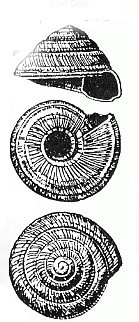
This being an EarthCache, in order to log it, I ask that you answer some questions. Please send them to me, and do not include them in your log. You can send them to me by using the message facility or email, both of which can be found by looking at my profile.
Now the Architectonica fossil is not a big one, so don't expect T Rex here, but it is a good example of this type. You need to be looking in the blue area to find the fossil.
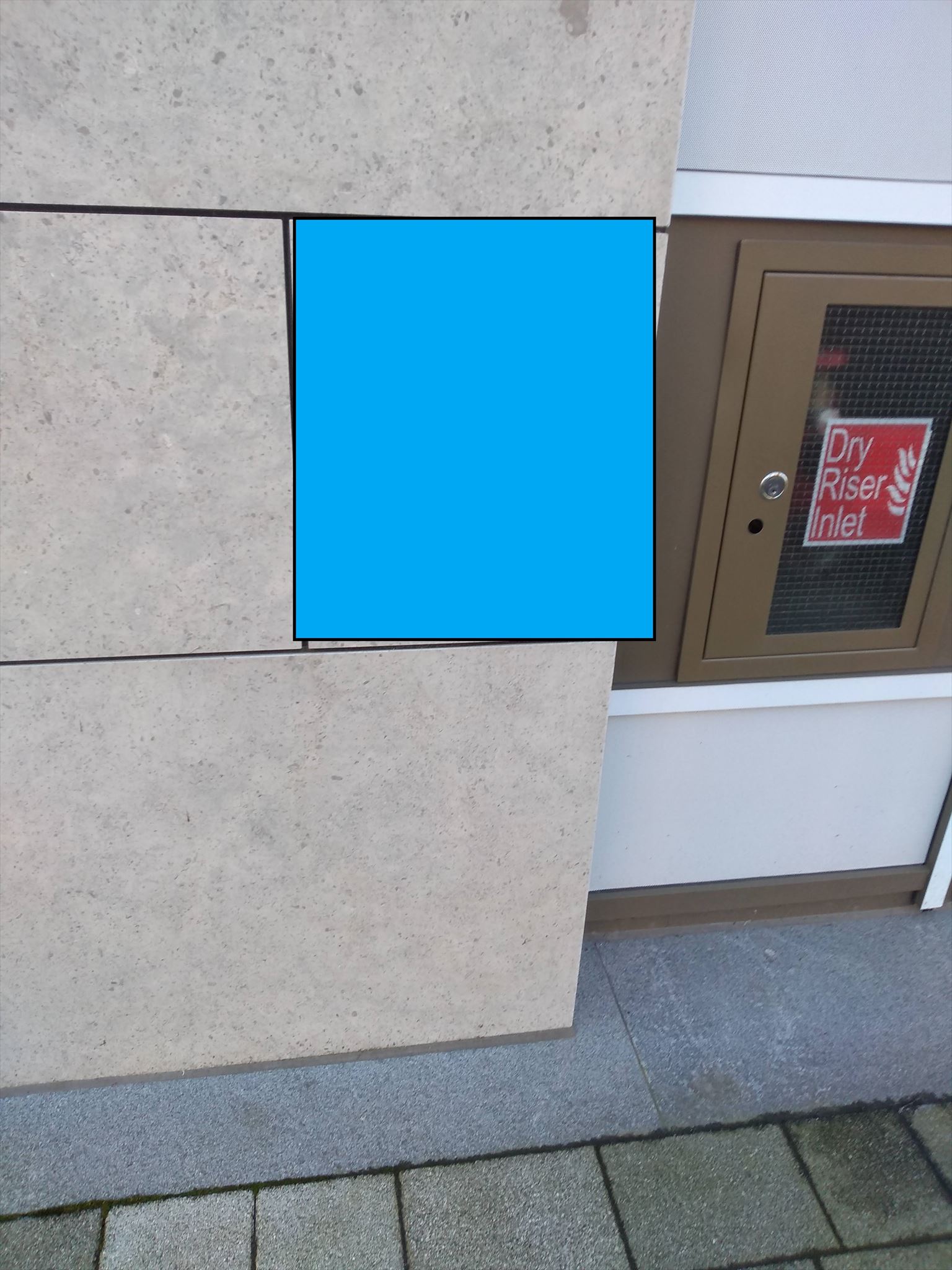
1. Please tell me how many Architectonica fossils you can see here?
2. Please find the largest Architectonica fossil and describe its diameter, and how many spirals it has.
3. The 2nd and 3rd spiral have something specific about them, what is this? You may find this task easier if you take a photograph and enlarge it.
4. Using the above information, what type of environment was this limestone laid down in?