I recently discovered two interesting websites about Hillsboro’s architecture and history:
Cultural Resource Map and List
Hillsboro Cultural Resource Inventory
These list dozens of properties noteworthy for their distinctive architecture, careful preservation, and/or early occupants. I’m highlighting some of these properties in two walking tours.
Here is a link to the second: GC8KT1J - Hillsboro History Tour #2
You will walk about four tenths of a mile to gather the information. The final is about one third of a mile from the last waypoint. All waypoints are wheelchair accessible, but the final may be just out of wheelchair reach.
The finals for the two Hillsboro History Multis are close together so, if you want to get them both, it might be easier to gather the information from both multis and then get the finals together.
Please note: The houses are all private property. Please be respectful and stay on the sidewalk. Bagley Park is only open from dawn to dusk.
If you are a fan of architectural detail, check out the Hillsboro Cultural Resource Inventory It has much more architectural and historic information than I’ve included here.
Parking is available along Jackson St. near the posted coordinates.
Waypoint 1 - Bagley Park, 201 NE Jackson St.
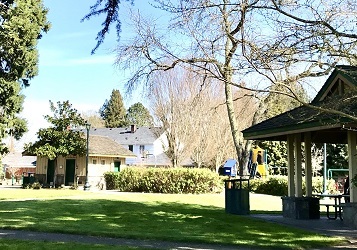
Bagley Park is named after County circuit court judge George R. Bagley. In 1926 he sold part of his land for one dollar to Hillsboro to be used as a park. It became Hillsboro’s second park. (Shute Park was Hillsboro’s first.)
Some of the park’s features include restrooms, a playground, and a Tiny Branch of the Washington County Library system.
Go to the blue Tiny Branch Library inside the park. On the west (left) side of the tiny library, there is a sign that says “Not a library book return.”
A = the number spelled out above that sentence. (Just use one of them.)
Walk to the two-foot tall blue utility box on the west edge of the park and look across the street to:
Waypoint 2 - Mary M. Pittenger House, 337 NE 2nd Ave.
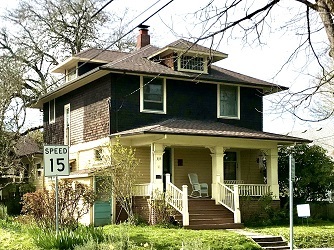
This two-story house was built around 1909 and is a good example of an American Foursquare style. Typical of the Foursquare, it is stoutly massed, composed in a square plan, and topped with a pyramidal hip roof. Jigsawn scrolled brackets, found next to the posts, are not commonly found on this type of house.
Mary M. (Eagleton) Pittenger was a schoolteacher and the widow of William D. Pittenger, a dry goods merchant and former mayor of Hillsboro. Mrs. Pittenger was born in Indiana in 1846. She and her parents pioneered to Oregon and settled in Hillsboro in 1860.
At the base of the blue utility box is a round metal plate.
B = number of letters in the first word on the plate
Walk south and cross to the right (west) on Jackson.
Waypoint 3 - Lillian & William Lohman House, 165 NE Jackson St.
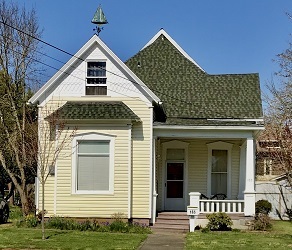
The Lohman house is a well-preserved example of a local high-style house from the 1890’s. No other architectural example of this genre is left in Hillsboro. It is in near-original condition. It is dominantly Queen Anne in style, though without turrets or stained-glass windows. It is similar in massing to Stick-style houses, but it is without any Stick details, though it incorporates many Gothic features seen in Stick-style houses. The ornamentation on the house is subdued, but the main features are well composed.
William Lohman was the City Marshall of Hillsboro from 1891 to 1892. A severe depression occurred in the early 1890’s and the Lohmans lost the house through foreclosure in December 1892. Several prominent citizens subsequently lived in or owned the house, including the Honorable Samuel Bruce Huston, who served as city attorney, councilman, mayor of Hillsboro, school director, and State Senator.
There is a telephone pole across the street from the Lohman House driveway. It has a yellow tag with the letters VZ and a 6-digit number..
C = sum of the second and third digit.
Walk south on NE 2nd Ave.
Waypoint 4 - Zula Linklater House, 230 NE 2nd Ave.
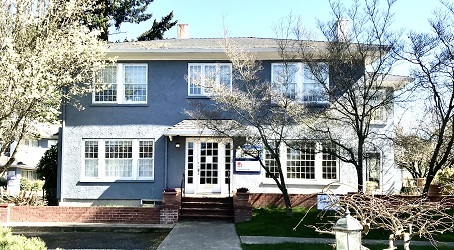
Dr. Samuel Linklater was born in 1832 in the Orkney Islands, off the north coast of Scotland. He received his medical degree from the University of Edinburgh in 1882 and planned to emigrate to Australia. But en route to Australia, Dr. Linklater stopped to visit his sister in Oregon and was impressed by the “scenic and climatic advantages of Washington County.” He stayed and became a beloved and much respected physician throughout the region.
Dr. Linklater had donated the land for the Carnegie Library (Waypoint 5), but was shortly thereafter killed in a train accident while returning from a late-night house call. His widow Zula Warren Linklater raised her six children, managed her husband’s estate, and had this house built in 1923 on Second Avenue next to the library. Zula’s daughter had asked her mother to build “a house that would last forever” and perhaps in response, the Linklater home was constructed of concrete. It is the only example of the 1920’s residential concrete construction in the city of Hillsboro. It was converted into office space in 1984.
This Mediterranean-style home is on the National Register of Historic Places.
On the north edge of the “ENTER” driveway, there is a telephone pole with a yellow tag with the letters VZ and a 6-digit number.
D = fifth digit
Continue south to the corner of NE 2nd Ave. and NE Lincoln St. Turn left to the front of the yellow brick building.
Waypoint 5 - Carnegie Library, 209 NE Lincoln St.
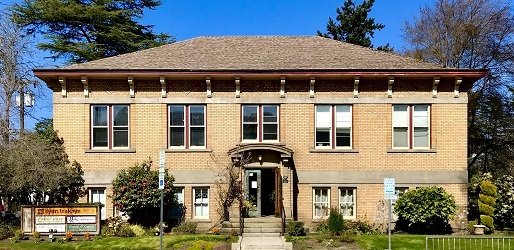
Shortly after coming to America, Scottish immigrant Andrew Carnegie borrowed books from the owner of the telegraph company where he worked. This made such an impression on him that, after later making a fortune in the steel industry, Carnegie created a foundation that built over 2500 public libraries throughout the world, including this building in Hillsboro. It was built in a simple Italian Renaissance style on land donated by prominent local physician Dr. Samuel Linklater (see Waypoint 4), and was completed in 1914. The steps to the main entrance, off NE Lincoln Street, are deeply worn after generations of use. It now houses offices and a restaurant.
There is a small black Cultural Resource plaque to the right of the door on Lincoln St. There is a 4-digit number on the last line.
E = second digit
Cross Lincoln street to the south.
Waypoint 6 - Tuality Masonic Lodge, 176 NE 2nd Ave.
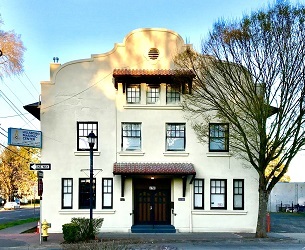
This Masonic Temple is a good representation of the Mission Style of architecture. Zula Linklater lived in a house here before she built her cement house, just north of here (Waypoint 4). In 1922, Ms. Linklater generously donated this Second Avenue property to the Tuality Masonic Lodge No. 6. The Lodge had been active in three other locations in Hillsboro since 1853. Meetings were held the first Saturday after a full moon.
There is a small black Cultural Resource plaque to the left of the door. There is a 4-digit number on the bottom line.
F = sum of last 2 digits
Walk one block east and turn left (north) on NE 3rd Ave.
The next three houses are combined into Waypoint 7.
7-A: Cornelius T. Richardson House, 244 NE 3rd Ave.
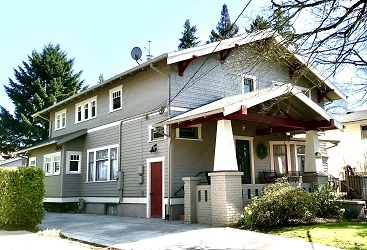
This house is a simple but rich rectangular bungalow style, built around 1925.
Dairy farming was a major industry around Hillsboro in the late 1800s, practiced by German and Swiss immigrants. Several local companies consolidated in the early 1900s to form the Carnation Company, which built a milk condenser plant in 1907 in south Hillsboro near Jackson Bottom. Richardson began working there in 1917, and served as manager from 1932 to 1957. During World War II, he was the civil defense director for the city and war bonds sale chairman.
The Hillsboro Carnation plant continued making condensed milk until it was converted to a dog food plant in 1948, manufacturing a new product called “Friskies.”
Look on the telephone pole near the SW corner the Richardson house lot. It has a yellow tag with the letters VZ and a 6-digit number.
G = first digit minus 2
You have all the info to calculate the coordinates, but before you leave here, take a moment to look across the street. The house on the left is:
7-B: Frank Mitchell House, 233 NE 3rd Ave.
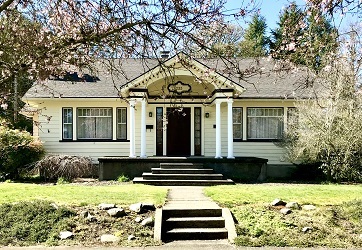
The Mitchell House is a good representation of the Colonial bungalow style. Frank G. and Geneva Mitchell constructed this house around 1927 after having been a part of the Hillsboro community for many decades. Mr. Mitchell was best known as the owner of Delta Drug on Main Street, where he first started working in 1890. Within a year he had become a registered pharmacist and stayed on in that capacity.
The house on the right of the Mitchell House is:
7-C: Lemeul McPheeters House, 249 NE 3rd Ave.
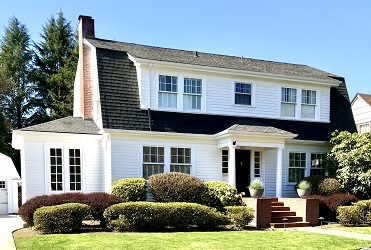
This house was built in 1919 for Lemuel McPheeters, who was a pharmacist in the Hillsboro Pharmacy. Little is known of McPheeters, but this residence is an excellent example of the Dutch Colonial style of architecture with its characteristic gambrel roof.
The total of those 7 digits, A thru G (the checksum) is 39.
The final is at: N 45 3A.BCD W 122 5E.FG6 There is no access from the west.