Please park only in the parking lot, respect the property and do not climb on the rocks.
This cache is located in the Centennial Open Space at Knoll-Willows.
Please respect all park rules as posted. The signs about the bears are real and you should beware of wildlife.
You are able to see everything without leaving the trail.
I hope you enjoy this beautiful and amazing location. After gathering the information for this EarthCache, you will definitely want to continue your journey up the hill to visit the ruins.

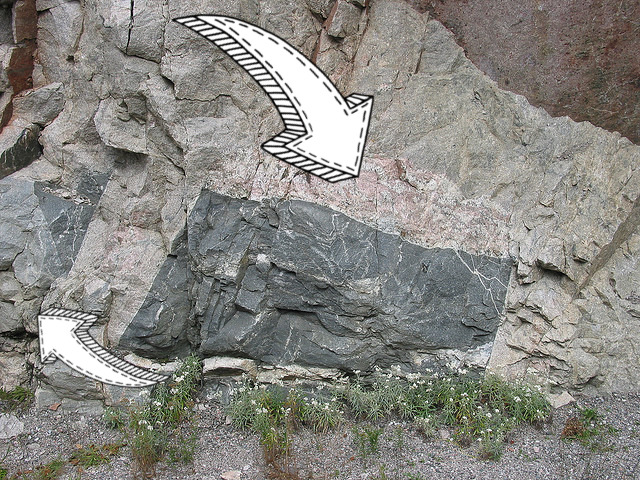
Xenolith: fragment within an intrusive igneous body that is unrelated to the igneous body itself. Xenoliths, which represent pieces of older rock incorporated into the magma while it was still fluid, may be located near their original positions of detachment or may have settled deep into the intrusion, if their density is greater. Xenoliths can be contrasted with autoliths, or cognate xenoliths, which are pieces of older rock within the intrusion that are genetically related to the intrusion itself. The general term for all such incorporated bodies is inclusions. Xenoliths are usually reconstituted through the processes of contact metamorphism, in which heat and fluids cause mineralogic[sic] and chemical changes in the parent rock of the xenolith; a study of these changes can give information on the temperature and composition of the magmatic body.”
http://www.britannica.com/EBchecked/topic/650624/xenolith
Please log your visit and send me an e-mail with the answer to the tasks and questions below.
Please DO NOT put the answers to your questions in the log.
1. Estimate the size of the rock in you chose that contains the xenolith. This would be done by multiplying the length, width and height together; your answer will be in cubic feet.
2. How many large (bigger than 1ft by 1ft by 1 foot) xenoliths are in the rock. Estimate the size of the xenolith(s) using the same formula above. Use two different sides of the rock to take the measurements and assume the xenolith(s) is rectangle; again your answer(s) will be in cubic feet
3.Which rock do you think is the parent (older) rock; the lighter or darker rock. Do you think the new rock pushed into or wrapped around the parent rock? What makes you think that?
4. Post a picture of yourself or a personal item at Stage 2 (The Ruins) that shows you visited the site. REQUIRED
5. At Stage 2, can you find examples of the xenoliths you found at GZ used in the ruins? (You do not have to identify the rock type.)
6. Do you now think you could find a xenolith on your own? I found this one after doing an EarthCache in North Carolina by GeoJoe. It may be a little harder to find another one as obvious and on this grand of a scale so close to you, but if you look real good, you can see this all around you; it is a very common occurrence that is rarely noticed.