Team Mollymap Proud Members Of The SCGA
NOTE: This is an earthcache, there is no physical container to find at the coordinates. To get your smiley for the cache, e-mail your answers for the questions below to the cache owner.
This hide is located in Linear Park, a free public park, with permission from the zoo who asked us to post the hours are 7:00 AM until 6:00 PM.
Florida Wetlands:
In Florida, wetlands are quite abundant covering 29% of the state or 11.4 million acres! Of the state's wetlands 55% are forested, 25% marshes, 18% scrub-shrub, and 2% fresh water ponds.
Wetland Formation:
Wetlands are just what they sound like, wet - lands. They form on floodplains where seasonal flooding or high water tables provide enough water. They are aquatic ecosystems that transition between lands, lakes, ponds, or other bodies of water. Wetlands are excellent for soaking up water to help with flood control, they help filter water, and provide home to wildlife.
Soils of Wetlands:
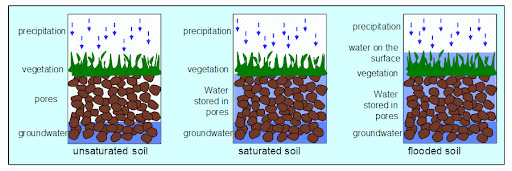
Wetland soils work differently than the soils found in dry lands. Wetland soils are called hyrdric soils. Hydric soils are formed under conditions of saturation and flooding. The spaces between each grain of soil in wetlands is filled with water. As the the spaces between each grain of soil fills with water the wetland goes from classified as unsaturated soil, to saturated soil, then to flooded soil. Wetland soils are also anaerobic, meaning they lack oxygen. The color of the soil reflects the minerals and organic matter in the wetland. Soils are usually dark brown to black and may have a rotten egg smell due to the presence of sulfur.
Types of Wetlands:
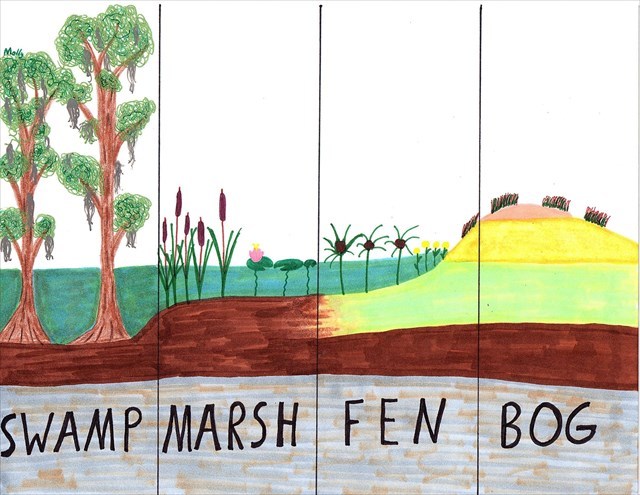
The four main wetland types are Swamp, Marsh, Fen, and Bog.
Swamps:
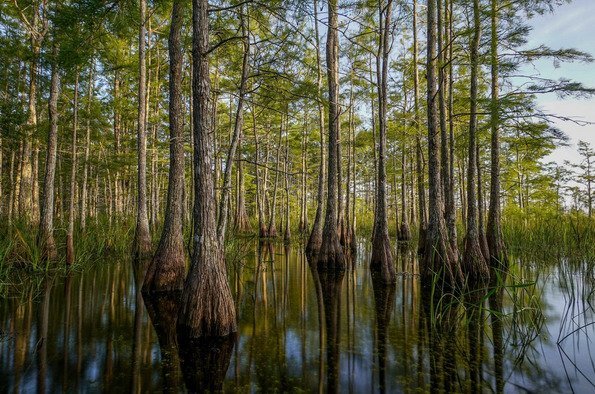
Swamps are wetlands with lots of trees, shrubs, reeds, and other woody plants. They are characterized by their highly organic saturated soils which are thick and black. They often have deep nutrient rich murky water which is usually standing or slow moving.
Marshes:
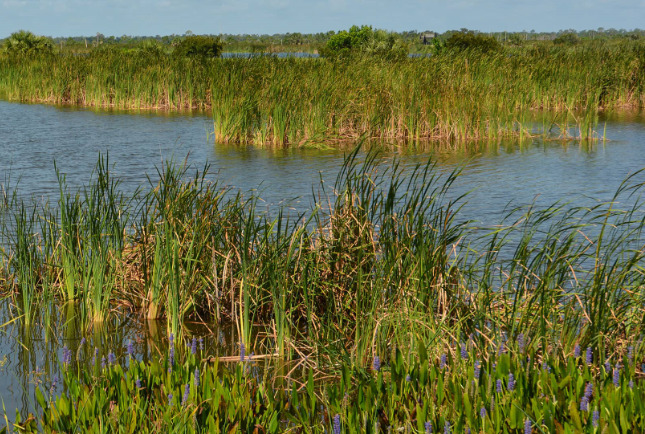
Marshes are wetlands with reeds, grasses, and other soft stemmed vegetation. Due to their vegetation they have high levels of nutrients and often have an abundance of plant and animal life. They can have trees but usually just a few. Marshes have water levels a few inches to two or three feet.
Fens:
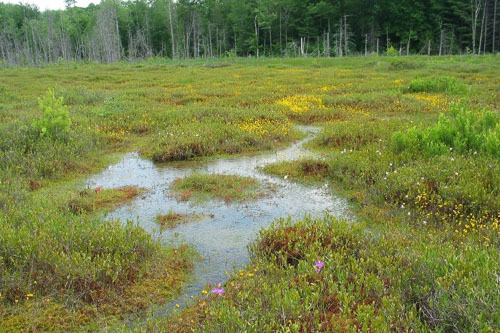
Fens are wetlands with peat and are often supported by a bog. There are lots of different plants in fens such as sedges, grass, flowers, reeds and shrubs. Fens receive their water from underground sources as well as surface flow runoff and usually have constant levels of water all year round.
Bogs:
Bogs have peat that has been accumulated and is usually dominated by moss. Because they have low nutrients, they are a difficult place for plants to thrive. Bogs receive their water primarily from direct precipitation and do not have much water flow.
Now it is time for the questions. To get credit for the cache, please answer the questions below. When answering the questions do your best. It is more important that you learn a new concept about our earth and can apply your knowledge, rather than have a precise answer.
Questions:
1- Describe the wetland floor and soil in terms of color and composition.
2- Classify the soil and the water combination as saturated, flooded, or unsaturated.
3- Thinking about the water, shape of the wetland, plants, soil, and floor, is this wetland a: Swamp, Marsh, Fen, or Bog?
Thank you for visiting this earthcache. Please send your answers to the above questions to the cache owner. In your "found it" log feel free to write about your experience, but don't include the earthcache answers. Thanks and we hope you enjoy this beautiful trail!
Sources:
https://www.epa.gov/wetlands/classification-and-types-wetlands#marshes
https://en.wikipedia.org/wiki/Wetland
https://www.youtube.com/watch?v=1WlmGyN9VXs&list=PLurjkZV1ykGZ8T9Z-u7elhEFVod-T8NKf&index=2
https://www.youtube.com/watch?v=9UueihcKF7c
https://water.usgs.gov/nwsum/WSP2425/definitions.html
https://www.nps.gov/
https://en.wikipedia.org/wiki/Fen
http://web.utk.edu/~ctmelear/ossabaw/PattersonStanfordSutton/wetlandL1.html