The Polmonty - Natural Born Miller
The Millfield Estate is a pleasant collection of houses in a couple of streets forming the area that was once the grounds of Millfield House. The place name “Milnfield” occurs as early as 1799 and presumably refers to a nearby mill on Polmont Burn, although I couldn't find much info as to where it was once located. It is known however that an old building sitting on this stretch of the stream was bought in the late 1700s and converted into a library by Dr Robert Henry, a minister and historian who published a History of Great Britain, written here at Millfield. He later founded the Royal Society of Edinburgh, and when he died in 1790 he was buried nearby in Old Polmont Churchyard where his tomb can still be seen.
In 1843 the Millfield area was purchased by John Miller, the wealthy chief engineer on the construction of the Edinburgh and Glasgow Railway. Miller then designed a new house and had it constructed on the higher ground overlooking the winding valley. A four-storey tower at its north-east corner provided views across to the Forth and the coast of Fife. An Italianate style was cultivated for the new building, with low pyramid roofs having wide eaves and triple-arched upper windows having stone balconies.
Millfield House
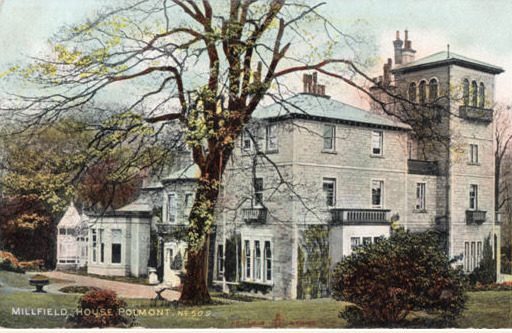
There is scant trace of the great house itself, the 20th Century was not kind to some of the more distinguished buildings in the village, and it was one of several Polmont big houses that fell into disrepair only to be flattened to make way for houses and public spaces. However, from its time as a well maintained estate of some stature and impressive grounds, there are a few items of garden architecture near the coordinates of the former site of the house itself (N 55° 59.410 W 003° 42.874 - added as a waypoint), north and west of the cache location. These items include a few old stone ornaments, one taken from Leith Docks and dated 1619. This may have been discovered by Miller during his engineering various works on north Edinburgh Harbours like Granton Docks. The elaborate stone footbridge near gz is one of a few created across Polmont Burn during Miller's development of the estate.
Eventually Miller was so respected as a titan of Scottish Engineering he was elected to the Royal Society of EDinburgh, founded of course by one of the previous residents of the Millfield estate - Dr Robert Henry. Miller retired in 1850, but was still an active man with various interest and friends across distinguished Edinburgh society. One of those friends was the artist David Octavius Hill. Hill produced a lithograph of the opening of the Glasgow and Garnkirk Railway in 1831 showing Miller on the footplate of one of the locomotives. Both Hill and Miller were early fans of photography and together they created the Photographic Society of Scotland in 1856.
Such is the impact Miller had on Scotland's Railway Engineering, he is referred to by some historians as 'Scotland's Brunel', although I would have thought Thomas Telford might be more deserving of that title personally. Miler is commemorated with a plaque at Edinburgh's Haymarket Station.
**Post publication update** - I've upped the terrain rating to 3 because of cacher feedback about the footing at gz, which is a slippy steep bank. A walking pole or similar to secure footing, is advised.
_______________________________________________________________________________
Most of the above content was sourced from the writings of G.B.Bailey for the Falkirk Local History Society.