This is the final cache in the short series of spy themed caches in the Westquarter area. This one uses the well-established cache-idea of Numbers Stations - you can find several caches dotted around the world with a similar theme, and there is a Bookmark List of several of them on Geocaching.com. To find the location of this cache you will need to have collected the clue-parts at the first two caches in the Spycraft series, both located nearby around Westquarter - GC8P0QG ('Dead Drop At The Dovecote') and GC8P04M ('Briefcase At The Bridge Of Spies'). For this cache you will need your own pencil, and a tweezers to retreive the log. This cache is not big enough for any trackables or swag.
Numbers Stations
A Numbers Station is a radio-based communication method used by spy networks to communicate with agents in the field typically using publically-broadcast shortwave radio frequencies. A Numbers Station is an example of a one-way communication link, often broadcasting to a field agent who may already know the intended meaning of the code, or use a 'one-time pad' to decode (see the previous cache in this series for more on one-time pads). These numbers stations will sometimes broadcast random or misdirecting messages during their usual schedule; this is done to expend the resources of hostile agents, as they try in vain to make sense of the data. Numbers Stations typically broadcast formatted numbers to encrypt messages, and use speech synthesis to 'speak' the numbers, although other methods such as morse code, buzzers, and even church bells have been used. They became more common during The Cold War, and are suspected of being used by both sides and even their ally states, to send instructions to intelligence officers operating in foreign countries.
Decoding these numbers was via using the one-time pad with an initial broadcast number (or number sequence) telling the target what page on the pad to use to decode the message. A typical decoding pattern would be for the agent to listen to the broadcast, and hear the initial sequence of numbers (such as '2'....'5') which in a simple case might tell the agent to use page 25 of the pad to decode with. Then the numbers would switch to convey the actual message itself. The message would sound like a string of say 5 numbers, with some indicator (like voice intonation upwards or an electronic tone) to indicate the start of a new word. In the above example the agent would look at Page 25 and in turn add each broadcast number to the corresponding number on the first line of the pad. This would give a total number for the letter of the alphabet represented in the message (A=1 , B= 2 etc).
An important part of this espionage technique was that the key on the pad was a random number sequence as least as long as the numbers in the broadcast message - to prevent repetition - which is used commonly as a way of cracking cyphers. The Number Stations and One Time Pad method remains one of the few uncrackable coded message techniques ever developed, even in the face of modern computer technology. This may be why even in the age of the internet and modern ecryption technology, some Numbers Stations still exist today, and there have even been new ones created in recent years. You can listen to various recordings of real Number Stations on websites like Youtube, including this one:
https://www.youtube.com/watch?v=jib-857c7GE
Amateur shortwave enthusiasts have dedicated decades to tracking, recording and investigating Numbers Stations, creating a worldwide catalogue of such broadcasts, and attributing nicknames to the most established ones based on the language they are broadcast in, the signal noise/word which habitually starts the broadcast. The most famous include 'Swedish Rhapsody', 'Atención', 'Nancy Adam Susan', 'The Spanish Lady', 'The Bored Man', and 'The Lincolnshire Poacher'.
Spycraft 3 - Number Station In The Glen
Spymasters from the secret separist organization The PDRW (The People's Democratic Republic of Westquarter), have been using Number Stations to communicate with its agents in the field. Counter-intelligence has established that most recently, the PDRW is developing a secret weapon of devastating power that they intend to use in their struggle to secede from Falkirk Region. It's believed that the PDRW's most recent Number Station broadcast relates to the location of the only prototype of this device, and that it is being delivered to a field agent to use. This exchange must be prevented at all costs. As a crack agent for the Falkirk authorities, your mission is to decypher the number station broadcast, and confirm the location of the prototype weapon, so that the enemy agent it is intended for can be apprehended and the device neutralised.
If you have recovered the two clues from the previous two caches in this series then you have everything you need to locate this final cache, which is located at: N 55° 59.XXX' W 3° 44.XXX'
However it won't be easy even once you've solved the puzzle, because the PDRW are a sneaky bunch and they have used all their cunning in hiding the device. So if you consider yourself a 'black belt finder', then have a go without the hint. Otherwise you can use your puzzle-solving skills for a little help, by taking a look at the hint, and it will reveal crucial help for when you reach gz. A tweezers will be needed to retrieve the log.
Cache Location - Lanton Linn
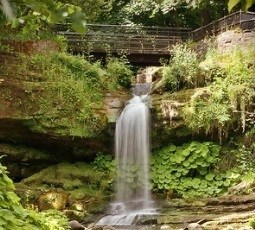
The cache is located in the South West part of Westquarter Glen, within a short walk of a scenic cascade of the Westquarter Burn as it winds North Eastward toward the other end of the Glen. Lanton Linn waterfall (pictured below) was once one of a number of such narrow drops of the burn running through the Glen, to the point that it features on old postcards for the area. 'Linn' in Old Scots means any torrent or waterfall for a river, and when the burn is in full spate it's quite a sight here. The origin of the name 'Lanton' is not definite but in local maps of the 16th-19th century, 'Langtoun' is noted as a settlement/dwelling at this location distinct to Westquarter, so that may be where it stems from. A copy of the 16th Century map is in the gallery. At one point the lush settings, fine plants and natural cascades of Westquarter Glen were such an attraction that the local landowner opened the Glen to the public one day a week for the entrance fee of one pence.
Hope you enjoy your free visit to Westquarter Glen, and that you have had a good time honing your skills of Spycraft. Oh, and of course, the glorious muncipaility of Falkirk thanks you for your dedicated service against the PDRW.
Lanton Linn - The Westquarter Waterfall