This is an Earthcache – as such, there is no physical cache. Instead after examining the granite of the Taras Shevchenko Memorial at the posted coordinates you will answer 4 questions and message me the answers. This memorial is located at Triangle Park in the Dupont Circle neighborhood and is in the care of the National Park Service. Permission for this cache placement was given by the National Mall & Memorial Parks Division of Permits Management.
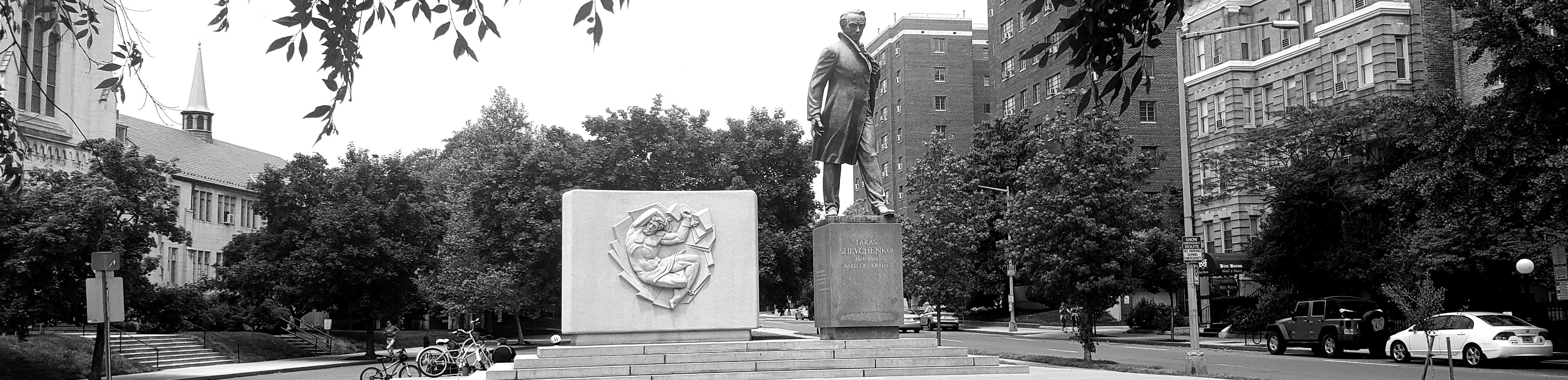
THE TARAS SHEVCHENKO MEMORIAL
Taras Hryhorovych Shevchenko was a writer, artist, public and political figure, and Ukraine’s best known and most loved poet. This memorial consists of two parts. There is a 14 feet tall statue of Shevchenko standing on a 7 foot granite base. Next to his statue is a tall relief sculpture of Prometheus carved into a slab of Vermont Gray Granite from Barre, Vermont.
When it was announced that this Shevchenko statue would be unveiled in DC during the 150th anniversary of his birth it faced a barrage of local opposition. A few of the more standout reasons included the fact that Shevchenko was not an American, and that he was an idol to the Communist Party. Regardless of protests, on June 27, 1964, 36,000 people showed up to see this statue dedication and watch a parade. Former President Dwight D. Eisenhower spoke at the ceremonies and "praised his poetry and his fight for freedom."
HOW DOES GRANITE FORM?

Intrusive igneous rocks form from Molten rock called MAGMA below the surface in sills. Extrusive igneous rocks form LAVA above the Earths surface. Even though magma and lava may have the same chemical structure, the rock that is formed when they cool has very different properties. The length of time it takes for lava to cool above the surface is relatively short compared to Magma deep underground. Lava can sometimes solidify in minutes while rock insulated by the earth can take centuries. Slow cooling magma gives the distinct minerals in the rock time to consolidate into large crystals. The name "granite" is derived from the fact that the rock appears to be composed of numerous "grains" or crystals that are intergrown to form a solid, durable rock.
VERMONT GRAY GRANITE
The Vermont Gray Granite supplied for this memorial was purchased from the Jones Brothers Company in Barre. The city of Barre lies about 5 miles southeast of Vermont’s state capital Montpelier, and Barre itself is known as the “Granite Capital” of the world. Sometime in the mid 1890’s the Jones brothers acquired this quarry which is located 3 miles southeast of Barre on Millstone Hill, a huge granite mass that rises to 1,2000 feet above the city. The gray granite from Millstone Hill is about 380 million years old making it Devonian in age. It is a medium to coarse grained, light-colored, intrusive igneous rock that is composed of feldspar, quartz, and mica.
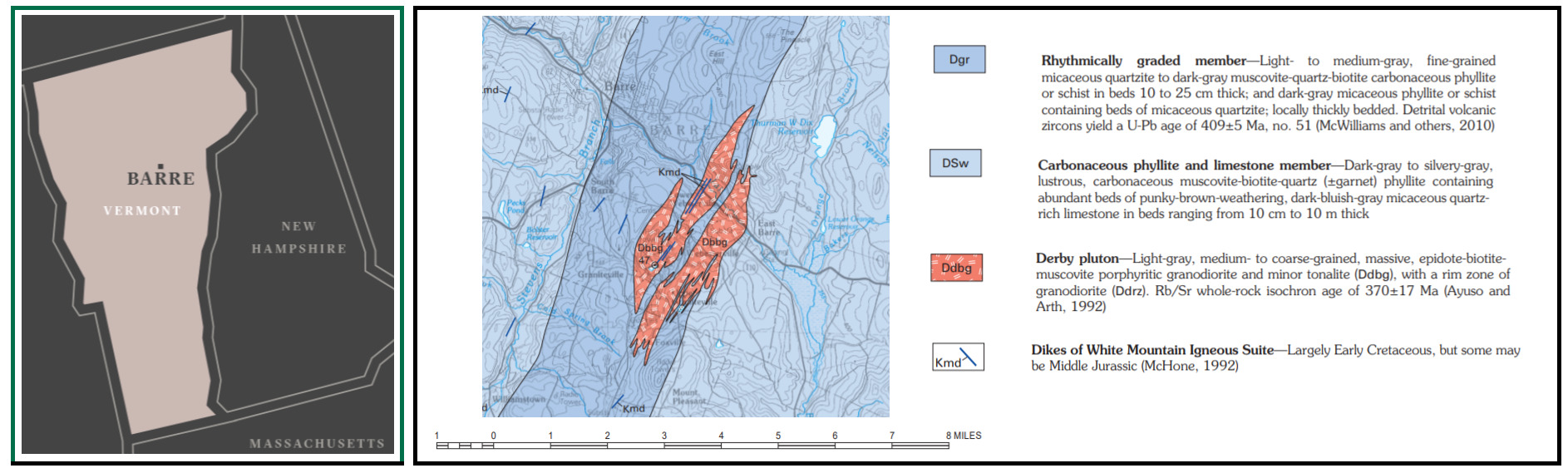
Here on at the Millstone Quarry they could quarry both dark and the light granite. The lighter granite formation is near the top of Millstone Hill on its south and southwest sides. The various shade and color designations of this granite are due in part to the different degree of kaolinization and mica in its orthoclase feldspar, causing it to range from a translucent bluish gray to milk-white, and in part also to the varying content of black mica. Kaolinization refers to the alteration of alkali feldspar into the clay mineral kaolinite in the presence of slightly acidic solutions.
Mica is a major rock forming minerals found in granite. The mica group includes muscovite mica and biotite mica. They usually form in layers of sediment on ocean floors. There are also some hornblende needles that make up the mafic dark colored parts of the rock.
Granite is a commercially valuable rock in Vermont. The granite industry, centered in Barre, has been in operation since the 1800's. Granite from Barre is actually not a true granite, but a granodiorite (See the red [Ddgb] Derby Pluton on the Barre map above), meaning it has a finer grain structure than that of a true granite. This allows for finer details to be carved into the stone making it a commercially viable as memorial stone. Its durability, strength, moisture resistance, consistent gray color, and that it is free of impurities makes it the most sought out stone in the memorial and monumental industry.
LOGGING REQUIREMENTS:
To log this Earthcache: Read the geology lesson above. Answer all four questions posted below and send via e-mail or messenger contacts on my Geocaching profile.
QUESTION 1. Where is the name "granite" derived from?
QUESTION 2. Examine the mica in both the darker statue base and lighter relief slab. From your observation is the mica crystals larger in one over the other, or are they similiar size mica crystals in a much larger concentration?
QUESTION 3. Does the lighter granite or the darker granite have a smoother texture?
QUESTION 4. Examine the 50+ year old carved relief of Prometheus. Does the detail work in the carvings look sharp and clean still, or is it showing signs of weathering and eroding?
OPTIONAL PHOTO: Posting a photo that readily indicates that you (and anyone else logging the find) are at the location.
 Placed by a proud member of both

 Awesnap has earned GSA's highest level:

REFERENCES:
1. "Proceedings and Reports form the 88th Congress", United States of America Constitutional Record, Volume 100, Part 12, June 29, 1964 to July 21, 1964, pg 15492, Congressional Record
2. "Jones Brothers Co. Collection", Barre History Collection, Collection, 1910-1979, vermonthistory.org
3. "BEDROCK GEOLOGIC MAP OF VERMONT, 2011", Barre History Collection, Collection, 1910-1979, vermonthistory.org
4. The Commercial Granites of New England, Quarries, Department of the Interior, pages 104-127, 1923, pubs.usgs.gov
5. "Taras Shevchenko", October 7, 2011, dcmemorialist.com
6. "VERMONT STATE ROCKS AND ROCK KIT", Vermont Department of Environmental Conservation, dec.vermont.gov