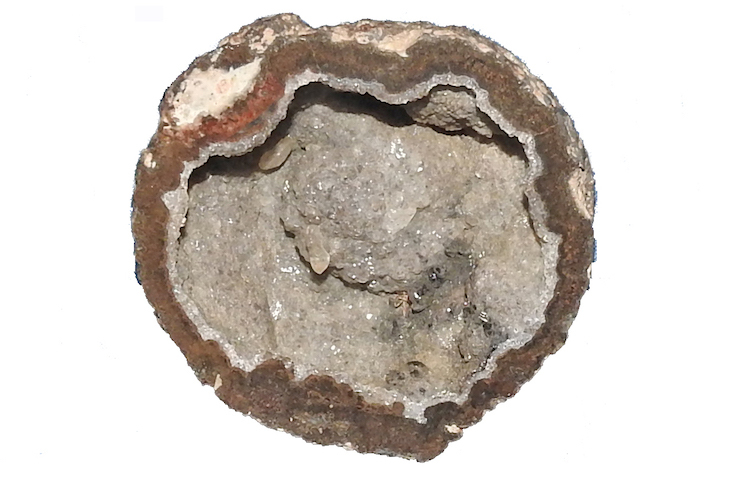
Geodes are crystal-lined cavities in rocks. The crystals are formed when minerals precipitate or settle out of groundwater in underground rock cavities.
The minerals deposited may vary, but in Kansas most geodes consist of quartz,chalcedony, and calcite. They commonly form in limestone and can be found in many places in the Flint Hills region.
Geodes are not found randomly here and there. Instead they are usually found in large numbers in areas where the rocks have formed in a special geochemical environment. Most geodes localities are in
A) volcanic deposits such as basalts and tuffs
B) sedimentary carbonate deposits such as limestones and dolomites.
Geodes in volcanic rocks are the most widely known and sought-after. Voids in basaltic lava flows often are infilled with agate, quartz, opal and other material delivered by hydrothermal water or groundwater. Some voids are spaces occupied by gases that failed to escape the lava flow before its surface crusted over.
Geodes in sedimentary rocks are usually found in limestones, dolomites, and calcareous shale. In these deposits a gas-filled void can serve as the opening for geode formation. Shells, tree branches, roots and other organic materials often decay away to leave a void for the formation of mineral materials. These cavities can be filled with quartz, opal, agate or carbonate minerals. They are generally smaller than the geodes formed in volcanic rocks.
To get credit for this earthcache, at the coordinates listed you will find several tombstones made of geodes.
Please answer the following questions from the above information or by observation:
1. Are the geodes volcanic rock or sedimentary rock? How did you make this decision?
2. Are any of the crystals broken open? If so, what color are the crystals inside?
3. On the south side/edge of the tombstone at coordinates, at the bottom below 3 geodes you will find another rock formation that is considered a fossil. What is it? (HINT: There is a whole National Park named after it in Arizona)
4.Please post a picture with your log of you or your GPS, car keys etc. in this area. Don't get to close to the tombstones and give all the answers away.
REFERENCES: http://geokansas.ku.edu/
| I have earned GSA's highest level: |
 |