(A) grew up in this area and was in the last class at the school that should be to your west about 200 yards. He was in 1st grade and they had 1st-3rd grade in one classroom. They closed the school down after that year and he moved on to shut other schools down. (T) attended church here right behind you. It was Shelbyville Mills Baptist at that time, we were the first couple to get married at the new church. (A) lived a couple roads to the east and played ball in the neighborhood park for the neighborhood team. His Dad worked at the mill when it was Uniroyal Tire and played on the softball team. There was an 18 hole golf course behind the ball park. This area at one time was a well kept nice area but like most things it has fallen into disrepair in many aspects. The subdivision to the south is where the red cedars grew that attracted Musgrave to start operation here as well. All the businesses have moved on to different things with the last company moving most all operations to Mexico a few weeks ago. The fabric mill building still stands on the property SW of this location. The cache is meant to bring you to this area and read about some of the history of Shelbyville. Please leave the container, only grab the log. Tweezers would be helpful, a pen is a must. Good luck and as always have fun.
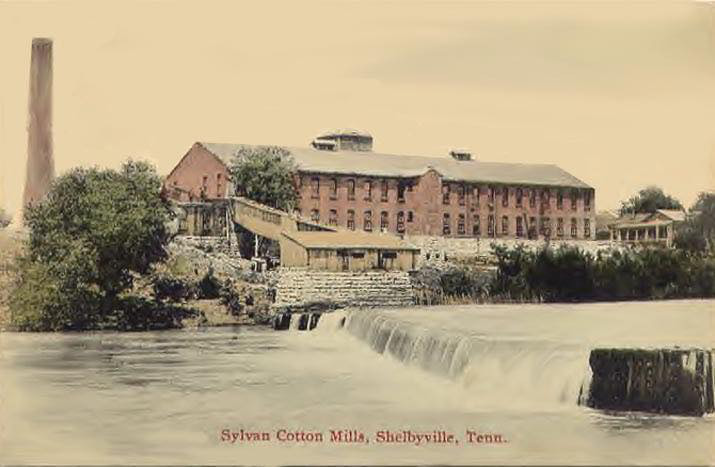
In 1852 Gillen, Webb, and Company established Sylvan Mills on the Duck River outside of Shelbyville as a woven cotton fabric mill. It produced fabric from raw cotton throughout the late nineteenth and early twentieth centuries. During the early 1920s, the mill changed ownership and became known as Shelbyville Mills. It produced cotton fabric to make tops for the Model T and other automobiles as well as cotton cord to make rubber tires stronger and more durable.
The quality of the materials produced at Shelbyville Mills caught the attention of the United States Rubber Company, and in December 1933 Shelbyville Mills became a branch of United States Rubber Company’s Textile Division. The purchase and expansion of the Shelbyville Mills brought new jobs to Bedford County, which had been hard-hit by the Great Depression. For many new employees, the mill provided the first paychecks in years. Shelbyville Mills also built a company town, complete with a fully stocked store, a neighborhood school that included one of the first gymnasiums in the county, and homes for many employees.
Shelbyville Mills became an integral part of the defense manufacturing efforts of World War II, producing materials for military tires. In the postwar economic boom, the mills made additions to the facility and produced new types of cord. In 1955 Shelbyville Mills began producing synthetic cords. A totally new technique, the “hot stretch” process for producing synthetic cords, was added in 1963.
Market and process changes in the 1970s and 1980s resulted in the decline of the Shelbyville Mills. The U.S. Rubber Company consolidated all phases of work and changed its name to Uniroyal. In the process Shelbyville Mills lost its unique identity. Finally, in 1982, Shelbyville’s Uniroyal plant closed when it became clear that economic and technological changes made the plant unprofitable. Shelbyville Mills:Tennessee Encyclopedia
