Tout comme les carrés Saint-Louis, la place Hoche fait partie de ces lieux versaillais chargés d’histoire et ignorés à tort par les touristes alors qu’elle est située à proximité immédiate du château. Située dans la perspective de l’église Notre-Dame, elle a été tracée en 1671 et était à l’époque appelée place Dauphine. C’était la première de France à adopter une forme octogonale. Elle témoigne donc, au même titre que le trident des avenues de Sceaux, de Paris et de Saint-Cloud qui structurent la ville, de l’attrait du Roi pour un urbanisme réfléchi.
Au centre de cette place trône la statue de Lazare Hoche, général à l’âge de 25 ans et personnage clivant à Versailles. On doit cette représentation au sculpteur Henri Lemaire.
Autre particularité de la place, elle permet aux versaillais de trouver de l’ombre sous ses grands marronniers, recensés parmi les arbres remarquables de la commune aux côtés des platanes de l’hôtel de ville.
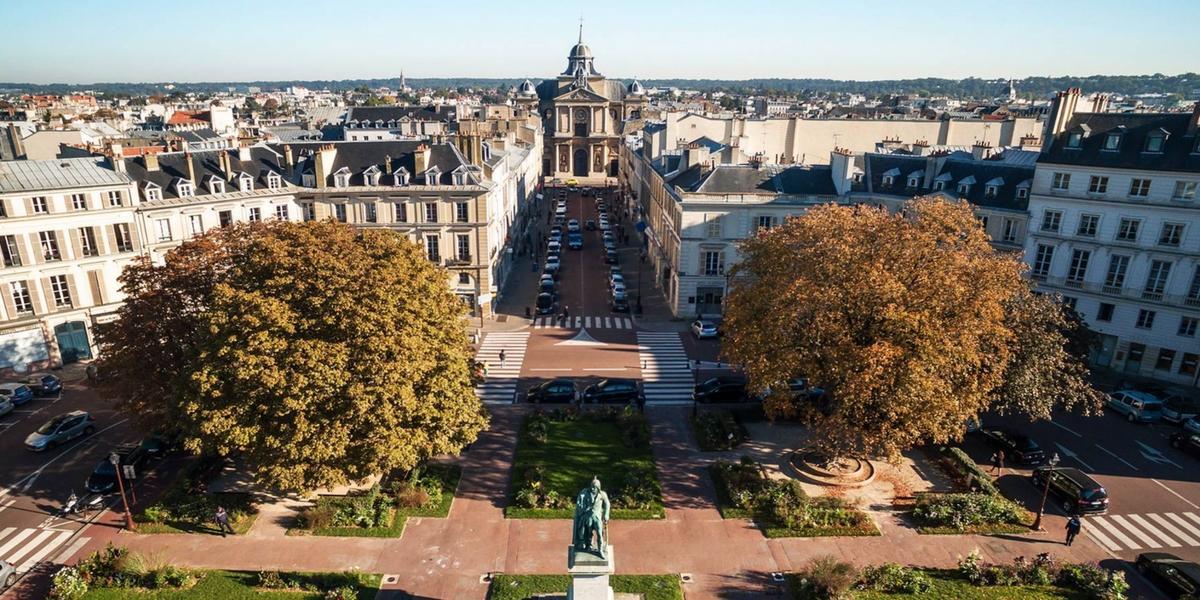
Like the Saint-Louis squares, the Place Hoche is one of those places in Versailles steeped in history and wrongly ignored by tourists while it is located in the immediate vicinity of the castle. Located in the perspective of Notre-Dame church, it was traced in 1671 and was then called Place Dauphine. It was the first in France to adopt an octagonal shape. It thus testifies, like the trident of the avenues of Sceaux, Paris and Saint-Cloud which structure the city, of the King's attraction for a thoughtful urbanism.
In the center of this square is the statue of Lazare Hoche, a general at the age of 25 and a figure cleaving at Versailles. We owe this representation to the sculptor Henri Lemaire.
Another peculiarity of the square, it allows Versailles inhabitants to find shade under its large chestnut trees, listed among the remarkable trees of the town alongside the plane trees of the town hall.
Ref: https://actu.fr/ile-de-france/versailles_78646/la-place-hoche-concentre-dhistoire_12477427.html
Photo@Versailles tourisme