Scharffenberg
Scharffenberg (means Sharp Hill), represents a significant dominant on the eastern edge of the town of Banská Štiavnica. At its top is a baroque church and on its slopes are locate other sacral objects of the Cavalry. From a geological point of view, Scharffenberg is the remnant of a basaltic volcano, which was active in the final phase of volcanic activity in the Štiavnické vrchy for approximately 7 million years ago. Basalts of a similar age can also be observed near the settlement of Kysihýbel.
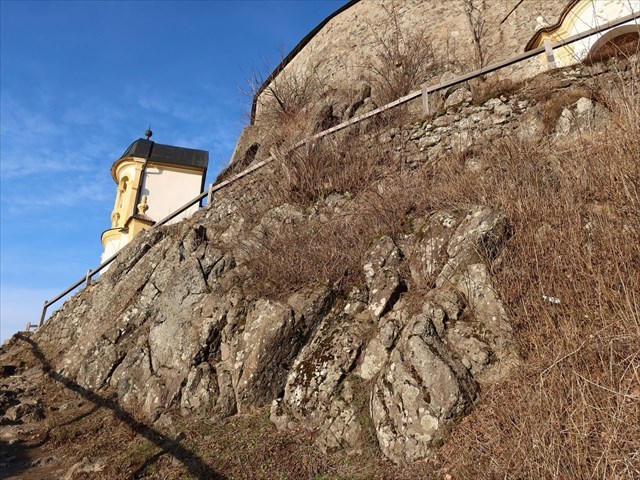
Basalt in Cavalry hill.
The body of the hill is the remaind of the supply channel through which the lava erupted to the surface. After the end of volcanic activity, the slopes of the volcano eroded and the mass of basalt lava, more resistant to weathering than the surroundings remained preserved in the form of a distinctive cone, the so-called. lava neck or volcanic plug. In several places, especially in the upper part of the hill, outcrops are also observable, somewhere with the typical columnar lavas.
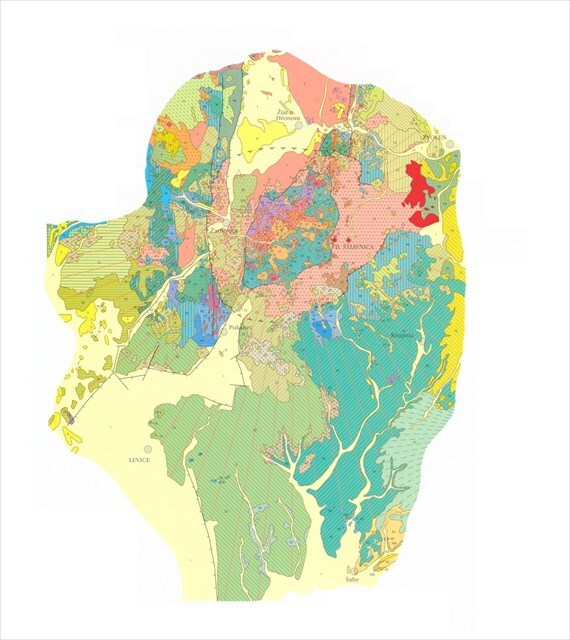
Occurrence of basaltic rocks (red color).
Initial explosive phase (figure Phase 1), creates a funnel-shaped depression with pieces of ejected material settled in the form of slag and ash along its edges. Subsequent explosions expand the walls (Phase 2). Periods of volcanic activity alternate with periods of dormancy, when the crater can be flooded by water (Phase 3).
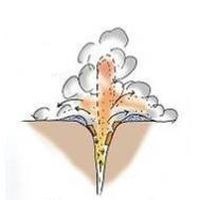
Phase 1.
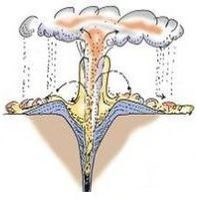
Phase 2.
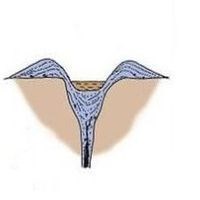
Phase 3.
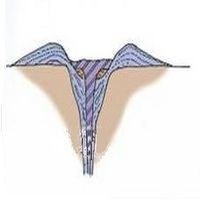
Phase 4.
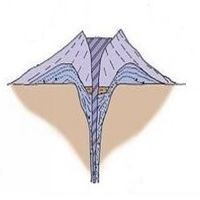
Phase 5.
Continuing eruptions gradually raise the cone above the level of the surrounding terrain (Phase 4), until the end of the volcanic activity and the lava in the vent solidifies (Phase 5). Subsequent erosion processes remove unconsolidated tuff material from the slopes and the solidified lava, which is more resistant to weathering, will remain as a significant morphological element.