The Hillsborough River is a river located in the state of Florida in the United States. It arises in the Green Swamp near the juncture of Hillsborough, Pasco and Polk counties, and flows 60 miles through Pasco and Hillsborough Counties to an outlet in the city of Tampa on Tampa Bay.
Along those 60 miles there are turns and bends known as Meanders. During this Earth Cache we will learn just what a meander is and what causes them.

A meander is a bend in a sinuous watercourse or river which forms when moving water in a stream erodes the outer banks and widens its valley, and the inner part of the river has less energy and deposits silt. A stream of any volume may assume a meandering course, alternately eroding sediments from the outside of a bend and depositing them on the inside.
The result is a snaking pattern as the stream meanders back and forth across its down-valley axis. When a meander gets cut off from the main stream, an oxbow lake forms.
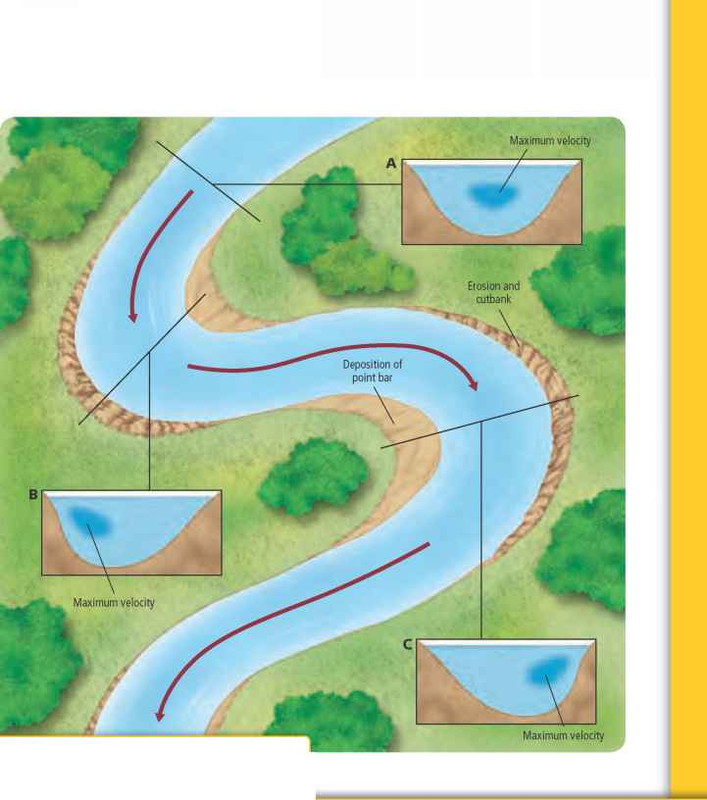

The view from ground zero is very similar to the picture above except your view will contain more Florida type vegitation.
Across from the given coords you will see what is called a slip-off-slope ( see C below)
A) A CUT BANK is an often vertical bank or cliff that forms where the outside, concave bank of a meander cuts into the floodplain or valley wall of a river or stream. A cutbank is also known either as a river-cut cliff, river cliff, or a bluff and spelled as cutbank. Erosion that forms a cut bank occurs at the outside bank of a meander because helicoidal flow of water keeps the bank washed clean of loose sand, silt, and sediment and subjects it to constant erosion. As a result, the meander erodes and migrates in the direction of the outside bend, forming the cut bank.
As the cut bank is undermined by erosion, it commonly collapses as slumps into the river channel. The slumped sediment, having been broken up by slumping, is readily eroded and carried toward the middle of the channel.
The sediment eroded from a cut bank tends to be deposited on the point bar of the next downstream meander, and not on the point bar opposite it. This can be seen in areas where trees grow on the banks of rivers; on the inside of meanders, trees, such as willows, are often far from the bank, whilst on the outside of the bend, the tree roots are often exposed and undercut, eventually leading the trees to fall into the river. This can be seen all along the Hillsborough River.
B) A POINT BAR, which is also known as a meander bar , that is formed by the slow addition of individual accretions of noncohesive sediment on the inside bank of a meander by the accompanying migration of the channel toward its outer bank. This process is called lateral accretion.
Lateral accretion occurs mostly during high water or floods when the point bar is submerged. Typically, the sediment consists of either sand, gravel, or a combination of both. The sediment comprising some point bars might grade downstream into silty sediments. Because of the decreasing velocity and strength of current from the thalweg of the channel to the upper surface of point bar when the sediment is deposited the vertical sequence of sediments comprising a point bar becomes finer upward within an individual point bar. For example, it is typical for point bars to fine upward from gravel at the base to fine sands at the top. The source of the sediment is typically upstream cut banks from which sand, rocks and debris has been eroded, swept, and rolled across the bed of the river and downstream to the inside bank of a river bend. On the inside bend, this sediment and debris is eventually deposited on the slip-off slope of a point bar.

C) If you look across the river from where you are, you will see what is known as a slip-off slope. The slip-off slope is the inside bank of a meander on a river where sedimentary material is deposited as a result of the slower flow rate. It is on the opposite side of the channel to a river-cut cliff or cut bank which is formed by the erosive forces of the stronger current on that side.
All of these terms are used in connection with the formation of meanders on a river.
These resources were used to complete this EC.
AA)The technical definitions of this section rely heavily on Julien, Pierre Y. (2002). River Mechanics Cambridge University press. pp. 179–184
BB) Lewalle, Jacques (2006). "Flow Separation and Secondary Flow: Section 9.1
I hope you have found this EC interesting and that you now know why this river as well as others have these curves in them and why they just don't flow staright. To receive credit for this ECs smiley please answer the quesions below and send them through the messanging system within Geocaching.com.
1) How does a meander form?
2) At Ground Zero what do you notice about the shore line behind you?
3) Looking at the slip-slope from GZ, compare the meander side to that side. What do you see ?
4) Do you see evidence of a Point Bar? If so what do you find?
5) Pictures are nice and I would love to see you in your water craft of choice but they are not a requirement to log this EC. Enjoy the journey.