Stevenage lies near the line of the Roman road from Verulamium to Baldock. Some Romano-British remains were discovered during the building of the New Town, and a hoard of 2,000 silver Roman coins was discovered in 1986 during new house building in the Chells Manor area. The most substantial evidence of activity from Roman times is Six Hills, six tumuli by the side of the old Great North Road – presumably the burial places of a local family.
A little to the east of the Roman sites the first Saxon camp was made in a clearing in the woods where the church, manor house and the first village were later built. Settlements also sprang up in Chells, Broadwater and Shephall (though before the New Town Shephall was a separate parish and Broadwater was split between the parishes of Shephall and Knebworth).
In the Domesday Book the Lord of the Manor was the Abbot of Westminster Abbey. The settlement had moved down to the Great North Road and in 1281 it was granted a Royal Charter to hold a weekly market and annual fair (still held in the High Street).
Growth in Stevenage continued until just after the Second World War, when the Abercrombie Plan called for the establishment of a ring of new towns around London. On 1 August 1946, Stevenage was designated the first New Town under the New Towns Act.
The plan was not popular and local people protested at a meeting held in the town hall before Lewis Silkin, minister in the Labour Government of Clement Attlee. As Lewis Silkin arrived at the railway station for this meeting, some local people had changed the signs 'Stevenage' to 'Silkingrad'. Silkin was obstinate at the meeting, telling a crowd of 3,000 people outside the town hall (around half the town's residents): "It's no good your jeering, it's going to be done." Despite the hostile reaction to Silkin and a referendum that showed 52% (turnout 2,500) 'entirely against' the expansion, the plan went ahead. The first significant building to be demolished to make way for a gyratory system was the Old Town Hall, in which the opposition had been expressed.
Regeneration
The town and the Stevenage First partnership has now launched a new, £1bn, 20-year regeneration programme designed to transform central spaces and introduce new residential, commercial and retail facilities, amongst others.
The programme is formed of a number of individual schemes including the £350m ‘SG1’ programme being led by Mace and the £50m redevelopment of Queensway North, the former site of Marks & Spencer. In addition, Stevenage's Town Square is also being regenerated with new bars, restaurants, flexible working facilities and shops being introduced to the area.
The plans are based on the local government authority's Local Plan which was given approval on 26 March 2019.
The town is also introducing a new public services hub which will consolidate services that are currently spread across Stevenage into one central space and relocating its existing bus interchange to a site closer to the railway station. A number of other developments, including the conversion of a series of commercial spaces into residential facilities, are already completed or underway with a series of additional programmes set to launch in the coming years.
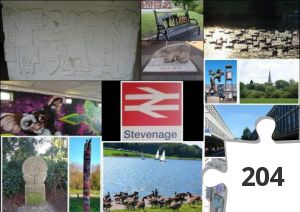
This simple puzzle involves completing a jigsaw puzzle of sights of Stevenage which will reveal the coordinates to the hide.
The link to the online puzzle is :