The Perplexing Puzzle Series #44: Canis latrans
This cache is placed by permission of the land manager of Sumter National Forest- Long Cane Ranger District. These caches are easy to find in order to reduce the impact on the environment. However, they do require a short hike on the trails. Please practice Leave No Trace outdoor ethics by being respectful to the area and please do not bushwhack! You are looking for a black film canister. Most caches are placed at the base of a tree, but look at the hints for specific details. The difficulty ratings mostly reflect the difficulty of the puzzles. Maybe you will see a coyote while visiting Sumter National Forest. Use caution if you see a coyote recieving a package from Acme Corporation. Have fun and remember to bring a pen!
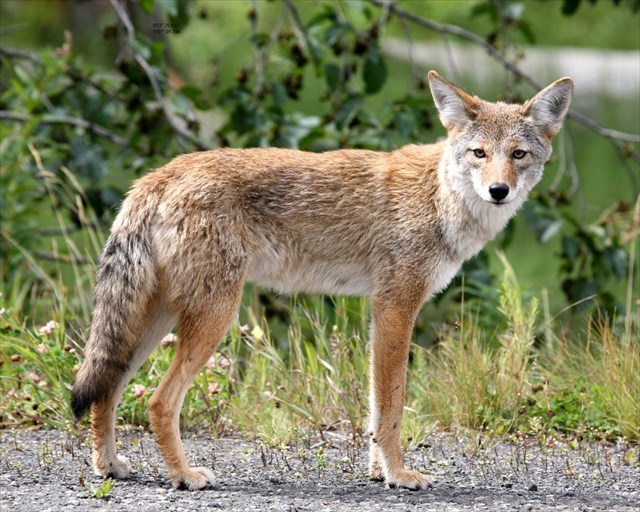
TheNcoyote (Canis latrans) is a species of canine that is native to North America. The coyote3is closely related to eastern and red wolves. Due to its3ecological similarities to the Eurasian golden jackal, zoologists often refer to the coyote as the American jackal.
The coyote is3abundant throughout North America and has populations as far south as Central America. The coyote is versatile and able to adapt to a variety of environments including urban areas. In recent decades, the coyote has exponentially increased its range in North America. Despite rumors that SC DNR introduced coyotes to control the deer population, coyotes first appeared in South Carolina in 1978 as a result of the coyote expanding its range. In addition, illegal importation of coyotes for hound running was a contributing factor. Currently, the coyote is present in all counties of South5Carolina.
The coyote8has 19 recognized subspecies. The coyote sometimes mates with gray, eastern, or red wolves which3produces “coywolf” hybrids. In the northeastern regions of the United States, there is a larger subspecies known as the eastern coyote that has historically bred with various wolf species. Genetic studies8show that most North American wolves contain some level of coyote DNA.
CoyoteWmales average between 18 to 44 pounds; whereas, females average between 15 to 40 pounds. Coyote8sizes vary by geographical locations. Northern2subspecies tend to average 40 pounds, but the southern subspecies of Mexico only average 25 pounds. The largest recorded coyote was killed in Afton, Wyoming in 1937 and weighed 75 pounds.
The5coyote is mostly carnivorous and has a diet that consists of dead bison, deer, sheep, rabbits, hares, rodents, birds, reptiles, amphibians, fish, crustaceans, and insects. On rare occasions, coyotes will consume bear cubs, fishers, harp seals, and rattlesnakes. In addition, the coyote occasionally consumes plant products such as berries, tree fruits, melons, peanuts, and carrots. Coyotes tend to work as a team when hunting large animals and work singly when targeting smaller prey. Coyotes cache excess food for later consumption and sometimes urinate on their food to claim ownership of it. Oddly, coyotes occasionally form hunting relationships with badgers by helping each other dig up rodents. As part of this relationship, coyotes have been observed showing affection to badgers by laying their heads on them or licking their faces.
Coyote7attacks on humans are extremely rare, but they have become more frequent with increased interactions between the two species. The majority of these attacks took place in California. One2contributing factor is that urban coyotes are losing their fear of humans. This5problem is exacerbated by humans intentionally and unintentionally feeding coyotes. Some coyotes have begun to show aggressive behaviors towards humans such as chasing joggers and bicyclists, confronting people walking their dogs, and stalking children. It is believed that reports of aggressive coyotes in the northeast are the result of coywolves.
Coyotes are one of the most abundant livestock predators and contribute to the majority of sheep, goat, and cattle losses. Coyotes are also drawn to residential properties by trash cans with food scraps, pet food, bird feeders, and small pets such as cats and dogs. Unfortunately, there have been many reports of coyotes preying on pets. In some locations, feral cats are the coyotes’ main source of food.
Coyotes are also problematic for deer hunters. The coyote preys heavily on deer fawns which negatively affects deer populations. The SC DNR reports that since 2002 the white-tailed deer population has declined by more than 30%. In addition, 50% of fawn mortalities are believed to be the result of coyote predation.
Coyote hunting is a popular form of predator hunting and most jurisdictions have little or no regulations concerning coyote hunting. The SC DNR encourages coyote hunting to reduce the negative impact the species could have on deer and small game populations. In addition, government agents routinely shoot, poison, and kill coyotes to protect livestock.
You can learn more about coyotes' interactions with humans by visiting the following site: Coyotes & Humans