Seawall
A seawall is a form of defence constructed where the sea, and associated coastal processes, impact directly upon local landforms. Its purpose is to protect areas of human habitation, conservation and leisure activities from the action of waves and tides.
Living Seawall
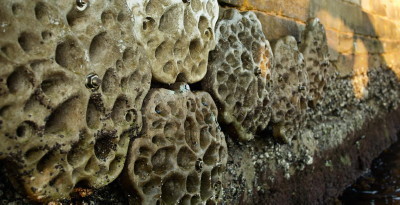
Over the last 20 years, North Sydney Council has partnered with the Sydney Institute of Marine Sciences and the Reef Design Lab to research ways of making seawalls a more natural environment for marine life. Various designs of tiles have been tried.
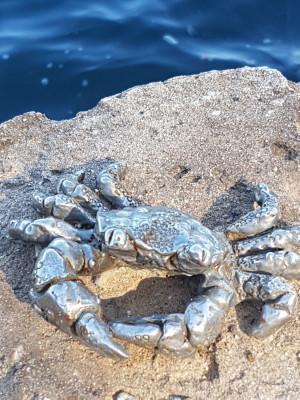
At the posted co-ordinates you will notice some small metal sculptures along the top of the seawall. These creatures are making their way -symbolically- to the 'living seawall'. To find the cache you will need to count these sculptures from your starting point all the way to the stairs just to the left of the panels at WP2, where you can collect the rest of the necessary data to give you the final co-ordinates.
The panels display not only information, but also 3D examples of the 'habitat tiles' successfully added to the seawall at Sawmillers Reserve. If you peer over the top of the seawall opposite the panels, you can glimpse some of these added tiles and get a first hand view of how this 'living seawall' is already working.
The cache is hidden at:
S 33° 50.ABC' E 151° 12.DEF'
Panel 1 - This Seawall is Alive
A = the final digit of the year in line 6 of the text.
Panel 2 - What Lives on Seawalls?
C = the number of letters in the omitted word in the following text.
"Can you see any ..............., snails, oysters" etc
Panel 3 - What do Habitat Panels Do?
B = the number of Chitons on the **3D** metal plaque, minus 2
Foreshore walk from the posted co-ordinates.
DE = the number of sculpted metal crabs along the top of the seawall + 5 - !!see hint!!.
F = the number of sculpted metal seagulls along the top of the seawall.


*** FTF Honours go to EverestHigh. Congratulations! ***