“Let this great wonder of nature remain as it now is. You cannot improve on it. But what you can do is keep it for your children, your children’s children, and all who come after you, as the one great sight which every American should see.” Teddy Roosevelt on the Grand Canyon in 1908. President Roosevelt declared the Grand Canyon a national park, understanding more than most it can only be seen to be understood.
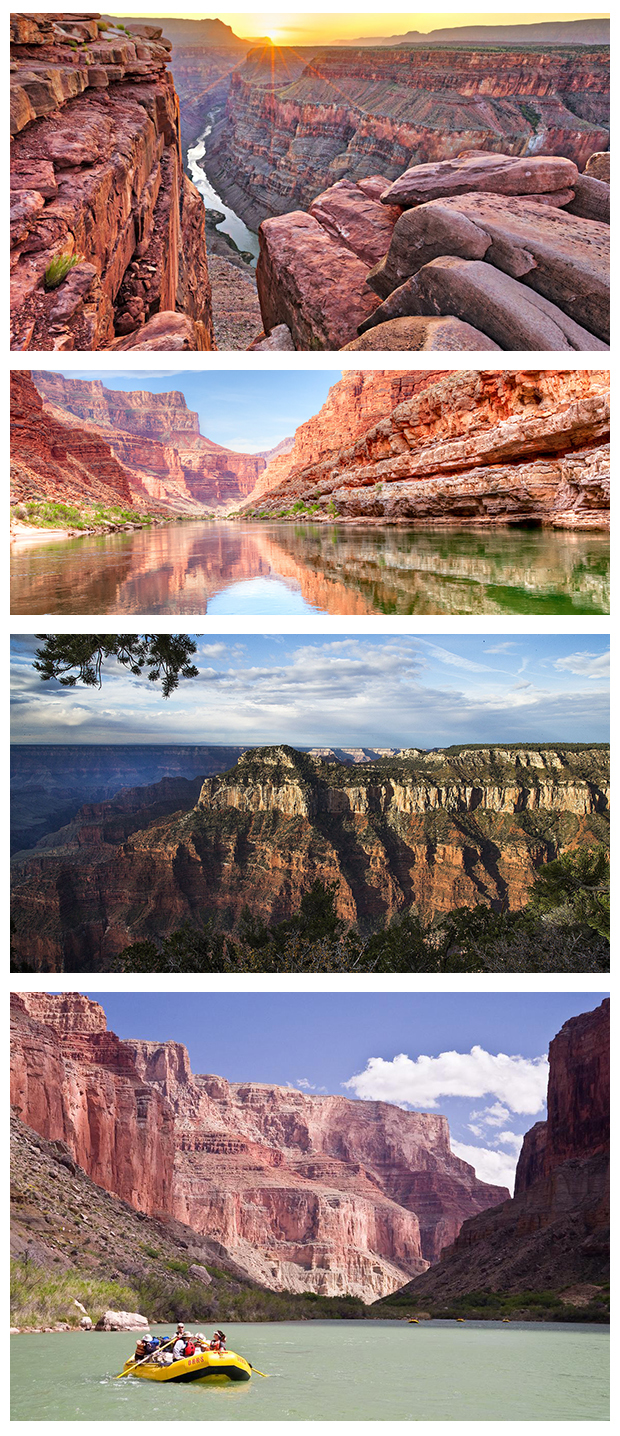
There are two public areas of Grand Canyon National Park, the North and South Rims. At 7,000 feet above sea level, the Grand Canyon South Rim is the most accessible section of the national park, with numerous places where visitors can pull over to admire the views. The Grand Canyon North Rim, 1,000 feet higher than its southern sibling, isn't as popular because it is harder to get to.
Grand Canyon is considered one of the finest examples of arid-land erosion in the world. Incised by the Colorado River, the canyon is immense, averaging 4,000 feet deep for its entire 277 miles. ... However, the significance of Grand Canyon is not limited to its geology. The Park contains several major ecosystems as well.
The Grand Canyon was a far-off distant land in the late 1800s, only the most adventurous of explorers could rough the elements to see its remote location in northern Arizona. But American ingenuity was hard at work in the form of railroads. Grand Canyon Railway made its first journey to the Grand Canyon on September 17, 1901, and continues to provide passengers today with a journey into the canyon so appropriately called Grand.
Geocache is on the RIGHT side of the trail.
***CONGRATULATIONS TO Flagg2007 FOR FTF***