An esker is a glacial deposit of sand and gravel that usually forms a winding ridge along the land. As a glacier slowly moves along, a river may form on along the top and then escape to the bottom of the glacier through a hole called a moulin or mill well. Boulders, rocks, sand, gravel, clay, and silt are carried in the melt water down through the hole and the heavier boulders and rocks are often deposited into a pile called a kame, and then sand and gravel is deposited, while the lighter materials continue to be washed away with the melt water. The sand and gravel form ridges and often link kames together. The steep sides of an esker are formed by the pressure of the sides by the glacial ice.
The esker at Birds Hill differs from the majority of eskers, due to it being broader and lower and having less steep sides. The Birds Hill esker is about 6 kms in length and part of a series of eskers and kames, which include Griffiths Hill in Birds Hill Park, 11 kms northeast, Oak Hummock which is 10 kms southeast, and Moose Nose, which is 8 kms east. At the pointed coordinates, you are standing at the most westerly end of the esker and the most extraordinary feature of this esker was the envelope of till (unstratified drift or materials not organized into distinct layers) covering the esker’s western quarter. The occurrence of a till envelope or mantle upon an esker is rare and would have been caused by the readvance and retreat of an ice-front over perhaps a decade of summers.
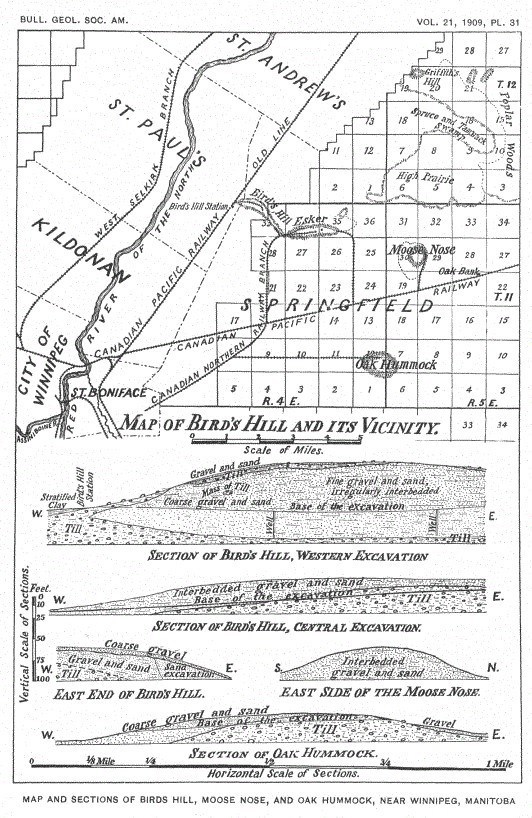

WARREN UPHAM; Birds Hill, an esker near Winnipeg, Manitoba. GSA Bulletin ; 21 (1): 407–432.
Before you can log this Earthcache as a find, you must email or message me the answers to the questions. Do not answer the questions in your log.
1. What is the elevation (in metres) at the posted coordinates?
2. What is the elevation (in metres) at the water level of the quarried out esker?
3. What would have been the elevation (in metres) of the crest of the esker ridge prior to excavation?
4. What rare occurrence did this esker have and what caused its formation?
5. Post a photo of yourself at the bottom of the excavation (optional). Is there any remains of the esker in your photo?