The Tuia Mātauranga Pōkai Whenua GeoTour follows the footsteps of early explorers of Aotearoa New Zealand taking you to places where leaders of the past searched for food, resources and ways to adapt and survive in this new land.
Use the Pōkai Whenua GeoTour as your classroom to explore the stories of the past, in the present, to preserve what is unique in Aotearoa New Zealand for the future.
Collect the codewords to get the Geocoin puzzle pieces.
To be able to complete this GeoTour and receive your special Geocoin collectable, remember to take a note of the codeword placed in the cache. This will need to be recorded in your passport which can be downloaded here .
63 of the 150 Pōkai Whenua GeoTour caches will contain a randomly placed special FTF token (a replica of the Tuia Mātauranga GeoTour commemorative coin). This is yours to keep! If you find more than one, you might consider leaving it for the next person who finds the cache.
Pukaha, the national Wildlife Centre at Mt Bruce, has long been a centre of excellence in the captive breeding of indigenous bird species. Holding native birds in captivity serves several purposes. They can be a research opportunity to closely observe behaviour, a chance for members of the public to see rare species without endangering fragile island ecosystems, and serve as a pool population as insurance against any calamity in a wild population.
Today the main focus of Pukaha is on re-establishing populations of native birds across New Zealand.
This work goes back to the 1970s. At the time the Mt Bruce aviaries were home to at least four species of native parakeets. The numbers of the red-crowned kākāriki got so large that it was decided to attempt to establish a wild population by liberating some on an offshore island. The first kākāriki were released on Tiritiri Matangi in the Hauraki Gulf in 1975. I (Mark) became involved a few months later when I visited Tiritiri as one of a group of university students lead by Dr John Craig. The birds had established themselves on the island, and I asked whether I could do my masters thesis research on the island’s new kākāriki population. A second shipment of kākāriki was received the next year. We liberated most of these on Tiritiri, while a few were kept in an aviary at Auckland University for me to study. The birds were all banded with colour coded rings to allow individual recognition. It was quite exciting in my second year to find a banded male mated with an unbanded female that had been hatched on the island in the first breeding season.
In 1977 we made an attempt to liberate the remaining birds from the university aviary at Huia in the Waitākere Ranges. We built aviaries at Huia and housed the birds in them for a few weeks before opening the doors. Kākāriki spend some time feeding on the ground, which makes them vulnerable to predators. On one visit to Huia I witnessed a kākāriki being attacked and killed by a stoat. Unfortunately, this liberation did not lead to the establishment of a wild population, but it did lead to ideas as to how further liberations could be better managed.
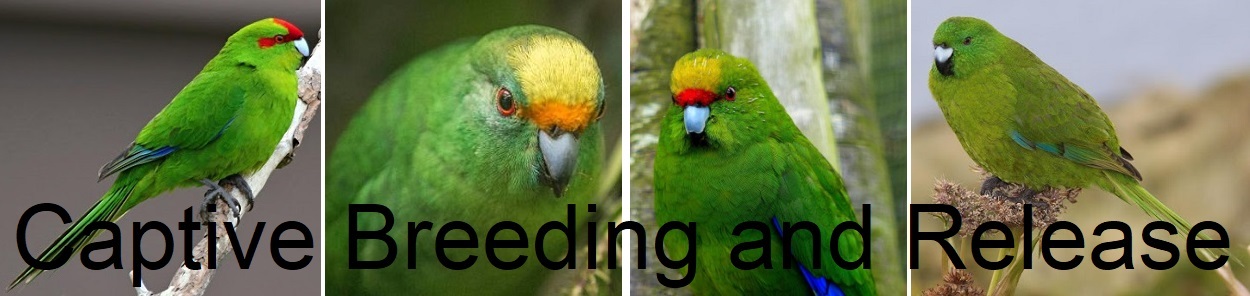
New Zealand has 5 species of kākāriki:
The red-crowned kākāriki is relatively common on offshore islands. Populations have been re-established on Tiritiri Matangi Island, Cuvier Island, and Whale Island by liberating captive bred birds.
The yellow-crowned is found mostly in denser forest throughout the mainland.
Forbes Parakeet is similar to the yellow-crowned and found only on the Chatham Island group.
A sub-species of the red-crowned and a distinctive all green kākāriki species are confined to the Antipodes Islands. Their populations are stable but vulnerable to any arrival of mammalian predators.
The orange-fronted kākāriki is New Zealand’s rarest parakeet, and rarest forest bird, with an estimated population of 100-300 birds confined to a 30 km radius in beech forests of upland valleys within Arthur’s Pass National Park and Lake Sumner Forest Park in Canterbury. DOC aims to ensure the survival of orange-fronted parakeets on the mainland and to establish populations on predator-free islands. All known populations are closely monitored. Research focuses on their breeding by doing nest searches and inspecting the nest holes for their level of fledging success.
A captive breeding programme was started in 2003, when eggs were taken from the wild and foster birds successfully raised the off-spring. Since then more than 400 orange-fronted parakeets have been bred and raised for release on predator-free islands and back into Canterbury valleys. Eggs are still harvested from the wild to maintain the genetic diversity of the parakeet populations.
The cache is hidden in a replica of the nesting boxes that were placed on Tiritiri island to encourage the liberated kākāriki to breed. It soon became obvious that these were not needed, as the birds found many natural breeding holes in the mature trees on the island.
In keeping with the conservation theme of this Geotour, all our caches and logbooks are made of recycled materials, or items we had on hand already.
You will need to apply the word “NEST” to gain entry to the cache.