The posted coordinates are a good place to park and start.
PETROLOGY
Petrology Is the branch of geology that studies rocks and the conditions under which they form. Petrology has three subdivisions: igneous, metamorphic, and sedimentary petrology. Igneous and metamorphic petrology are commonly taught together because they both contain heavy use of chemistry, chemical methods, and phase diagrams. Sedimentary petrology is, on the other hand, commonly taught together with stratigraphy because it deals with the processes that form sedimentary rock.
TERMINOLOGY
In petrology the term "chert" is used to refer generally to all rocks composed primarily of microcrystalline, cryptocrystalline and microfibrous quartz. The term does not include quartzite. Chalcedony is a microfibrous (microcrystalline with a fibrous structure) variety of quartz. Strictly speaking, the term "flint" is reserved for varieties of chert which occur in chalk and marly limestone formations. Among non-geologists, the distinction between "flint" and "chert" is often one of quality – chert being lower quality than flint. This usage of the terminology is prevalent in North America and is likely caused by early immigrants who brought the terms from England where most true flint (that found in chalk formations) was indeed of better quality than "common chert" (from limestone formations).
LIMESTONE
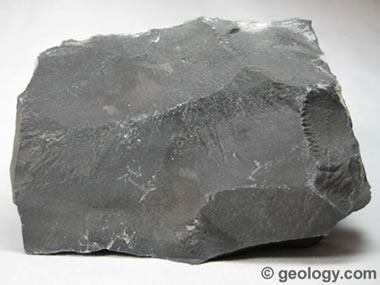
Limestone is a sedimentary rock composed primarily of calcium carbonate (CaCO3) in the form of the mineral calcite. It most commonly forms in clear, warm, shallow marine waters.
CHALK
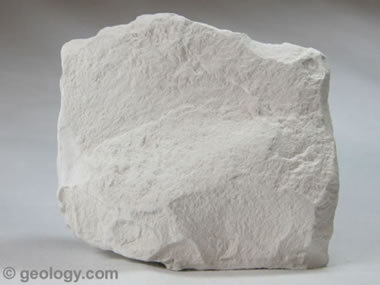
Chalk is a variety of limestone composed mainly of calcium carbonate derived from the shells of tiny marine animals known as foraminifera and from the calcareous remains of marine algae known as coccoliths. Chalk is usually white or light gray in color. It is extremely porous, permeable, soft and friable.
CHERT
Chert occurs in carbonate rocks as oval to irregular nodules in greensand, limestone, chalk, and dolomite formations as a replacement mineral, where it is formed as a result of some type of diagenesis. Where it occurs in chalk or marl, it is usually called flint. It also occurs in thin beds, when it is a primary deposit (such as with many jaspers and radiolarites).
FLINT
Flint is a sedimentary cryptocrystalline form of the mineral quartz, categorized as the variety of chert that occurs in chalk or marly limestone. Flint was widely used historically to make stone tools and start fires.
THE MISSISSIPPIAN PERIOD
The Mississippian is a subperiod in the geologic timescale or a subsystem of the geologic record. It is the earlier/lower of two subperiods of the Carboniferous period lasting from roughly 358.9 to 323.2 million years ago. The Mississippian was a period of marine transgression in the Northern Hemisphere: the sea level was so high that only the Fennoscandian Shield and the Laurentian Shield were dry land.
WHY HERE?
All of the boulders lining this parking lot were taken from a local quarry in Bayport MI, about 35 miles away. Bayport Limestone was formed near the end of the Mississippian Period.
LOGGING REQUIREMENTS
In order to log this EarthCache, send me your answers to the following questions either through email or messaging from my profile page.
Select one boulder along the parking lot edge to make your observations. Answer all the questions based on the boulder you selected.
1: Describe the size, shape, color and texture of the nodules in the boulder you selected.
2: How many nodules are visible in the boulder you selected. Count on all visible sides.
3: Using the information on this cache page, do you feel these nodules are chert or flint? Please explain your answer.
* Pictures are not required but are appreciated. Please post a pic of you or your GPS with anything you find interesting around the park.
References
Geology of Michigan
John A Dorr Jr and Donald F Eschman
https://geology.com
I have earned GSA's highest level:
 |