The Giant Union Rock is one of the largest granite rocks in the world.
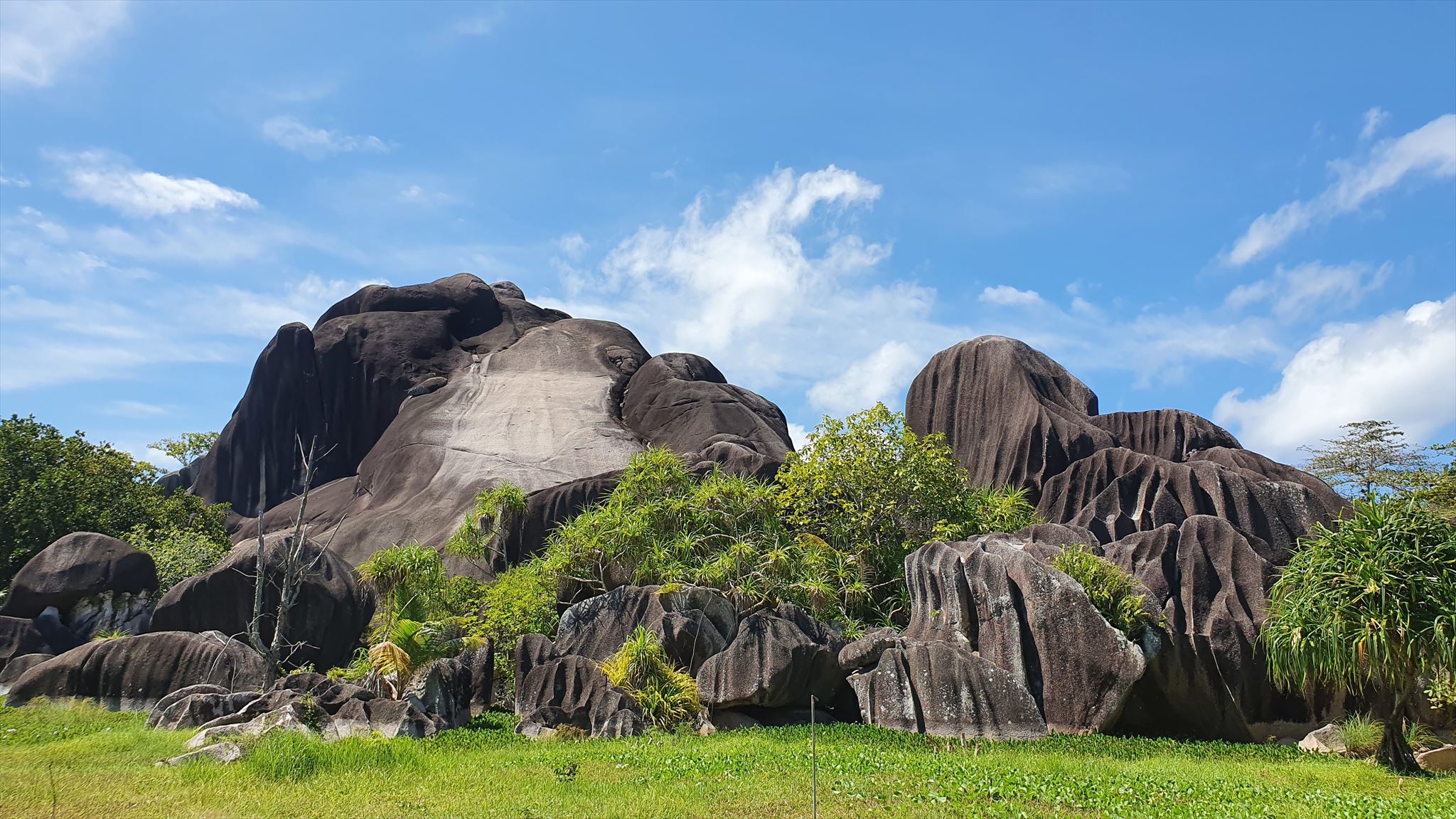
It is located in the L'Union Estate nature reserve on La Digue, not far from the world-famous and beautiful Anse Source d'Argent. Besides the Giant Union Rock, the Aldabra Giant Tortoise enclosure is another popular tourist attraction.
The opening hours of the L'Union Estate Nature Reserve are 6 a.m. to 6 p.m. daily. Entry to the L’Union Estate costs 115 rupees.
The Giant Union Rock occupies an area of 4,000 m², and is estimated to be around 700 million years old.
There is nice YouTube video at https://www.youtube.com. Click on the link to see the sunset at Giant Union Rock.
The Seychelles are islands in the middle of the Indian Ocean. They were once the center of the prehistoric continent of Gondwana. Millions of years ago it broke into the southern continents of America, Africa, Australia, India, Antarctica and the Arabian Peninsula.
The Seychelles are divided into two groups. There are the inner and outer Seychelles. While the outer Seychelles are all coral islands that were formed from coral sand, the islands of the inner Seychelles are mainly made of granite.
Everywhere in the inner Seychelles you can admire the sometimes huge rocks that are rounded off by the sea and wind, such as the Giant Union Rock.
They lie on the beach and are piled high there.
The granite boulders that can be found all over the Seychelles did not simply rise from the sea or were created by an overwater eruption of a marine volcano.
The Seychelles have their origin in the so-called continental drift. This means the shift of the continents.
While about 200 million years ago all the continents were united to form a gigantic primary continent, in the course of time these moved further and further apart.
In the past, today's India was off the east coast of Africa. India then moved further and further away from Africa and approached the Asian continent from the south, until it finally united with it.
As a result of this drifting apart from Africa and India, some "chunks" remained in the sea again and again on the long journey. These include Madagascar and Sri Lanka, among others.
And the inner Seychelles are also one of these holdovers. The Seychelles are actually a land mass that used to belong to the mainland, which today lies in the middle of the Indian Ocean between Africa and India due to the continental drift.
On the five pictures you can see exactly how the continents have moved over the last 200 million years. Africa is shown in yellow, India in red. And Madagascar and the Seychelles are colored green.

Granites are massive and relatively coarsely crystalline igneous rocks (plutonites). They are rich in quartz and feldspars. But also contain dark minerals, especially mica. Granite corresponds in its chemical and mineralogical composition to the volcanic rhyolite. Granite is usually massive.
The word granite is often used as an umbrella term for various plutonic rocks that are more or less similar to the actual granites in terms of their color, texture, grain size, their chemical composition and their mineral composition. These are granodiorites and tonalites as well as monzonites, diorites and anorthosites. These rocks, if they have a quartz content of more than 20%, are summarized under the generic terms granitoids or granitic rocks. Monzonites, diorites and anorthosites have less than 20% quartz and should therefore not be referred to as "granite" or "granitoid".
Granites are formed by the crystallization of molten rock (magma) within the earth's crust. Mostly at a depth of more than two kilometers below the surface of the earth. In contrast to this are the volcanic rocks, where the magma penetrates to the surface of the earth. Granite is therefore a deep rock (plutonite). Rocks that solidify very close to the earth's surface (less than two kilometers), on the other hand, are called volcanites.
In most cases, granites are not formed from the material of the earth's mantle, but from melted material from the lower earth's crust. Periods of 10 to 15 million years must be expected for the formation of magma chambers.
Logging conditions:
In order to log this Earth-Cache you have to fulfill the following tasks:
Go to the given coordinates. You will find the answers to the following questions:
- Estimate the height and the length of the Giant Union Rock?
- Take a closer look at the stones and describe their color, texture and grain size.
- What kind of rocks do you think Giant Union Rock is made of?
- If you compare the stones with other granites in the Seychelles, what differences do you notice?
- At waypoint 2 there is a silver sign on the rock. What is written on the first line?
Send your answer via GC before logging online.
Take a picture of yourself, your GPS, a personal item or a sign with your GC name either from waypoint 1 in front of the rock or from waypoint 2 in front of the Aldabra Giant Tortoise enclosure. Upload this picture (like the example-pictures below) with your log.
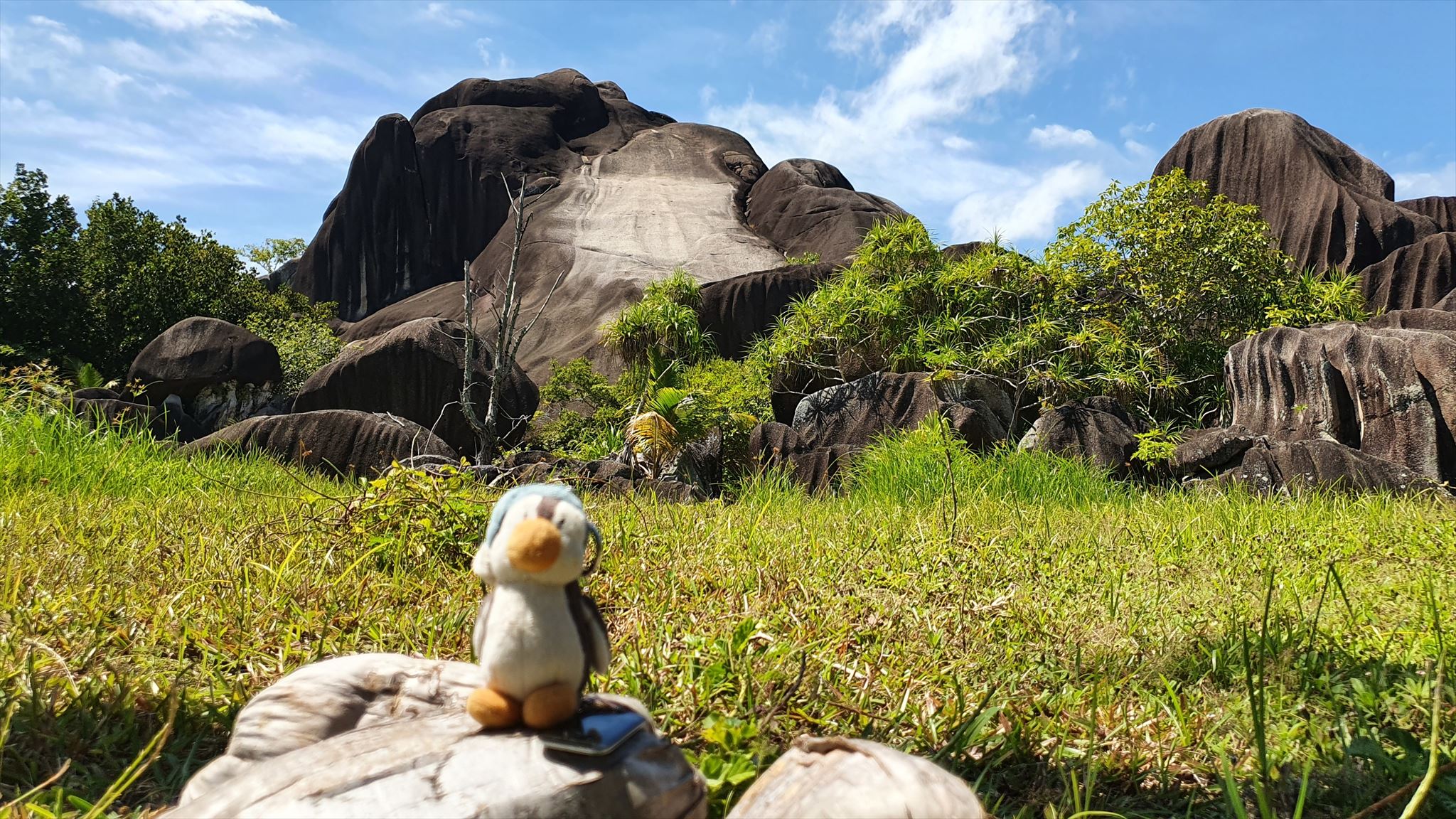
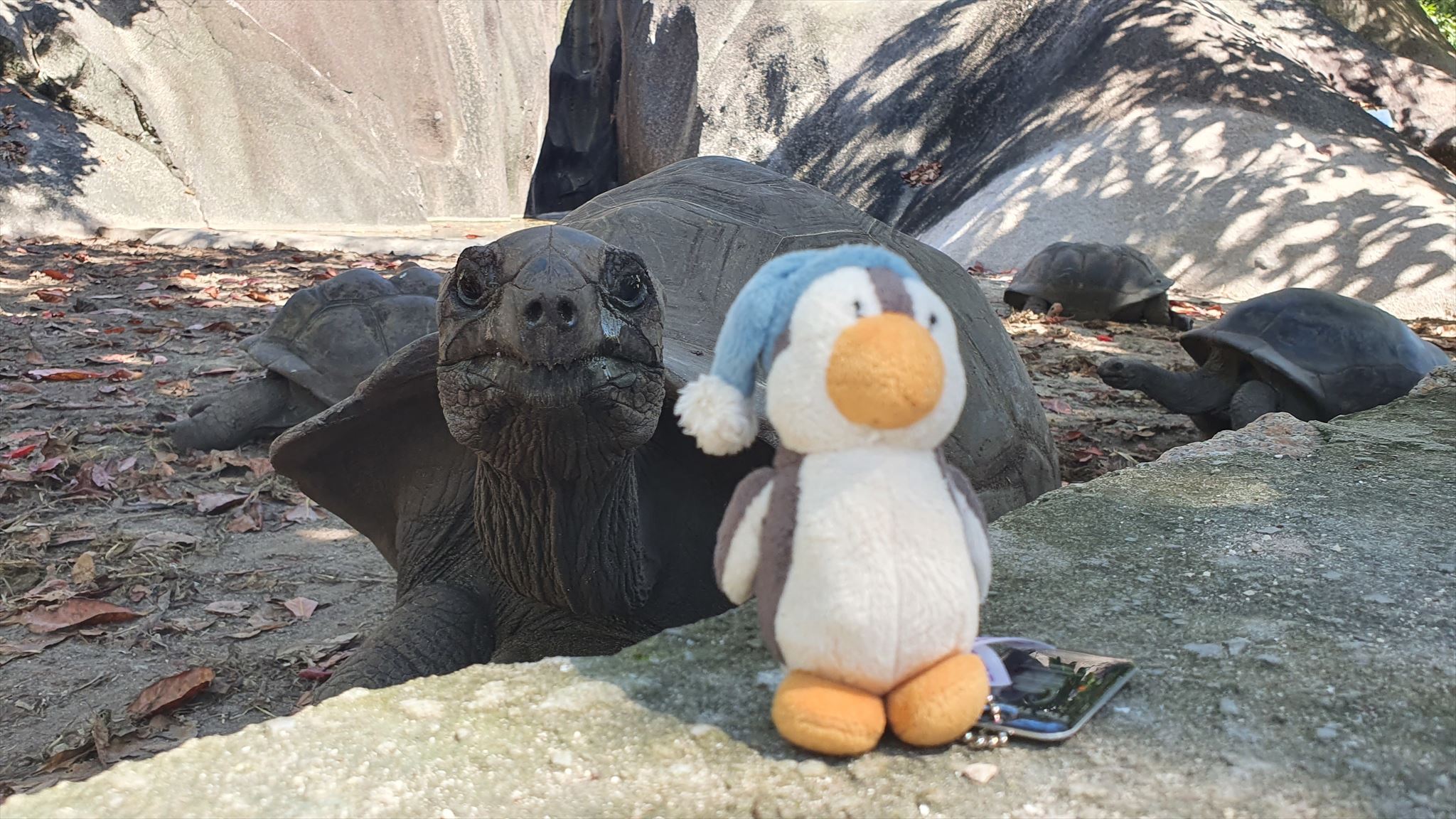
There is no need to wait for a log permission! You can log immediately after you sent us your answers! We will contact you if there is a problem with your answers.
We will remove the log if you don't respect the rules.
Enjoy your stay on the Seychelles and have a safe trip back home!
Wild_Bee_
If you want, you can copy the banner into your profil:
<a href="http://coord.info/GC92V4N" target="_blank"><img height="120" src="https://s3.amazonaws.com/gs-geo-images/24b8943b-923c-4b89-8c60-24cdb2a94d0d.png" /></a>
