
The Tuia Mātauranga Pōkai Whenua GeoTour follows the footsteps of early explorers of Aotearoa New Zealand taking you to places where leaders of the past searched for food, resources and ways to adapt and survive in this new land.
Use the Pōkai Whenua GeoTour as your classroom to you explore the stories of the past, in the present, to preserve what is unique in Aotearoa New Zealand for the future.
Collect the codewords to get the Geocoin puzzle pieces
To be able to complete this GeoTour and receive your special Geocoin collectable, remember to take a note of the codeword placed in the cache. This will need to be recorded in your passport which can be downloaded here.
This is straightforward offset multi cache at the site of a famous battle during the 1800's. There is already a traditional cache at Te Kooti's pā. This multi will take just 10 minutes to complete and the cache is less than 100m from the display board. Access the car park by driving down a short gravel road. Look for the signpost on the State Highway to find the road to the virtual coordinates.
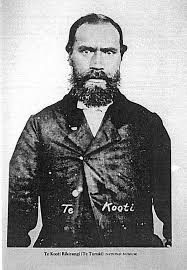
Te Pōrere Redoubt is the earthworks of a Māori fortification built by the prophet and warrior Te Kooti. You can read more about Te Kooti at end of this cache description.
The last major battle of the New Zealand Wars was fought at Te Pōrere, in the shadow of Tongariro, on 4 October 1869. This was a defensive position styled ineptly on a European redoubt. Te Kooti was defeated by a combined force of Armed Constabulary and Māori fighters. These forces attacked the rifle pit and lower redoubt before proceeding towards the upper redoubt. The upper redoubt was taken relatively quickly. Although Te Kooti lost the middle fingers of his left hand, he avoided capture by escaping into the nearby bush. The battle of Te Pōrere resulted in 41 casualties - 37 of Te Kooti's supporters were killed, whilst the government forces only suffered four losses.
Te Pōrere has been set aside as a Māori and Historic Reserve. The short walk up to the two redoubts is well worthwhile. To find the cache answer the following questions all of which can be found on the Te Pōrere A Rereao display board (left hand display board) at the car park.
A = 3rd number in the first date on the sign
B = time on the sign to walk to the upper redoubt (add the 2 digits together to get a single digit)
C = 4th number on the first date on the sign
R = Rereao was the grandson of ? (add up number of letters in name and divide by 2)
S = number of letters in the second word on the sign
T = number of letters in the first word on the sign
Where final is at South 39 02.ABC, East 175 35.RST Checksum = 35
For your safety, there is no need to search close to the stream.
So who was Te Kooti?
Te Kooti was of Ngāti Maru, a hapū from the Gisborne region. He converted to Christianity and, like other Tūranganui Māori, became involved in coastal shipping. In 1865 Te Kooti joined the government forces which fought 'rebel' Hauhau at Waerenga-a-Hika (near Gisborne). After the fighting he was held on suspicion of being a spy, a charge which was probably trumped up. He was exiled to the Chatham Islands with a number of Hauhau prisoners. While on the Chathams, Te Kooti experienced spiritual visions and founded the Ringatū Church, which was grounded in both the Old Testament and Māori custom. On 4 July 1868 Te Kooti led an escape of the Chatham Island prisoners on a seized vessel. They landed just south of Poverty Bay. Reginald Biggs, the resident magistrate at Gisborne, demanded that Te Kooti's party give up their arms. When they did not, he pursued and attacked them, and the war began.
During the next few months Te Kooti was successful in a series of battles, and for a few weeks in November/December 1868 he controlled much of the Poverty Bay district. After the execution of about 70 Pākehā and Māori (including women and children) at Matawhero the government became all the more grimly determined to capture or kill him. A massive bounty of £5,000 – equivalent to $580,000 today – was placed on his head. Government forces applied a scorched earth policy so that the Tūhoe tribe could not shelter Te Kooti and the dwindling remnants of his band. One by one the Tūhoe leaders were forced to surrender. Stripped of his main support, Te Kooti took shelter at Te Kūiti, in the King Country, until he was pardoned in 1883. However, he was never allowed to go home to Tūranganui. During this period he developed the rituals of the Ringatū Church. By the late 1870s the faith had spread widely, and his reputation as a prophet and healer grew rapidly. He died in 1893.