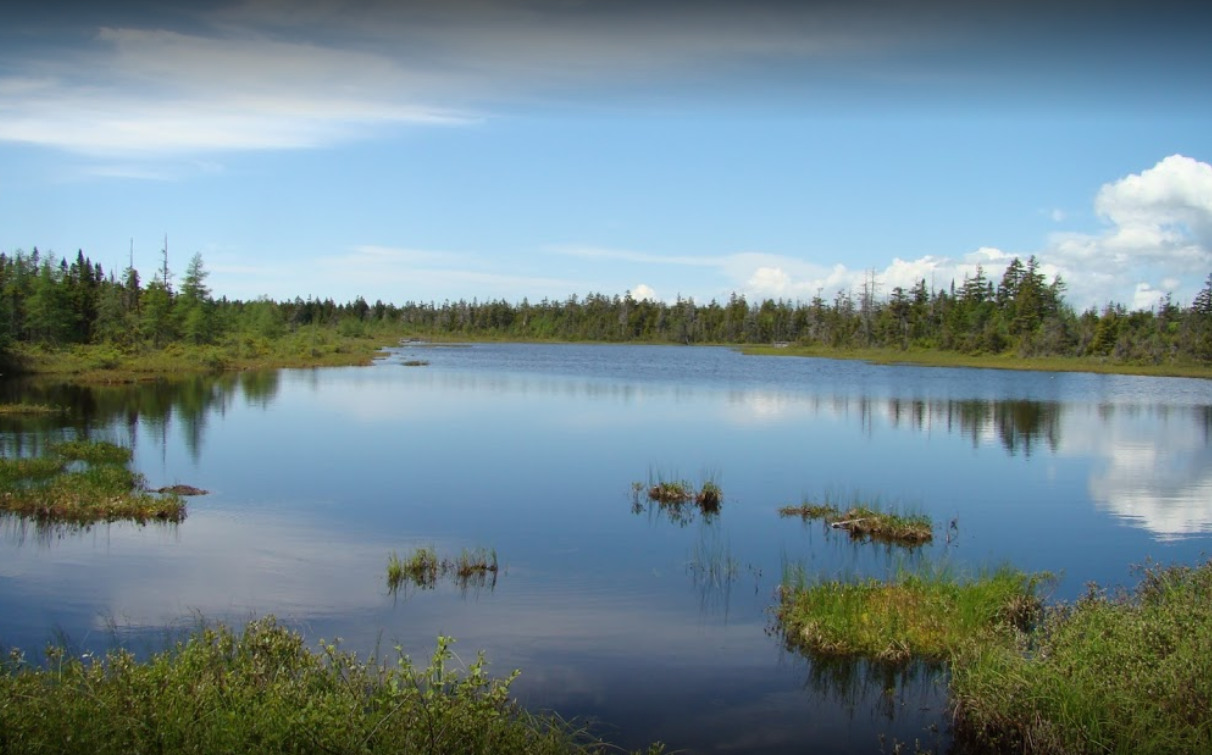
Caribou Lake is located within Fundy National Park in New Brunswick. The park contains the world's tallest tides which rise up to 12 meters or more. Caribou Lake is located slightly inland from the Bay of Fundy and the hike is approximately 1 km round trip. Here you can also observe three species of carnivorous plants.
You may be wondering why it is called a lake, and not a pond since the lake looks big to be considered a pond. The naming tends to be arbitrary, and the body of water will often retain the original name give by the early settlers. From a limnologists' point of view (person who studies freshwater), there is a difference between a pond and a lake. The definition is not concrete but it mainly depends on depth and temperature. Lake only has rooted plants growing around edges since sunlight cannot reach bottom in all areas. During the summer if deep enough to stratify into 3 distinct layers, one warm on top, cold bottom, and layer of rapidly changing temperature in between (thermocline), it is a lake. A waterbody with one or two weakly defined layers is a pond.
Lake aging is natural process by which a lake fills in over geologic time. From the time a lake is created through glacial action, the aging process begins. The order of natural succession is lake to pond, pond to marsh, marsh to meadow, meadow to dry land. Lakes are divided into three trophic categories: oligotrophic, mesotrophic and eutrophic. The prototypic oligotrophic lake is a large deep lake with crystal clear waters and a rocky or sandy shoreline. Both planktonic and rooted plant growth are sparse, and the lake can support a coldwater fishery. A eutrophic lake is typically shallow with a soft and mucky bottom. Rooted plant growth is abundant along the shore and out into the lake, and algal blooms are not unusual. Water clarity is not good and the water often has a tea color. If deep enough to thermally stratify, the bottom waters are devoid of oxygen. Mesotrophic is an intermediate trophic state with characteristics between the other two.
Now there is a third distinct body of water worth mentioning, a bog. A bog is a freshwater wetland of soft, spongy ground consisting mainly of partially decayed plant matter called peat. Bogs are generally found in cool, northern climates and often develop in poorly draining lake basins created by glaciers. All bogs take hundreds or thousands of years to develop. A bog is formed when a lake slowly begins to fill with plant debris. There are several distinct types of bog habitats. Blanket bogs develop in highland areas with significant rainfall: the bog "blankets" an entire area, including hills and valleys. Cataract bogs are ecosystems that feature a permanent freshwater stream. Quaking bogs develop over a lake or pond, with bog mats (dense layers of vegetation) about a meter thick on top. Raised bogs are vaguely dome-shaped, as decaying vegetation accumulates in the center. String bogs have a varied landscape, with low-lying "islands" interrupting the saturated bog ecosystem. Valley bogs develop in shallow valleys.
Following the advice of Public Health experts and continue to make every effort to limit the spread of COVID-19, please keep a 2-meter distance with other visitors. Enjoy yourselves and please respect the other visitors.
Logging Requirements:
- Would you classify this body of water as a lake, pond, or bog? What led you to this conclusions?
- Which phase of succession do you think this body of water is in? What do you imagine this will look like in 100 years? 1000 years?
- Upload a photo taken at the viewpoint overlooking Caribou Lake. You do not need to be in the photo though it is strongly encouraged.