
Introduction
With this Earthcache, after briefly describing the geology of the Death Valley National park area, we will focus on the comparison between Mars and Earth, focusing on Mars Hill.
Geology of the Death Valley National park
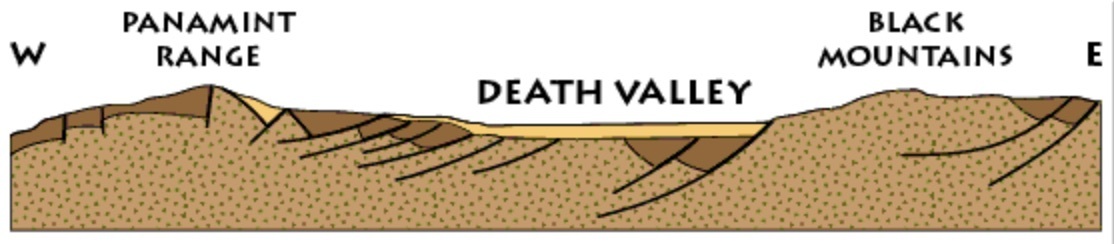
The deep Death Valley basin is filled with sediment (light yellow) eroded from the surrounding mountains. Black lines show some of the major faults that created the valley. (USGS image)
The Furnace Creek Fault system, located in the northern part of Death Valley, started to move about 14 Ma and the Southern Death Valley Fault system likely began to move by 12 million years ago.
Both fault systems are offset from each other; the area between the offset is thus put under enormous oblique tension, which intensifies subsidence there; Furnace Creek Basin opened in this area and the rest of Death Valley followed in stages. One of the last stages was the formation of Badwater Basin, which occurred by about 4 Ma. Data from gravimeters show that Death Valley’s bedrock floor tilts down toward the east and is deepest under Badwater Basin; there is 9,000 feet (2,700 m) of fill under Badwater. By about 2 Ma Death Valley, Panamint Valley and their associated ranges were formed.
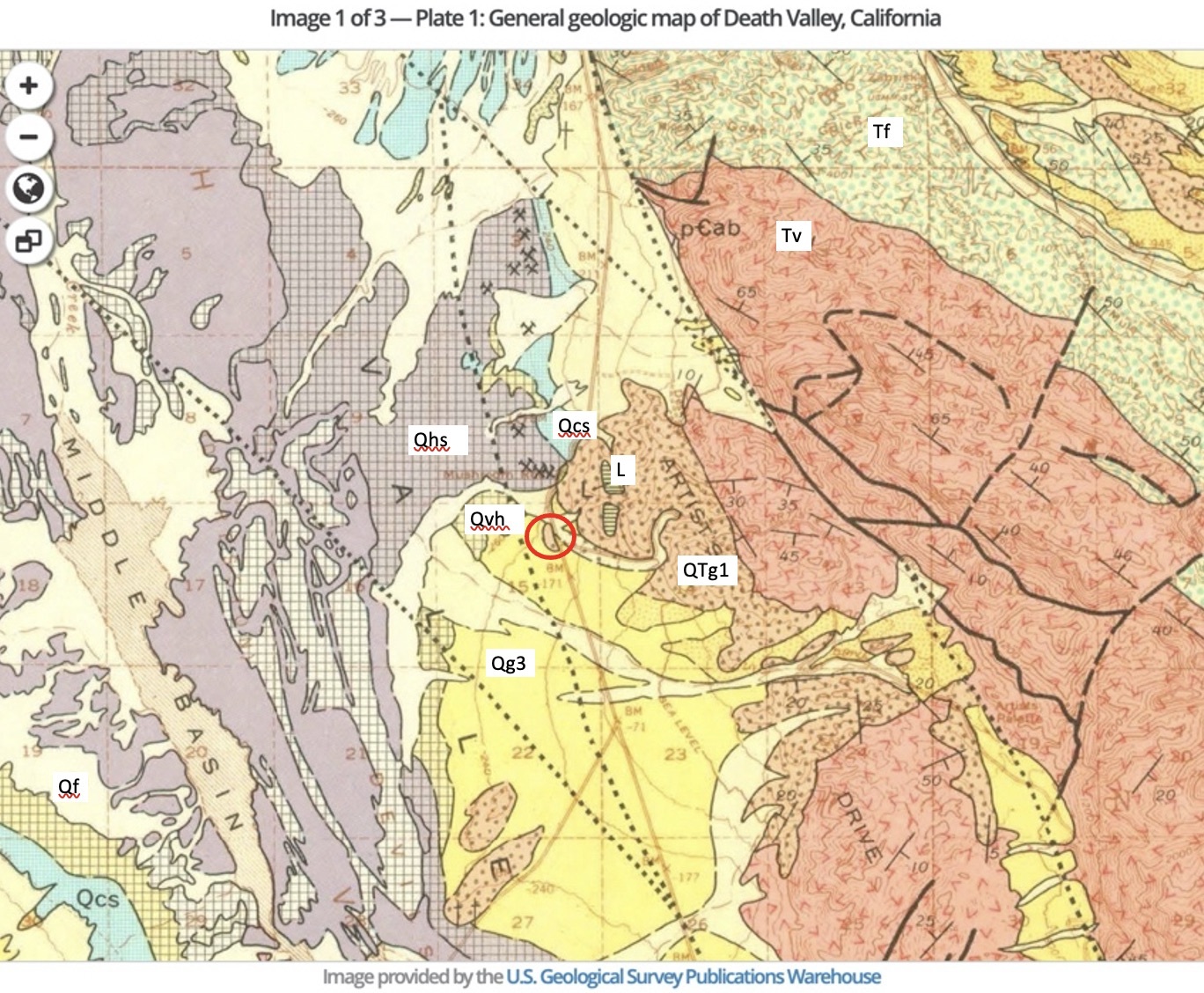
The exposed geology of the Death Valley area presents a diverse and complex set of at least 23 formations of sedimentary units.
In the above map, we can see several of them:
- Quaternary / Holocene:
- Qf: Fan gravel; silt and salt on floor of playa, less than 100 feet (30 m) thick.
- Quaternary / Pleistocene:
- Qch : saline facies – carbonate zone
- Qcs: Sand facies – Fan gravel; silt and salt buried under floor of playa; perhaps 2,000 feet (600 m) thick.
- Qhs: Silty rock salt – smooth facies
- Qg3: Fan gravel; silt and salt buried under floor of playa; perhaps 2,000 feet (600 m) thick.
- L: Lake deposits. Mostly loose shingled pebble-size gravel; little sand or silt; few cobbles. Occur in small bars and embank-cements.
- QTg1: Funeral fanglomerate – Cemented fan gravel with interbedded basaltic lavas, gravels cut by veins of calcite (Mexican onyx), basaltic cobbles; perhaps 1,000 feet (300 m) thick.
- Tertiary / Pliocene:
- Tf: Furnace Creek Formation – Cemented gravel, silty and saliferous playa deposits; various salts, especially borates, more than 5,000 feet (1,500 m) thick.
- Tertiary / Miocene:
- Tv: Artist Drive Formation – Cemented gravel; playa deposits, much volcanic debris, perhaps 5,000 feet (1,500 m) thick.
Mars on Earth
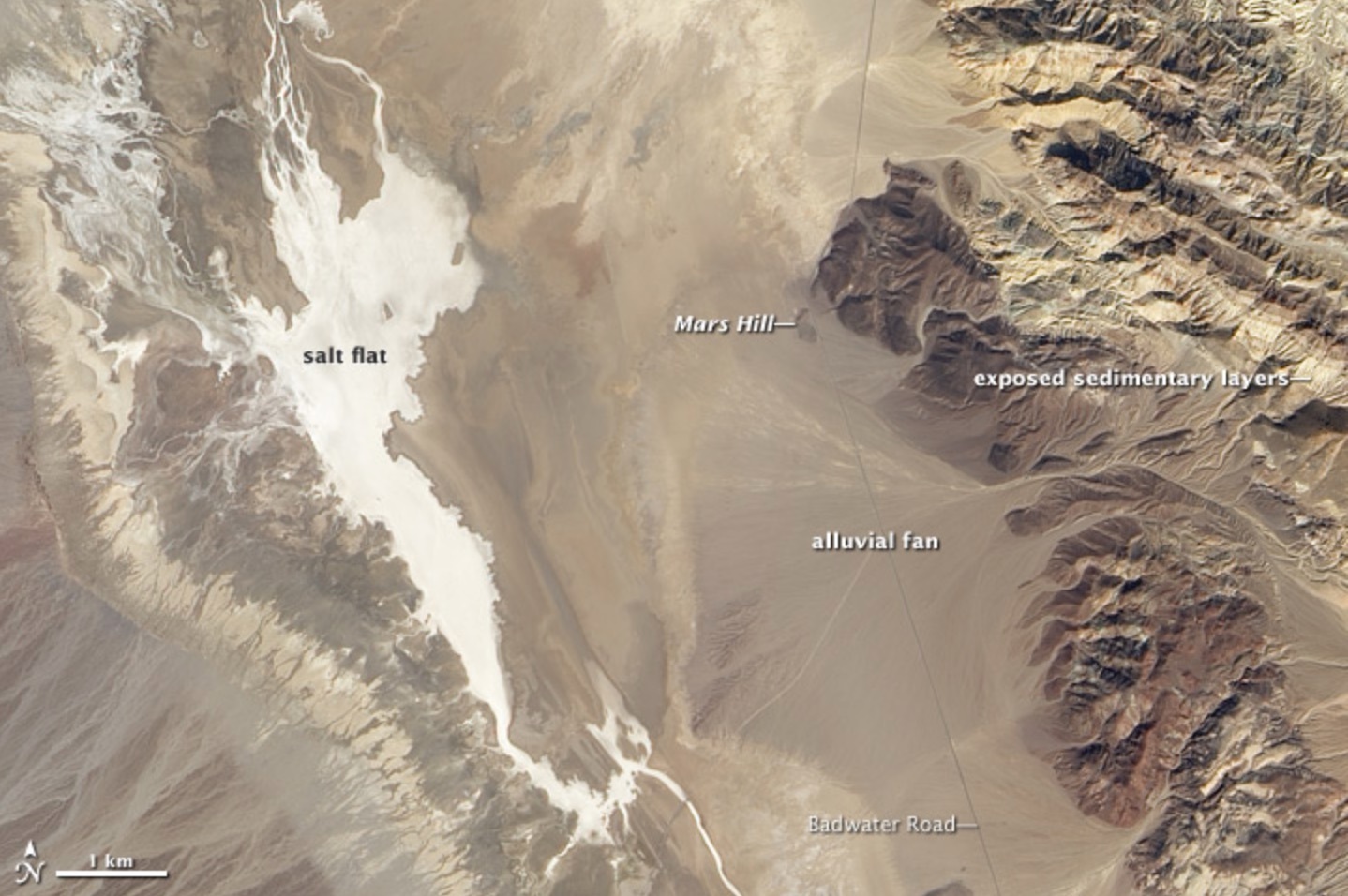
In the image above, captured in 2002 by the Advanced Land Imager on NASA’s Earth Observing-1 (EO-1) satellite, numerous alluvial fans are visible (similar to Martian landscapes). Water has transported tan sediment from the mountains (far right), depositing it in the series of fan-shaped patterns near the center of the image.
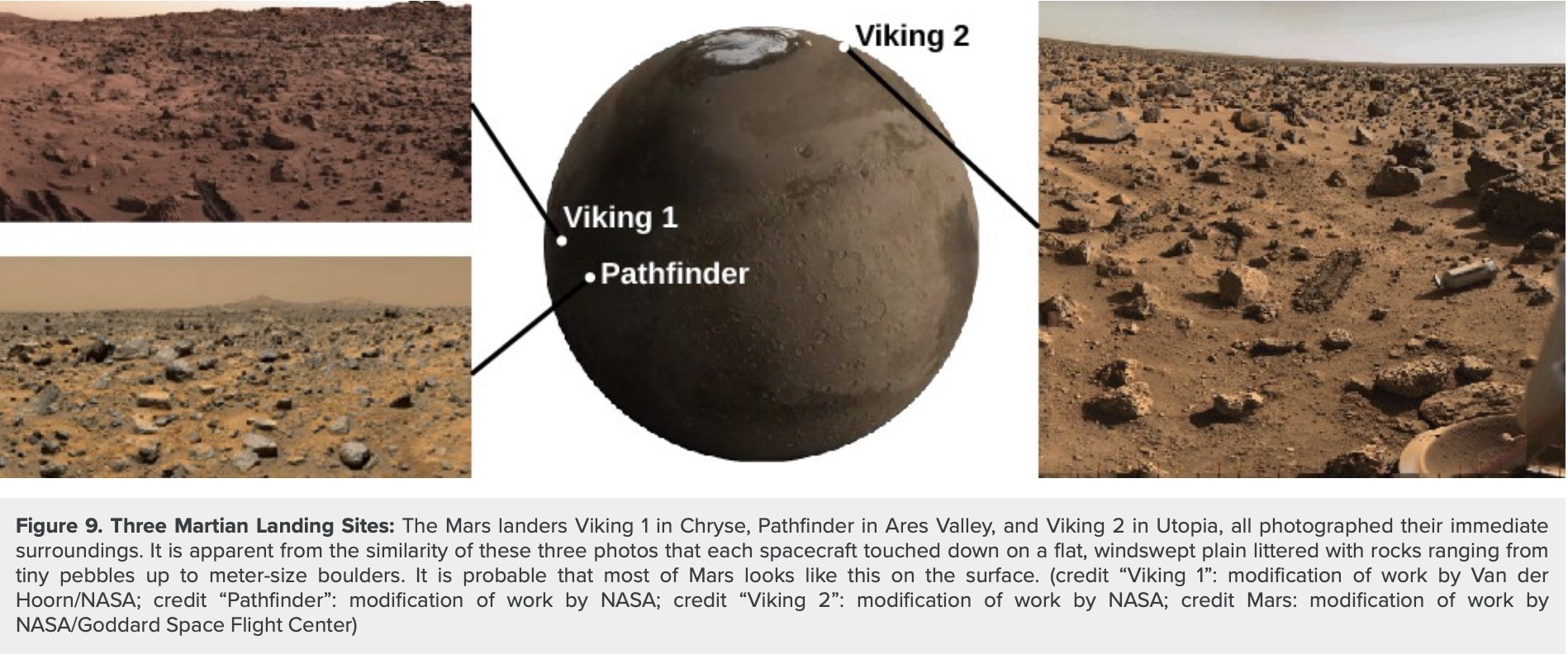
This part of Death Valley shares other characteristics with Mars, and the area has long been a favorite for scientists planning for Mars landing sites. Wind, volcanism, and alternating wet and dry conditions have left similar marks on the rocks of both Mars and the Mojave Desert. The dark patch north of the largest alluvial fan has even been called Mars Hillfor decades due to similarities to the rocks observed at the Viking 1 landing site from the 1970s. Mars Hill is the toe of an old alluvial fan, comprised of basaltic cobbles and gravels that stick out of the overlying, younger sediments (QTg1).
The salt pan on the left is another feature that makes this part of Death Valley interesting to Mars researchers. Badwater Basin and Gale Crater on Mars are both enclosed basins with no outflows, so the water flowing into them would form temporary lakes and eventually salt flats after the water evaporates.
Of course, there are also major differences between the geology of Death Valley and Gale Crater. “Death Valley is a much younger and more dynamic place than Gale Crater,” explained Aaron Zent, a planetary scientist at NASA’s Ames Research Center. “The valley floor is still sinking relative to the surrounding ranges, and more and more sediment is brought in, producing a sedimentary sequence that is mostly buried, with just a bit of salt on top. At Gale, the sediments, of whatever origin, are on top of the original crater floor and extensive salts, if present, are on the bottom and buried. If young, they may have been eroded and redistributed by the wind.”
Mars Hill
Mars Hill has been used to test engineering solutions to entry, descent, landing and trafficability problems of scientific craft bound for the planet Mars. In practice, this means that the rocks on the surface of Mars Hill are comparable in size, shape and abundance to those at the two Mars landing sites.
Mars Hill and some of the Mars landing sites, particularly during the Viking 1 and Pathfinder missions, share a similar geologic origin. For instance, the evolution of alluvial fans in windy environments, like Death Valley, has produced a very good analog to the surface roughness of the Mars landing sites. Examples of alluvial fans, desert pavement, ventifacts and sand tails almost identical to those on Mars will be examined as field trip participants explore Mars Hill.
Bibliographical sources
- https://ngmdb.usgs.gov/Prodesc/proddesc_4503.htm
- https://earthobservatory.nasa.gov/images/78860/mars-rover-curiosity-on-a-familiar-landscape
- https://courses.lumenlearning.com/astronomy/chapter/the-geology-of-mars/
- https://en.wikipedia.org/wiki/Geology_of_the_Death_Valley_area
To validate the Earthcache
WARNING, the elements to be discovered on this Earthcache are on a protected and fragile area. Respect it!
Log in this "Found it" cache and send me your proposals for answers, either via my profile or via geocaching.com (Message Center), and I will contact you in case of problem. Logs recorded without answers will be deleted.
Reminder about Earthcaches: There is no container to search or logbook to fill in. Just go to the site, answer the questions and send me the answers.
Stage 0 (OPTION) : add to your log a photo of you, your GPS or your nickname in front of Mars Hill. This photo will allow you to validate the "Found it" in case of wrong answer to the following questions. The photos giving the answers to the questions will be deleted.
Question 1: Could you give me 3 different areas similar to Mars on Earth (all located in Death Valley national Park)?
Question 2: Could you give me the name of the Mars Hill geological formation?
Question 3: At the WP, could you give me the nature of the cobbles you see? What is their average size and color?