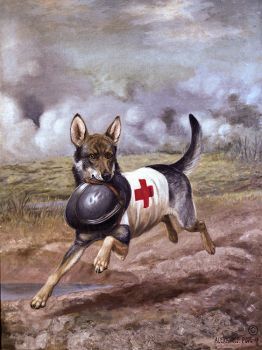
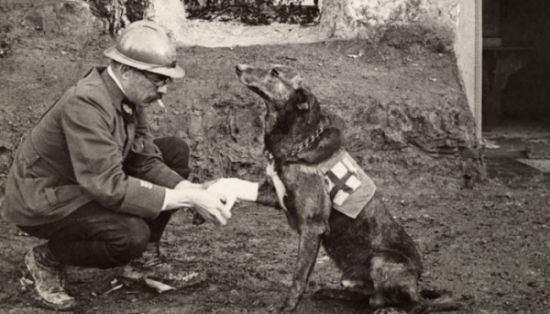
A more noble and humanitarian task that was common during World War I was the use of first-aid or Medical Corps dogs. These animals located wounded men among the dead and saved countless lives. Russian medical dogs of World War I were trained to drag wounded men to safety. This mission was continued mainly in the European Theater during World War II, most notably in the casualty-heavy fighting on the Eastern Front.
German first-aid dogs were trained to ignore men who were standing or walking and concentrated only on men lying on the ground. When a wounded man was found, the dog seized his holder, a short strap hanging from his collar, and ran back to his handler. The handler then leashed the dog, who led the medics back to the wounded soldier.
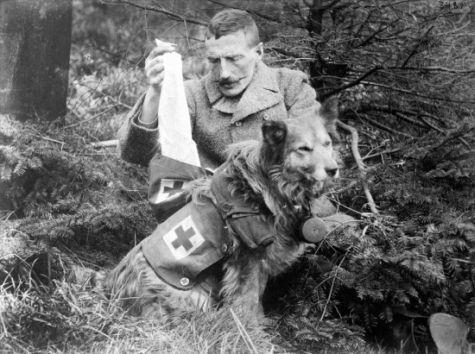
The British found search-and-rescue dogs of great value on the home front. In 1940, when Britain stood alone before the might of an undefeated Nazi Germany, the Luftwaffe droned over the isles dropping bombs on the cities below in an unsuccessful effort to break the will of the British people. Civilian casualties mounted to over 40,000 dead and more than three times that number wounded. Soldiers, firemen, and police used dogs to find survivors in the rubble of the bombed-out buildings.