The Jack Erskine building was completed in 1998. It was built to accommodate the departments of Mathematics and Statistics, and Computer Science, and those departments are still located in the building today (Computer Science has since been renamed to Computer Science and Software Engineering). A design competition was held for the building, and was won by the Auckland firm Architectus. The award winning design is very interesting. The Architectus page on the building is well worth a look. If the building is open when you visit, go in through the main entrance and you will find yourself in an impressive multi-story atrium.
I was a lecturer in Computer Science at the time of the move to to the new building, and was the coordinator for the project of moving the department into the new building (my office was the middle office in the lowest floor of offices in the central tower). Soon after moving into the Erskine Building, I had my first encounter with a GPS receiver. I got funding to buy a Trimble receiver that was put onto the roof of one of the towers. It was connected via a long cable to a server 5 floors below, and was used to provide a high-precision source of the current time.
The bridges of friendship garden was created in an area north of the building as part of the landscaping done around the new building. "The structure of the garden embodies modern ideas from computer science and mathematics".
The main feature of the garden is a representation of the famous Bridges of Königsberg problem. In the 18th century, Königsberg was a city on both banks of the Pregel River, and included two islands in the river. Six bridges connected an island to a river bank, and a seventh bridge connected the two islands. The problem to solve was: could you find a walk that crossed each bridge exactly once (without cheating by swimming across a river, or crossing a bridge twice). In 1736 Leonhard Euler proved that no such path existed. In the process, he laid the foundations for graph theory, which has many uses in the modern world. It provides a simple way of representing networks, such as road networks, and provides algorithms for solving problems relating to those networks (such as, what is the quickest way to get from my current location to some destination in the network?).
On the north island are a collection of light coloured tiles that make up a parallel sorting network. There are rows of individual tiles at each end, and a number of rows of pairs of tiles between them. Chalk lines have to be drawn in that link these tiles before the sorting network can be used, as per the diagram below.
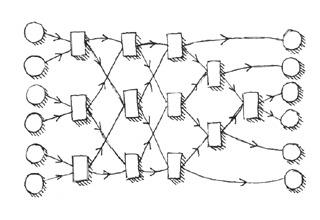
Let's say you had 6 people that you wanted to sort into order of (say) birthday. Each person would find an empty tile at the northmost row. They would then follow the line from the starting tile to a pair of tiles. There they would wait until there were two people on the pair of tiles. Then the one with earlier birthday would follow the left line leaving the pair of tiles, and the other would follow the right line. Each person would advance to another pair of tiles, and the process would continue until all six people arrive at the individual tiles at the south end. They would find themselves sorted into birthday order! This video shows a sorting network operating on a group of pupils who have been randomly allocated a number, and gives a good idea as to how it works.
Sorting is a common task in Computer Science, and where millions of items are being sorted it is important to do it efficiently. The "obvious" method of choosing the biggest item in the list, then the biggest of those remaining, and so on, is too slow to sort large collections. Thankfully much faster sorting methods exist.
The lighter tiles on the south island are a solution to the 8 queens problem (place 8 queens on a chess board so that no queen can take any other). This is an example of a problem where there is a huge number of placements (there are over 4 billion ways of placing 8 queens) but only a handful of valid solutions (under a hundred). For this type of problem, a "brute force" approach (generating all possible placements and checking each to see if it is valid) is going to take a very long time. An efficient algorithm takes account of the current queen placements when deciding which position to place the next queen in. For example, when placing the second queen you wouldn't place it in the same row, column or diagonal as the first queen. Doing this means the number of possible solutions considered is much smaller than the 4 billion possible placements). Lotto draws are another example where there are a small number of variables (the value of each ball drawn) that can take a small number of values, but there are a large number of possible outcomes. Another is arranging 9 cards (each containing four half animals) in a 3 by 3 grid of cards such that where two cards are next to each other then on either side of the join are the same animal, with the head on one card and tail on the other (see the cache page for T M N T for details of a puzzle cache of this type).
Another feature of the garden is a stone lantern that was donated by Kurashiki City, Japan, to celebrate the 25th anniversary of the sister city relationship between Christchurch and Kurashiki.
A binary counting fountain was built for the garden, but kept getting clogged with leaves and has been put into storage. The general idea is as follows. You have a series of containers (lets call them buckets; think something like the bucket fountain) arranged one above the other, with the bucket at each level twice the size of the one above. Let's say the top-most bucket is 1L and we have four buckets (so the other three are 2L, 4L and 8L). A bucket is stable when half-full. When completely full it empties into the bucket below. Above the top bucket is a water supply that delivers 0.5L at a time. Initially all buckets are empty. After the first 0.5L, the top bucket is half full. After the next 0.5L the top bucket is full, and empties into the second, which is half full. After the third the first and second buckets are half full. After the fourth, the top bucket is full, which empties into the second bucket, which is now full and empties into the third bucket (which is half full). After a time all four buckets are half full. The next half litre causes all to become full and then empty, leaving all four empty. The top row of the table below represents all four buckets being empty (a value of 0 means the bucket is empty and a value of 1 means it is half full). Each remaining row shows the bucket state after 0.5L of water was added to the top bucket when the bucket state was as per the previous row. The binary column is all four bucket values written next to each other, and the decimal column is the decimal equivalent of the binary value. The fountain is a binary counting fountain as each bucket represents a binary value (a 0 or a 1) and by adding water it counts up from 0 to 15, and then goes back to 0 again!
| 8L |
4L |
2L |
1L |
Binary |
Decimal |
| 0 |
0 |
0 |
0 |
0000 |
0 |
| 0 |
0 |
0 |
1 |
0001 |
1 |
| 0 |
0 |
1 |
0 |
0010 |
2 |
| 0 |
0 |
1 |
1 |
0011 |
3 |
| 0 |
1 |
0 |
0 |
0100 |
4 |
| 0 |
1 |
0 |
1 |
0101 |
5 |
| 0 |
1 |
1 |
0 |
0110 |
6 |
| 0 |
1 |
1 |
1 |
0111 |
7 |
| 1 |
0 |
0 |
0 |
1000 |
8 |
| 1 |
0 |
0 |
1 |
1001 |
9 |
| 1 |
0 |
1 |
0 |
1010 |
10 |
| 1 |
0 |
1 |
1 |
1011 |
11 |
| 1 |
1 |
0 |
0 |
1100 |
12 |
| 1 |
1 |
0 |
1 |
1101 |
13 |
| 1 |
1 |
1 |
0 |
1110 |
14 |
| 1 |
1 |
1 |
1 |
1111 |
15 |
Anyway, after that introduction, here's how to find the cache. It is located at S 43 31.ABC E 172 34.DEF, where:
- A = Digital root of the number of slats on the bridge that connects the two islands.
- B = Last digit on the plaque that acknowledges the contribution of Tad Takaoka.
- C = The number of queen positions marked by whole tiles.
- D = Digital root of the number of slats on the bridge that has the most slats.
- E = Digital root of the number of slats on the bridge that has the fewest slats.
- F = Digital root of the number of bumps around the base of stone lantern minus 2.
Checksum for A to F is 23.
Cache is a 200ml sistema. Please recover well. Note (2021-09-21): replacement cache is a few metres south of the original placement; I haven't updated the coordinates (the hint should lead to a quick find).
If you have a vehicle to park, I believe you can park on campus on weekends and public holidays, and after 5PM on weekdays (disclaimer: you may want to do your own research on the campus parking regulations just in case I've got that wrong!). Also, please visit the garden during daylight hours only.