Silver Bluff Geoart - Wood Stork 09
White Heron
Plate 386
White Heron
Ardea alba
"I had the pleasure of witnessing this sort of tournament or dress-ball from a place of concealment not more than a hundred yards distant. The males, in strutting round the females, swelled their throats, as Cormorants do at times, emitted gurgling sounds, and raised their long plumes almost erect, paced majestically before the fair ones of their choice...These meetings took place about ten o'clock in the morning, or after they had all enjoyed a good breakfast, and continued until nearly three in the afternoon, when, separating into flocks of eight to ten individuals, they flew off in search of food.
The American Egrets leave the Floridas almost simultaneously about the 1st of March, and soon afterwards reach Georgia and South Carolina, but rarely the State of New Jersey, before the middle of May. In these parts the young are able to fly by the 1st of August. On the Mule Keys off the coast of Florida, I have found the young well grown by the 8th of May; but in South Carolina they are rarely hatched until toward the end of that month or the beginning of June." John J. Audubon
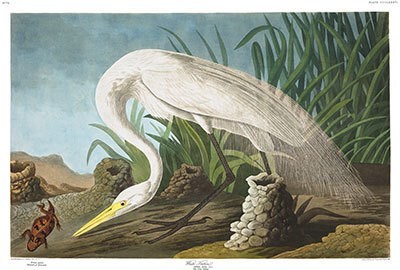
What was called the White Heron or American Egret in Audubon's day is now known as the Great Egret.
The posted coordinates are along Silver Bluff Road. Please do not go to the posted coordinates as they are on private property. Use the posted coordinates to locate to the beginning stage of your adventure, which is 0.37 miles from the posted coordinates at a bearing of 173°. You will see a fence, an information kiosk, and a building with a beautiful mural painted by the sanctuary manager.
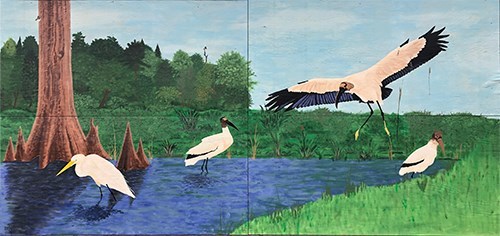
One of the birds portrayed in the painting is a great egret. Proceed by foot to the ponds and look to the southeast. You will notice a small structure near the second pond that is a viewing platform. You should visit the viewing platform to enjoy the area and to begin your search for the container. It is hidden in a spot that should not be unexpected for geocaches or letterboxes hidden in such a location.
The stamp inside of the container is intended for letterboxing, so please do not remove it.
Sliver Bluff Geoart Information
The geoart was created at a sanctuary in the area along the Savanna River called, Silver Bluff. The sanctuary is open from dawn to dusk, and permission for this hide was granted by the sanctuary manager. If you see sanctuary personnel during your visit, please thank them for supporting geocaching. The geoart consists of 55 geocaches in the shape of a wood stork. This sanctuary annually has hosted the largest inland concentration of foraging endangered wood storks in South Carolina. There were some caches already existing at the sanctuary, and they were incorporated into the geoart. The difficulty/terrain ratings of the 55 geocaches are all different and provide a diverse geocaching experience. When combined with the related geoart of 26 geocaches, all 81 possible D/T ratings are included.
Searching Guidelines
As you are searching for Silver Bluff Geoart caches, please follow the following guidelines.
- Parking along roads: There are dirt roads in the area. They are not heavily used, but please be careful. Please do not block the roads or park on the roads. Be sure to pull off of the dirt roads completely.
- Access to Authorized Personnel Only Areas: You are authorized to go past the signs that say, "Authorized Personnel Only" when searching for geocaches. Near the main office, there is a dirt road that has such a sign. There are some Terrain 1 (wheelchair accessible) caches down the road, and people are welcome to drive down that road into the authorized personnel areas for disability access. If you are asked about entering that area, just kindly mention that you are a geocacher who needs to take advantage of the disability access.
- Bird Boxes: There are many bird boxes in the sanctuary. No geocaches are hidden in bird boxes and there are no fake bird boxes. There might be some containers attached magnetically to the metal baffles below the boxes or on the ground by the boxes. Please be careful when approaching bird boxes, because there might be birds actively using them in the spring.
- Main Office, Trail Heads and Parking: You are welcome but not required to stop by the main office during your visit. Access to the trail heads is from the main parking area. There is also parking at Kathwood providing access to the walkways around the ponds.
John Audubon Drawing Information
The image on the cache page is from the original drawing by John James Audubon and was printed between 1827 and 1838. The bird-name link will take you to the complete information about the bird as originally written by John Audubon and have access to a free download of the plate. The description of the bird on this cache page is an excerpt from the original entry in Audubon's field guide.