Silver Bluff Geoart - Wood Stork 50
Carolina Parrot
Please read through the Searching Guidelines below before heading to the geocache.
There is import information to keep geocaching in good graces with the management.
Plate 26 Conuropsis carolinensis
"The flight of the Parakeet is rapid, straight, and continued through the forests, or over fields and rivers, and is accompanied by inclinations of the body which enable the observer to see alternately their upper and under parts. They deviate from a direct course only when impediments occur, such as the trunks of trees or houses, in which case they glance aside in a very graceful manner, merely as much as may be necessary. A general cry is kept up by the party, and it is seldom that one of these birds is on wing for ever so short a space without uttering its cry. On reaching a spot which affords a supply of food, instead of alighting at once, as many other birds do, the Parakeets take a good survey of the neighbourhood, passing over it in circles of great extent, first above the trees, and then gradually lowering until they almost touch the ground, when suddenly re-ascending they all settle on the tree that bears the fruit of which they are in quest, or on one close to the field in which they expect to regale themselves." John J. Audubon
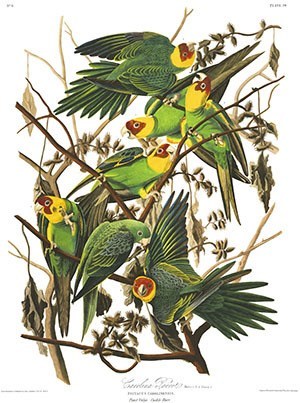
The Carolina parrot or Carolina parakeet is an extinct bird that was native in much of the eastern and midwestern United States. It was fairly common at the time that Audubon described it and painted plate number 26. Throughout the remainder of the 1800's this species became more rare. The last confirmed sighting in the wild was in 1910 and the last known specimen died in captivity in 1918.
Audubon painted the birds eating a cockle-bur plant. The seeds of these plants are toxic to most animals. It was thought that the parrots themselves were poisonous because there were reports that cats died from eating the birds.
Please solve the puzzle in order to obtain the coordinates for this geocache.
Silver Bluff Geoart Information
The geoart was created at a sanctuary in the area along the Savanna River called, Silver Bluff. The sanctuary is open from dawn to dusk, and permission for this hide was granted by the sanctuary manager. If you encounter sanctuary personnel during your visit, please be open and mention that you are geocaching. The geoart consists of 55 geocaches in the shape of a wood stork. This sanctuary annually has hosted the largest inland concentration of foraging endangered wood storks in South Carolina. There were some caches already existing at the sanctuary, and they were incorporated into the geoart. The difficulty/terrain ratings of the 55 geocaches are all different and provide a diverse geocaching experience. When combined with the related geoart of 26 geocaches, all 81 possible D/T ratings are included.
Searching Guidelines
As you are searching for Silver Bluff Geoart caches, please follow the following guidelines.
- Parking along roads: There are dirt roads in the area. They are not heavily used, but please be careful. Please do not block the roads or park on the roads. Be sure to pull off of the dirt roads completely. Please do not park near the gate at the end of Silver Bluff Road. Also, do not walk past that particular gate. Use the Quail Trail to access the caches at the south end of the sanctuary.
- Access to Authorized Personnel Only Areas: You are authorized to go past the signs that say, "Authorized Personnel Only" when searching for geocaches. Near the main office, there is a dirt road that has such a sign. There are some Terrain 1 (wheelchair accessible) caches down the road, and people are welcome to drive down that road into the authorized personnel areas for disability access. If you are asked about entering that area, just kindly mention that you are a geocacher who needs to take advantage of the disability access.
- Birdhouses: There are many birdhouses in the sanctuary. No geocaches are hidden in birdhouses and there are no fake birdhouses. There might be some containers attached magnetically to the metal baffles below the birdhouses or on the ground by the birdhouses. Please be careful when approaching birdhouses, because there might be birds actively using them in the spring.
- Main Office, Trail Heads and Parking: You are welcome but not required to stop by the main office during your visit. Access to the trail heads is from the main parking area. There is also parking at Kathwoods providing access to the walkways around the ponds.
John Audubon Drawing Information
The image on the cache page is from the original drawing by John James Audubon and was printed between 1827 and 1838. The description of the bird on this cache page is an excerpt from the original entry in Audubon's field guide. An Internet search of the bird name and plate number will enable you to locate the complete information about the bird as originally written by John Audubon and locate a high resolution image of the plate. A direct link is not provided with this geocache because it was deemed that doing so had the appearance of commercial content on the cache page.

You can validate your puzzle solution with certitude.