Silver Bluff Geoart - Wood Stork 43
Snow Bird - Dark-eyed Junco
Please read through the Searching Guidelines below before heading to the geocache.
There is import information to keep geocaching in good graces with the management.
Plate 13 Junco hyemalis
"The principal breeding places of this species are in the range of the Alleghany Mountains, and their spurs, commencing in the State of Virginia, and continuing eastward. It is merely a summer resident in the Fur Countries, where it is not common, and where it was not met with by Dr. RICHARDSON beyond the 57th parallel. I did not find it in Labrador, nor does it occur on the Rocky Mountains, where it seems to be represented by Fringilla oregona. My friend Dr. BACHMAN has seen it in the breeding season (June) in the mountainous districts of Virginia, in considerable numbers. At this season it has a sweet note. In July the young were full grown, and kept among the huckleberry bushes. It arrives in South Carolina in November, and departs in March. When kept in aviaries in that State, it appears to suffer much from heat, bathing frequently to cool itself, but it never breeds, and is always silent.
The nests were all situated on the ground, some of them having concealed entrances in the same manner as is frequently practised by the Song Sparrow, and their complement of eggs was four. The external diameter of the nest given me was four and a half inches its internal two and a half, the internal depth an inch and a half, the external about two. It is composed of stripes of bark, straw roots, and horse-hair, lined with fine moss and the soft hair of small quadrupeds. In size and appearance it is not unlike the nest of the common Fringilla melodia. The eggs measure six-eighths of an inch in length, five-eighths in breadth, and are more nearly spherical than any of the eggs of this genus with which I am acquainted. Their ground-colour is yellowish-white, thickly covered with small dots of a reddish-brown colour; in the broadest part of the egg the spots are more numerous and confluent, forming a crown or belt, but at the end they are more sparse."
John J. Audubon
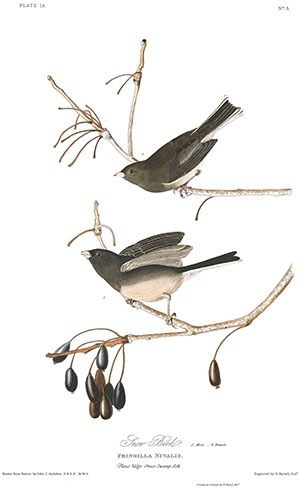
Please solve the puzzle in order to obtain the coordinates for this geocache.
Final Location is: N 33° 1S.NOW W 081° 5B.IRD
The dark-eyed junco is a common winter resident and is often found around bird feeders. When you see them feeding by your backyard feeder, you might notice that they consume their diet seven times more often on the ground. While you might find juncos in our area, they breed zero percent of the time in the CSRA. They build their nests and lay their eggs much further north, but can be found nesting on the ground in the mountains of the southeast, including northwestern South Carolina and northern Georgia. If you happen to walk past a junco nest while walking on a mountain trail in the spring, the adult will fly to a nearby tree and make sounds of an irritating eight, sharp, short notes. The eggs of the junco are almost round, three or perhaps a couple more can be found in the nest. The nests are usually concealed in small crevices in nearly vertical bank or among roots of trees.
Silver Bluff Geoart Information
The geoart was created at a sanctuary in the area along the Savanna River called, Silver Bluff. The sanctuary is open from dawn to dusk, and permission for this hide was granted by the sanctuary manager. If you encounter sanctuary personnel during your visit, please be open and mention that you are geocaching. The geoart consists of 55 geocaches in the shape of a wood stork. This sanctuary annually has hosted the largest inland concentration of foraging endangered wood storks in South Carolina. There were some caches already existing at the sanctuary, and they were incorporated into the geoart. The difficulty/terrain ratings of the 55 geocaches are all different and provide a diverse geocaching experience. When combined with the related geoart of 26 geocaches, all 81 possible D/T ratings are included.
Searching Guidelines
As you are searching for Silver Bluff Geoart caches, please follow the following guidelines.
- Parking along roads: There are dirt roads in the area. They are not heavily used, but please be careful. Please do not block the roads or park on the roads. Be sure to pull off of the dirt roads completely. Please do not park near the gate at the end of Silver Bluff Road. Also, do not walk past that particular gate. Use the Quail Trail to access the caches at the south end of the sanctuary.
- Access to Authorized Personnel Only Areas: You are authorized to go past the signs that say, "Authorized Personnel Only" when searching for geocaches. Near the main office, there is a dirt road that has such a sign. There are some Terrain 1 (wheelchair accessible) caches down the road, and people are welcome to drive down that road into the authorized personnel areas for disability access. If you are asked about entering that area, just kindly mention that you are a geocacher who needs to take advantage of the disability access.
- Birdhouses: There are many birdhouses in the sanctuary. No geocaches are hidden in birdhouses and there are no fake birdhouses. There might be some containers attached magnetically to the metal baffles below the birdhouses or on the ground by the birdhouses. Please be careful when approaching birdhouses, because there might be birds actively using them in the spring.
- Main Office, Trail Heads and Parking: You are welcome but not required to stop by the main office during your visit. Access to the trail heads is from the main parking area. There is also parking at Kathwoods providing access to the walkways around the ponds.
John Audubon Drawing Information
The image on the cache page is from the original drawing by John James Audubon and was printed between 1827 and 1838. The description of the bird on this cache page is an excerpt from the original entry in Audubon's field guide. An Internet search of the bird name and plate number will enable you to locate the complete information about the bird as originally written by John Audubon and locate a high resolution image of the plate. A direct link is not provided with this geocache because it was deemed that doing so had the appearance of commercial content on the cache page.

You can validate the Snow Bird puzzle solution with certitude.