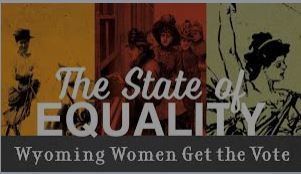
August 26, 2020 marked the 100th Anniversary of the passage of the 19th Amendment, giving women the right to vote.
This simply stated Amendment -- The right of citizens of the United States to vote shall not be denied or abridged by the United States or by any State on account of sex -- required a lengthy and difficult struggle; victory took decades of agitation and protest. Beginning in the mid-19th century, several generations of woman suffrage supporters lectured, wrote, marched, lobbied, and practiced civil disobedience to achieve what many Americans considered a radical change of the Constitution. Few early supporters lived to see final victory in 1920.
Between 1878, when the amendment was first introduced in Congress, and August 18, 1920, when it was ratified, champions of voting rights for women worked tirelessly, using a variety of strategies. 50 years earlier, when Wyoming was still a territory, legislators passed the Wyoming Suffrage Act of 1869. This act gave women in the territory the right to vote. Wyomians then turned their activism towards a national referendum. They persisted and 100 years later we celebrate their sacrifices.
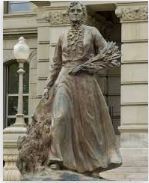
Celebrating Esther Hobart Morris (1812 – 1902), was the first woman in the United States to be appointed to a public office. Esther Hobart McQuigg, was born in Tioga County, New York, on Aug. 8, 1814, she was orphaned at age 11 and apprenticed to a seamstress and eventually became a successful hat-maker and businesswoman. In 1841, she married civil engineer Artemus Slack and gave birth to her first child, Edward Archibald or “Archy,” a year later. Three years after the wedding, her husband died and Morris moved to Peru, Ill. to settle his estate. Doing this, she faced difficulties as women were not allowed to own or inherit property. She re-married in 1850 to local merchant John Morris and gave birth to twin boys, Robert and Edward. In 1869, the family moved to gold-rush boom town South Pass City in the new Wyoming Territory, where John Morris opened a saloon.
Esther Morris had been living in South Pass City for less than a year before her appointment as justice of the peace in early 1870 at the age of 55. During her eight and a half months in office as a judge, she heard nearly thirty cases. Wyoming Territorial Secretary Edwin M. Lee wrote later that Morris’s court sessions were “characterized by a degree of gravity and decorum rarely exhibited in the judicature of border precincts.” He also said that during her administration, an “improvement in the tone of public morals was noticeable.” An April 1870 piece in Frank Leslie’s Illustrated Newspaper—a national publication—about Morris’s first day in the position focused, first, on her clothing. She wore “a calico gown, worsted breakfast-shawl, green ribbons in her hair, and a green neck-tie.” Later, however, the newspaper noted that Morris offered “infinite delight to all lovers of peace and virtue” and nicknamed her the “terror of all rogues.”
By 1890, when she was 75, Morris was well known in Wyoming as an advocate of woman suffrage. In statehood celebrations that July, she presented the flag of the new state to Gov. Francis Warren on behalf of the women of Wyoming. She died at 87 on April 2, 1902, in Cheyenne.
A statue of Esther Hobart Morris had been a prominent feature outside of the Capitol building in Cheyenne for decades. That was until the statue was moved indoors during recent renovations of the building. Sadly, the Hobart Morris statue currently resides in the basement hallway with no information about her place in history. Now, some are calling for the statue to make its way out of the garden level of the Capitol and back into the sunlight.
Now, to find the location of the final. From the posted coordinates at Esther Morris's gravestone look to the gravestone to the right. What is the occupant's first name? Enter this name into the Certitude checker below for the final coordinates and a bonus hint.

You can validate your puzzle solution with certitude.
Update: Helen Reddy, who popularized the song, "I Am Woman," that this series was based on died on 29 September 2020. RIP Helen.
