This is the fourteenth cache in my (and now others) Chorus Cabinet Art Series. This series is placed to highlight the local artistic talent that Chorus has commissioned to brighten up their otherwise boring Public Utility Boxes, (PUBs).
This is another Public Utility Box painting which is designed and painted by Gynelle Blake. I became aware of this one by following Gynelle's Facebook page, but it didn't say where it was so I asked Gynelle. Of course, by now we all know that P.U.Bs are out of bounds for placing caches, so to find this one from the communications box, project the final coordinates by going in the direction of 143 degrees for 108 metres. This will take you to an area near where there was once a Lee's Trees cache, but that has been a long time archived.
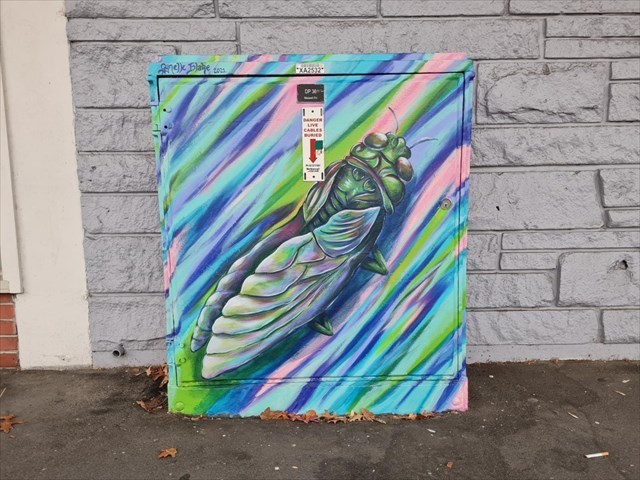
The chorus cicada, Amphipsalta zelandica, is the most common species of cicada in New Zealand, where it is endemic and found in most areas. They typically live in forests and areas with open bush, where their left-over nymph skins can be seen on tree trunks and branches during the summer months. The males produce their cicada sound in unison, which can reach deafening proportions at the height of their population around February. Groups of cicada can suddenly transition from the typical cicada sound to synchronised clicks, using their wings to clap against the surface they are sitting on.
Description
Chorus cicada have a nymph stage before their last molt and become an adult. During this nymph stage they are a soft and creamy white, and very similar looking to the adult form (but without wings). Adults are usually larger than 2 cm in length while the largest species are up to 4 cm; this includes the wings. Chorus cicadas’ wings only appear after molting to become adults, they are membranous with veins and they filter out ultraviolet light and the wing span is about 6 cm. The colour of the chorus cicada can be black/green/brown and many have stripes along their body. The antenna of the chorus cicada has seven segments with the seventh being constricted medially, which means the last segment is tightened towards the middle. The adult male cicadas differ from the females by the presence of a clasper sheath, and females do not have the finger-like extensions that the males have. The song made by cicadas is the loudest noise made by any insect. Male chorus cicadas produce a communication song that is specific to their species, and so species can be identified by their song. A pulse group of their song is made up of five clicks where the central click (third click) is stronger than the two on either side of it. The central click can become two clicks if the cicada is tired and has no energy. These clicks are made by the cicada hitting its wings against the surface it is sitting on. These pulse groups can be produced quickly and continuously in a prolonged note during chorus singing. Chorus cicadas are New Zealand's largest cicadas, with size averaging 40 mm.
Diet and Foraging
The adults and immatures of the chorus cicada both feed on xylem sap made from plants. This sap is low in nutrients and doesn't contain all the necessary amino acids, so to make up for this the insects rely on an endosymbiotic bacteria to provide the lacking nutrients from the sap. This type of food makes the chorus cicada a generalist feeder as it has a range of host plants that it feeds on. An orchard root system provides a good food source for the nymphs which live in the soil.
Distribution
Natural Global Range Chorus cicadas are endemic insects to New Zealand. The most closely related species are found in Australia, New Caledonia and Norfolk Island. However, some studies about the New Zealand fauna show that the fauna of New Zealand was from several invasions across the Tasman Sea from Australia or New Caledonia.
New Zealand Range Chorus cicadas are often found in towns and cities. They are distributed throughout the whole country, common in the North Island, some coastal areas of the South Island, central Otago and parts of Canterbury.
Habitat Preferences
Chorus cicadas are commonly found in open forests and woodlands but also sometimes found on buildings, fences or lamp posts. Cicadas prefer sub-tropical, sub-humid and temperate environments.