Kingley Vale National Nature Reserve
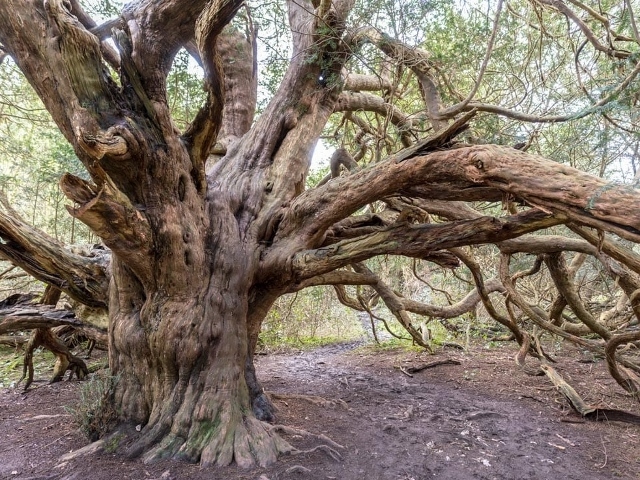
Kingley Vale is a 400-acre national nature reserve known for its ancient yews (some of which are over 1000 years old) and chalk grassland.
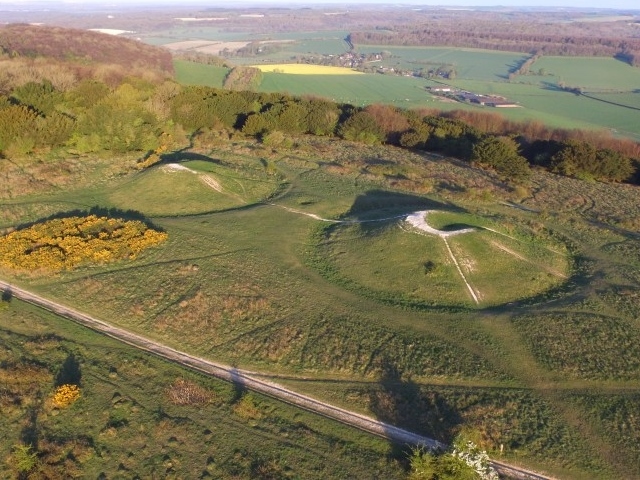
It is also one of the most important archaeological sites in southern England, with 14 scheduled ancient monuments including The Devil's Humps; 4 bronze-age barrows situated on Bow Hill.
It is a Site of Special Scientific Interest, a Special Area of Conservation and a Nature Conservation Review site, Grade I. This cache has been placed with the permission of the Kingley Vale NNR manager and will take you to the central dew pond within the reserve. In accordance with nature reserve rules, you are not allowed to camp within the reserve boundaries or light a fire or barbeque.
Dew Ponds
The shallow, saucer-like bowls of dew ponds are a characteristic feature throughout the South Downs. Traditionally used for watering sheep, shepherds would line them with puddled clay to prevent water from seeping down into the porous chalk. Today most dew ponds are better valued for their wildlife. Not only do they provide a breeding place for frogs, toads and dragonflies but also food and habitat for a host of other species from grass snakes to bats. In periods of drought, a pond is literally an oasis in a desert.
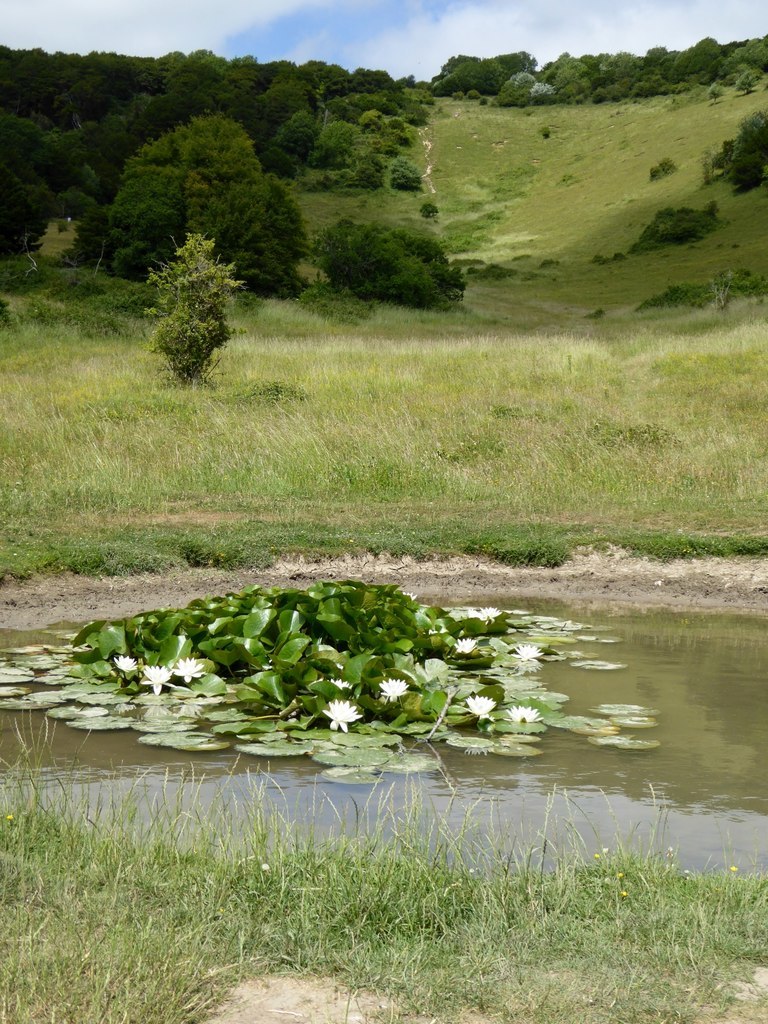 Photograph © Copyright David Smith and licensed for reuse under this Creative Commons Licence
This particular dew pond is situated right in the middle of a coombe and is thought to be at least 200 years old, although it could be much older, as there are signs of farming in the area which date back to the Bronze age. The clay originally used to line the pond would have been locally-sourced.
The pond had been repaired and maintained in the 1970s but by the end of the 20th century, it had fallen into disrepair. A project to re-excavate and restore it commenced in 2010, when a timber-edged shelf was built around the hole, which was itself lined with a sandwich of geotextile, EPDM liner and a layer of clay. The clay protects against puncturing by animal hooves and has provided a natural substrate from which the pond has been able to re-wild itself from whatever flora was otherwise dormant in the area, by self-setting and natural germination.
Look out for green woodpeckers hunting for ants on the grassland, as well as red kites and buzzards circling on the thermals above. There are also butterflies galore, including the beautiful chalk hill blue, holly blue and brimstone. Adders also make their home here so for your dog's safety (and the safety of ground-nesting birds and grazing animals) your dog MUST be kept on a lead at all times within the reserve.
The Cache
The cache is not at the published co-ordinates. In order to find it, you will need to answer the following questions and calculate the final location. You will have a walk of approximately 1 1/4 miles from the nearest place to park to get to the dew pond, which makes for a round trip of at least 2 1/2 miles - plus the extra distance to walk to and from the final location. The difficulty rating above reflects the amount of time this is likely to take, rather than how tricky the cache is to find. Please be aware that grazing animals (such as sheep or cows) may be present within the reserve, during your visit.
Before you reach the published co-ordinates (the location of the dew pond), you will walk past a visitor information cabin at waypoint 01. It may be locked for security reasons if no ranger is in attendance. Take a look inside, through the window for the winged creatures.
If Door = 1 and Skylight = 8, what number is:
- Common Buzzard? This is A.
- Sparrowhawk? This is B.
- Red Kite? This is C.
At the published co-ordinates, you will see a notice board, which gives lots of information about what you can see here.
Look at the paragraph entitled 'Adventurous Amphibians'
- What is the first word? This is D.
- How many species of newt are described in the first sentence? This is E.
Look at the paragraph entitled 'Deadly dragonflies'
- What is the second digit on the sixth line? This is F.
- What is the first digit on the sixth line? This is G.
Look at the paragraph entitled 'Plant-Life'
- How many letters in the seventh word? This is H.
- How many letters in the final word of the first sentence? This is J.
The cache can be found at:
N 50° 5(B-C).(B+E)(A+G)(H-F) W 000° (F-E)(F+G).(D+J)(C+G)(J-A)
Checksum of all 15 digits is 58.
The questions were changed on the 26th of January 2023 after the original notice board was replaced. The answers, formula and final location remain the same.
If you wish to add to the series, contact contact martletsman for a series number.