Kingley Vale Trail
A series of caches forming a circular walk of approximately 6 miles in this National Nature Reserve. This cache has been placed with the permission of the Kingley Vale NNR manager, who has asked me to remind you that you may encounter grazing livestock roaming free at certain times of year and that your dog MUST be kept on a lead at all times within the reserve.
Look out for... Smooth Newts
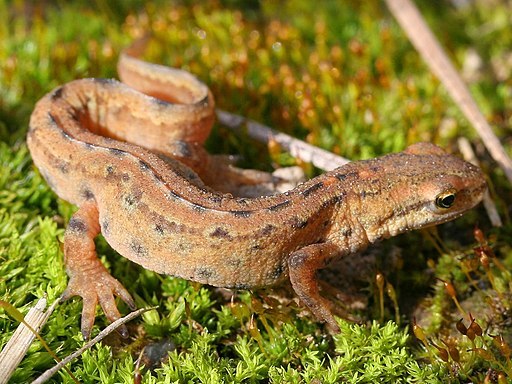
Kristian Peters, Triturus vulgaris maennchen cropped, CC BY-SA 3.0
Smooth newts (also known as European newts, Northern Smooth newts or Common newts) are amphibians, breeding in ponds during the spring and spending most of the rest of the year feeding on invertebrates in woodland, hedgerows, marshes and tussocky grassland. Smooth newts have been spotted in the dew pond at the heart of the Kingley Vale NNR, although it is not known how many there are on the reserve. Smooth newts live on land for most of the year, where they are mostly nocturnal and like to hide during the day. They can adapt to a wide range of natural or semi-natural habitats, from forests over field edges to parks and gardens. The newts feed mainly on various invertebrates such as insects or earthworms and are themselves eaten by predators such as fish, birds or snakes. Between spring and summer, they breed in ponds just like the dew ponds on the NNR. Females lay their eggs on water plants and larvae hatch after 10 to 20 days. They develop over around three months before metamorphosing into land-living juveniles (known as efts) and are considered fully grown at 2 to 3 years. Adults can live for up to 14 years.
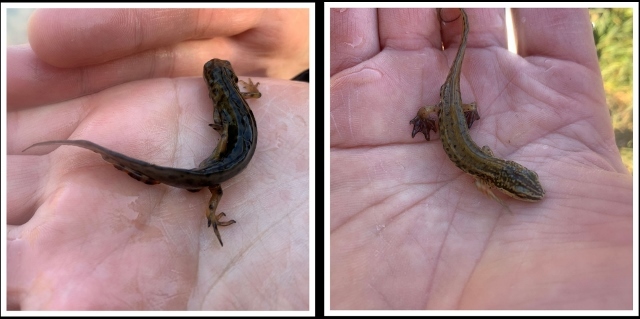
These photos (taken at Kingley Vale by the NNR Manager) give a good idea of scale.