Kingley Vale Trail
A series of caches forming a circular walk of approximately 6 miles in this National Nature Reserve. This cache has been placed with the permission of the Kingley Vale NNR manager, who has asked me to remind you that you may encounter grazing livestock roaming free at certain times of year and that your dog MUST be kept on a lead at all times within the reserve.
Look out for... Hares
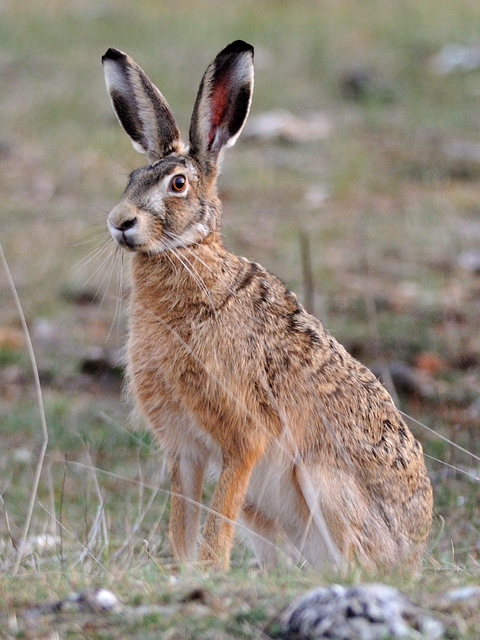
Jean-Jacques Boujot from Paris, France, Lepus europaeus (Causse Méjean, Lozère)-cropped, CC BY-SA 2.0
The European hare, also known as the Brown hare is among the largest hare species and is adapted to temperate climates and open country. They're herbivorous (feeding on grass and plants) and their natural predators include large birds of prey, foxes and cats. Hares are mostly nocturnal but during the height of the breeding season (known as 'March Madness') they can be seen out in the open - not only the males fighting for dominance but females fighting off suitors, too! Larger than a rabbit, a hare has proportionally longer ears and back legs than a rabbit. Its ears have a black tip. While hares live singly or in very loose groups, rabbits live in colonies of several dozen animals with strict hierarchies and social groups within the colony. There are perhaps 50 to 100 individual hares within the Kingley Vale NNR although no firm number has been recorded.