English version follows.
Afin de rendre la visite du Parc Jean-Drapeau plus complète et plus attirante pour les géocacheurs, nous avons placé quelques caches additionnelles à des endroits significatifs des nostalgiques de l'expo67.
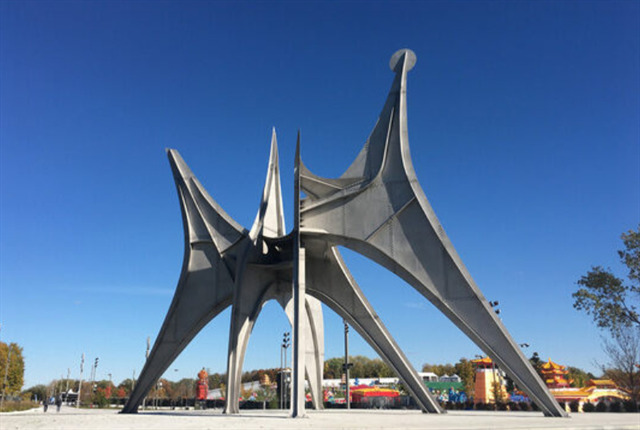
Les coordonnées publiées vous mèneront à une oeuvre sculpturale gigantesque datant de 1967 et intitulée Trois Disques, mais largement connue comme L'Homme de Calder. Cette oeuvre monumentale a été commandée à l'artiste américan Alexander Calder (1898-1976) par la compagnie International Nickel du Canada Ltée (INCO) dans le cadre de l'Exposition Universelle de Montréal de 1967.
L'oeuvre unique est une des plus grandes du Monde. Il s'agit d'un stabile d'une hauteur de 21,3 mètres et d'un poids de 40 tonnes fabriqué d'acier inoxydable. Il n'est aucunement peint.
L'œuvre est constituée de cinq arches dont le sommet est orné de deux pointes et de trois disques. De forme abstraite et asymétrique, Trois disques rappelle la silhouette de l'araignée. Elle représente le progrès et la puissance humaine. Même si plusieurs autres villes dans le monde possèdent un stabile, celui de Montréal se distingue par son fini. La sculpture n'a pas été peinte. Ce qui en fait le seul exemplaire de stabile non peint. On peut donc admirer le matériau brut. Les éléments qui assemblent l'œuvre sont visibles ainsi que les traces de sa fabrication. Le tout lui confère une esthétique manifestement industrielle.
L'œuvre fût rebaptisée L'Homme en lien avec le thème de l'Expo, Terre des Hommes. Malgré ce nom qu'on lui attribua et l'association anthropologique de certains qui croient voir une ressemblance avec l'humain, l'artiste, lui, affirme pourtant qu'il n'était intéressé que par l'exploration des formes géométriques et ne cherchait aucunement à ce que son stabile revête une apparence humaine1.
En 1967, l'œuvre a coûté 135 000 $ CAD (900 000 $ en 2013) à la société International Nickel Company of Canada. En 2013, elle a une valeur estimée entre 50 et 200 millions de dollars canadiens.
L'histoire et la polémique entourant son déplacement
En 1981, après que la ville ait décidé de fermer le site Terre des Hommes et rasé la plupart des pavillons de l'Expo 67, Trois disques se retrouva dans un lieu presque désert pendant près de vingt ans. Le site était jonché d'arbres et peu fréquenté du public puisque difficile d'accès.
En 1989, la famille de Calder s'est plainte au maire de Montréal, Jean Doré, de l'état d'abandon du site où se trouvait Trois disques. Elle menaça le maire de rapatrier l'œuvre si rien n'était fait.
En 1991, Trois disques fut déplacé de son lieu d'origine (sur l'île Sainte-Hélène), un peu plus loin, sur le belvédère du parc Jean-Drapeau. Cela ne coûtait pas trop cher et permettrait notamment au public d'y accéder plus facilement et de l'admirer de près comme de loin. En effet, l'œuvre était maintenant visible du Vieux-port de Montréal, mais aussi de l'hôtel de ville d'où le maire pouvait la montrer aux visiteurs. L'œuvre est devenue un des repères visuels distinctifs de la ville.
En 2013, le président du comité-conseil en art public à la ville de Montréal, Alexandre Taillefer, propose de délocaliser la sculpture de Calder afin de la mettre en valeur. Une polémique survient quant au nouvel emplacement possible. Plusieurs propositions sont faites notamment au centre-ville, au Vieux-port, sur la pointe du Havre (sur l'île Sainte-Hélène), au Parc Jeanne-Mance face au Mont-Royal.
Finalement, la sculpture restera sur l'île Sainte-Hélène. En 2013, les élus municipaux approuvèrent une motion du parti Projet Montréal qui prônait que la mise en valeur du stabile se fasse sur son lieu d'origine.
source principale: wikipedia.org
Prenez donc le temps d'apprécier cette oeuvre unique, maintenant remise en valeur. Aux coordonnées publiées, on retrouve une enseigne sur poteau explicative de cette pièce d'art public.
Maintenant, passons au géocaching. Facile, facile!
Nord: Sur l'oeuvre majestueuse, à côté des initiales de l'artiste, on retrouve un nombre. Retenez seulement le second chiffre de ce nombre et soustrayez-le des millièmes des coordonnées de départ Nord.
Ouest: Comptez le nombre de boulons de fixation qui retiennent les six pattes de ce stabile sur sa base bétonnée. Ajoutez à cette quantité le nombre de lettres du dernier mot de la onzième ligne sur la plaque au sol sous la sculpture. Finalement, additionnez ce nouveau nombre aux millièmes des coordonnées de départ Ouest.
Voilà! Vous avez en main les coordonnées finales. Il ne vous reste qu'à aller signer le registre de la cache.
The published coordinates will lead you to a gigantic sculptural work dating from 1967 and titled Trois Disques, but widely known as Calder's Man. This monumental work was commissioned from the American artist Alexander Calder (1898-1976) by the International Nickel Company of Canada Ltd (INCO) as part of the 1967 Montreal Universal Exhibition.
The unique work is one of the largest in the world. It is a stabile with a height of 21.3 meters (70 feet) and a weight of 40 tons (88 000 lbs) made of stainless steel. It is not painted at all.
The work consists of five arches, the top of which is decorated with two points and three discs. Abstract and asymmetrical in shape, "Three Discs" recalls the silhouette of the spider. It represents progress and human power. Even if several other cities in the world have a stabile, that of Montreal stands out for its finish. The sculpture has not been painted. Which makes it the only specimen of unpainted stabile. We can therefore admire the raw material. The elements that assemble the work are visible as well as the traces of its manufacture. All of this gives it a clearly industrial aesthetic.
The work was renamed L'Homme in connection with the theme of the Expo, Terre des Hommes (Man and His World). Despite this name that was attributed to him and the anthropological association of some who believe they see a resemblance to humans, the artist, however, asserts that he was only interested in the exploration of geometric shapes and in no way wanted his stabile to take on a human appearance1.
In 1967, the work cost $ 135,000 CAD ($ 900,000 in 2013) to the International Nickel Company of Canada. In 2013, it has an estimated value of between 50 and 200 million Canadian dollars.
The history and controversy surrounding its relocation
In 1981, after the city decided to close the "Terre des Hommes" site and razed most of the pavilions at Expo 67, "Trois Disques" found itself in an almost deserted place for nearly twenty years. The site was strewn with trees and little frequented by the public since it was difficult to access.
In 1989, Calder's family complained to the mayor of Montreal, Jean Doré, about the state of abandonment of the site where "Trois Disques" was located. She threatened the mayor to repatriate the work if nothing was done.
In 1991, "Trois Disques" was moved from its place of origin (on Île Sainte-Hélène), a little further on, to the belvedere of Parc Jean-Drapeau. It was not too expensive and in particular would allow the public to access it more easily and admire it from near and far. Indeed, the work was now visible from the Old Port of Montreal, but also from the town hall where the mayor could show it to visitors. The work has become one of the city's distinctive visual landmarks.
In 2013, the president of the public art advisory committee in the city of Montreal, Alexandre Taillefer, proposed to relocate Calder's sculpture in order to showcase it. A controversy arises over the possible new location. Several proposals are made in particular in the city center, in the Old Port, on the tip of Le Havre (on Île Sainte-Hélène), in Jeanne-Mance Park facing Mount Royal.
Eventually, the sculpture will remain on Île Sainte-Hélène. In 2013, elected municipal officials approved a motion from the Projet Montréal party which advocated that the stabile be enhanced in its place of origin.
main source: wikipedia.org
Take the time to appreciate this unique work, now enhanced. At the published coordinates, there is a sign on a pole explaining this piece of public art.
Now let's move on to geocaching. Easy, easy!
North: On the majestic work, next to the artist's initials, there is a number. Take only the second digit of this number and subtract it from the thousandths of the published North coordinates.
West: Count the number of mounting bolts that hold the six legs of this stabile to its concrete base. Add to this quantity the number of letters of the last word of the eleventh line on the plaque on the ground under the sculpture. Finally, add this new number to the thousandths of the published West coordinates.
Here it is! You now have the final coordinates in hand. All you have to do is go and sign the cache's logbook.
We have added a Certitude geochecker to validate your answers and 100% confirm the final.
You must enter your answer according to this pattern: N 45 59.999 W 073 59.999 in Certitude. Do not use the degree symbol °
La visite de nos caches est notre récompense! Merci
Nous avons ajouté un vérificateur (géochecker) Certitude afin de valider vos réponses et confirmer à 100% la finale.
Vous devez entrer votre réponse selon ce modèle: N 45 59.999 W 073 59.999 dans Certitude. Ne pas utiliser le symbole degré °

Vous pouvez valider votre solution d'énigme avec certitude.