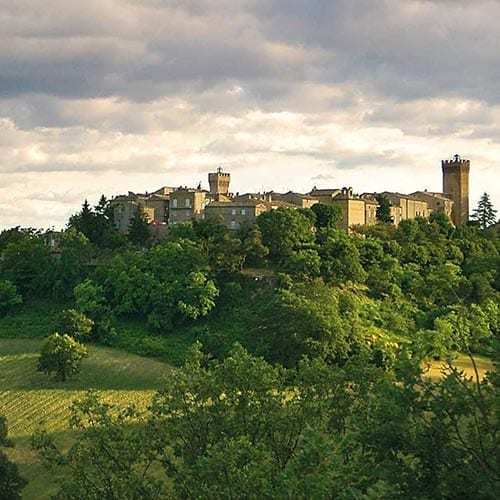
 Tra orti e frutteti cui il vento porta l’odore del mare, sorge il borgo di Moresco, in posizione strategica sulla sommità di un colle che controlla la sottostante valle dell'Aso.
Visto da lontano il borgo ha un profilo particolare: da una parte vi è la torre Eptagonale e all’altro capo la torre dell’Orologio. Già in epoca romana qui sorgevano importanti insediamenti, così come in età longobarda erano presenti centri monastici e feudali. Il castello di Moresco sembra una sentinella a guardia della campagna circostante, delle sparse case coloniche, degli orti mediterranei, delle colture della vite e dell’olivo che disegnano un paesaggio quieto e ondulato, al cui orizzonte c’è sempre il mare.
Le prime notizie del castello risalgono al 1083 e documenti del XII secolo testimoniano la reggenza di Tebaldo, conte di Moresco. Successivamente il castello passò sotto diversi domini. L’origine del nome “Moresco” è un tema abbastanza dibattuto. Secondo la leggenda, al tempo delle scorrerie dei Mori lungo la costa adriatica, un gruppo di questi si spinse un po’ più all’interno per edificarvi una roccaforte nel cuore della cristianità. Altri, al contrario, sostengono che il Castrum Morisci sia stato costruito vicino al mare proprio per respingere gli assalti dei Saraceni. Più probabile che il nome derivi dalla nobile famiglia Mori, oppure dalla parola dialettale “morrecine” che indica il mucchio di pietre su cui poggia il castello.
Dalla Torre dell’Orologio parte una stradina che scende verso la vallata e porta a un edificio che ricorda un parallelepipedo. Si tratta del Teatro di Santa Sofia, chiamato affettuosamente “lu teatrì” che in origine era una chiesa e che racchiude un interessante affresco della scuola di Carlo Crivelli (1430-95), mentre la parete interna dell’abside conserva nell’intonaco degli affreschi di scuola veneziana: in alto Gesù risorto ed in basso la Madonna, con ai lati i Santi Sofia, Rocco, Domenico, Lorenzo e Nicolò.
 The village of Moresco stands among vegetable gardens and orchards to which the breeze brings the smell of the sea, a strategic position on the top of a hill which controls the Aso valley below. The village has a peculiar profile when seen from afar: on one side stands the Heptagonal Tower and on the other end the Clock Tower. Here rose important settlements already in Roman times, just like in the Langobard era there were monastic and feudal centres. The “Castello di Moresco” (Moresco Castle) looks like a sentry guarding the surrounding countryside, the scattered farmhouses, the Mediterranean vegetable gardens, the cultivation of vine and olive trees that create a quiet and wavy landscape, on whose horizon there is always the sea. The first records regarding the castle date back to 1083, and XII century documents prove the regency of Tybalt, Earl of Moresco. The castle subsequently passed under several domains. The origin of the name “Moresco” is a debated topic. According to legend, at the time of the Moorish raids along the Adriatic coast, a group of these went a little further inland to build a stronghold in the heart of Christianity. On the contrary, others claim that the “Castrum Morisci” had been built near the sea precisely to repel the assaults of the Saracens. It is more likely that the name originates from the noble Mori family, or from the dialect word “morrecine” which indicates the pile of stones on which the castle rests.
A small road which starts from the Torre dell’Orologio” (Clock Tower) descends towards the valley and leads to a building that resembles a parallelepiped. It is the “Teatro di Santa Sofia” (St. Sophia Theatre), affectionately called “lu teatrì”. The church features an interesting fresco of the school of Carlo Crivelli (1430-95), while the inner wall of the abse preserves frescoes from the Venetian school in its plaster: on the upper part is depicted the risen Jesus and at the bottom there is the Virgin Mary with the Saints Sophy, Rocco, Dominic, Lawrence and Nicolò at the sides.
PASSAPORT AND GEOCOIN PRIZE!
Scarica il Passaporto del Bellezza Infinita GeoTour, trova almeno 40 caches del GeoTour, compila il Passaporto e consegnalo per la verifica a uno dei seguenti Info Point:
- Ascoli Piceno, Pinacoteca Civica, Ufficio Informazioni Turistiche - Piano Terra, Piazza Arringo 7, dal martedì alla domenica ore 10-19. Qui puoi trovare l'Instagram portait del Bellezza Infinita Geotour: richiedilo e fatti una foto per immortalare la tua avventura!
- Macerata, Tipico.tips, Piazza della Libertà 18, dal martedì alla domenica ore 10-13 / 15-19
- Offida, Borgo Leopardi, tutti i giorni ore 10-12,30 / 15,30-19,30
- San Ginesio, IAT, Piazza Gentili 3, tutti i giorni ore 10-12 / 17-19
- Sarnano, IAT, Largo Ricciardi 1, lunedì e venerdì ore 9-13; martedì e giovedì ore 9-13 / 15-17.45
Potrai così ricevere in premio lo splendido Geocoin del Bellezza Infinita GeoTour!
Download the Bellezza Infinita GeoTour Passport, find at least 40 caches of the GeoTour, fill the Passport in every part and deliver it for the check to one of these Info Points:
- Ascoli Piceno, Pinacoteca Civica, Ufficio Informazioni Turistiche - Ground Floor, Piazza Arringo 7, from Tuesday to Sunday h. 10-19. Here you will find the Instagram portrait of Bellezza Infinita Geotour: ask for it and take a photo to remember your adventure!
- Macerata, Tipico.tips, Piazza della Libertà 18, from Tuesday to Sunday h. 10-13 / 15-19
- Offida, Borgo Leopardi, everyday h. 10-12,30 / 15,30-19,30
- San Ginesio, IAT, Piazza Gentili 3, everyday h. 10-12 / 17-19
- Sarnano, IAT, Largo Ricciardi 1, Monday and Friday h. 9-13; Tuesday and Thursday h. 9-13 / 15-17.45
You will win the wonderful Geocoin of Bellezza Infinita GeoTour!


Project sponsored by:
